
Social Collaborative Retrieval: Solving the Sparsity Crisis in Context-Aware Recommendations
Social Collaborative Retrieval
The paper introduces Social Collaborative Retrieval (SCR), a novel framework that integrates social graph data into context-aware recommendation systems. By leveraging the LCR architecture and adding social regularization, SCR significantly outperforms state-of-the-art methods in ranking accuracy for user-item pairs within specific query contexts.
TL;DR
Social Collaborative Retrieval (SCR) extends traditional recommendation by adding a "query" dimension (e.g., searching for "Rock" music specifically) and utilizes social connections to fill in the gaps where user data is sparse. By regularizing user embeddings based on their social neighbors, SCR outperforms baseline models like LCR and NMF, specifically in high-sparsity scenarios.
Background & Motivation: Beyond the User-Item Matrix
In traditional Collaborative Filtering (CF), we aim to predict a user's interest in an item. However, modern search involves context. A user doesn't just want "music"; they want "Jazz while studying" or "High-energy Pop for the gym." This is Collaborative Retrieval (CR).
While CF deals with a Matrix (Users Items), CR deals with a Tensor (Queries Users Items). This dimensionality explosion leads to a "sparsity crisis"—it is almost impossible to have enough training data for every possible combination of query, user, and item.
The authors propose a simple yet profound insight: Your friends are a mirror of your tastes. If behavioral data is missing for you, the system can "borrow" information from your social network.
Methodology: Socially-Regularized Embeddings
SCR builds upon the Latent Collaborative Retrieval (LCR) model. The scoring function represents the relevance of an item to query for user :
Where , , and are embeddings for queries, users, and items. The secret sauce of SCR is the Relational Measure, a social error term added to the loss function:
This penalty ensures that if user and are friends, their base preference vectors () are pulled closer together in the latent space.
 Figure 1: The scoring function of SCR, where user-item similarity is modulated by local user search styles ().
Experiments: Does Social Context Actually Help?
The authors performed extensive testing using the Last.fm music dataset (artists as items, tags as queries).
1. Validating the "Friendship Hypothesis"
The team first proved that friends share significantly more artists than non-friends (Figure 1 in the paper). As the overlap in musical taste increases, the probability of being friends in the social graph increases exponentially.
2. Performance Gains
SCR consistently outscored LCR across all metrics. More importantly, when the training data was reduced from 100% to 40% (simulating extreme sparsity), the margin of improvement for SCR grew. This confirms that social information acts as a safety net when user history is lacking.
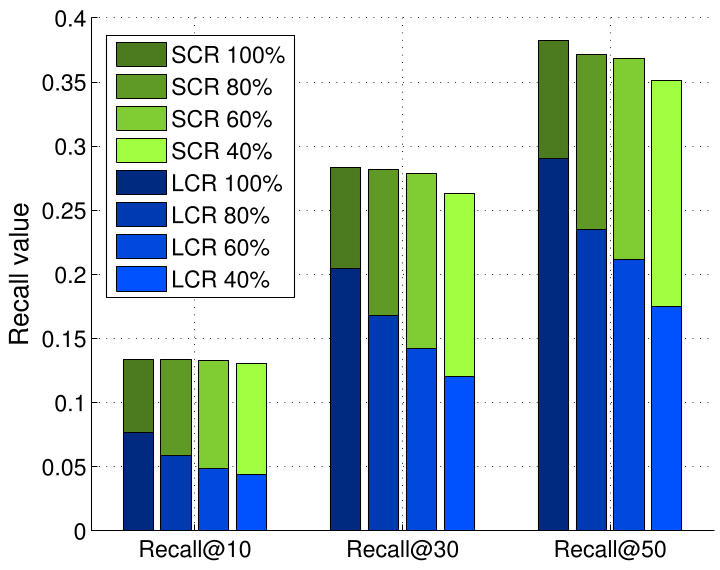 Figure 2: Performance comparison showing SCR's dominance as data density decreases.
3. Robustness to Noise
A fascinating part of the study involved "poisoning" the social graph by adding or removing links. SCR proved remarkably resilient to removing edges (likely due to the high connectivity and cliques within social networks) but was sensitive to spurious additions, suggesting that "confirmed" social links are much higher quality signals than random associations.
Critical Analysis & Conclusion
The core contribution of SCR is demonstrating that the "Tensor Sparsity" problem in Information Retrieval can be mitigated by external graph structures.
Strengths:
- Efficiency: SCR's training is faster than LCR because social regularization provides a smoother landscape for the sampling-based SGD optimization.
- Flexibility: It can use "standard" WARP loss or a "generalized" version that incorporates item weights (e.g., how many times a user listened to a song).
Limitations:
- Social Noise: The model relies on the assumption that social graphs are representative of taste. In platforms where people "add" friends for non-interest reasons (e.g., professional networks), this model might require different weightings.
- Linearity: The current embedding interacts linearly; exploring non-linear interactions via deep learning could be a natural next step.
Conclusion: SCR is a landmark approach for context-aware systems, proving that who you know is just as relevant to what you find as what you have done in the past.