
SCI: Melding Social Networks and 3D Virtual Worlds into a Powerhouse IDE
A Social Collaborative virtual environment for software development
This paper introduces SCI (Social Collaborative IDE), a novel Social Development Environment (SDE) that integrates a 3D virtual environment with social networking features and collaborative coding tools. SCI achieves a "socially aware" development space by unifying real-time presence, activity tracking, and asynchronous news feeds to enhance team coordination.
TL;DR
Software engineering is inherently social, yet our tools often treat us like isolated islands. This paper presents SCI (Social Collaborative IDE), an environment that bridges the gap between coding and community. By embedding 3D virtual spaces, social profiles, and real-time activity feeds directly into the IDE, SCI transforms software development from a lonely task into a vibrant, socially aware team effort.
Context: The Productivity Wall in Distributed Teams
When developers move from a shared office to a distributed setup, they lose "ambient awareness"—the ability to see who is busy, who is struggling, or who just finished a key module. Traditional Collaborative Development Environments (CDEs) like early versions of Eclipse or SourceForge help manage code but fail to manage people. The authors argue that software development is a form of object-centered sociality, where our social interactions should happen around the code itself.
The SCI Architecture: More Than Just a Text Editor
The brilliance of SCI lies in its three-layered approach to collaboration:
- CVE (Collaborative Virtual Environment): The foundation. It provides a 3D world where developers have avatars.
- ICI (Idaho Collaborative IDE): Adds synchronous tools like real-time pair programming and VoIP.
- SCI (Social Collaborative IDE): The "Social Layer." This adds the news feeds, profiles, and deep activity awareness that makes the team feel like a cohesive unit.
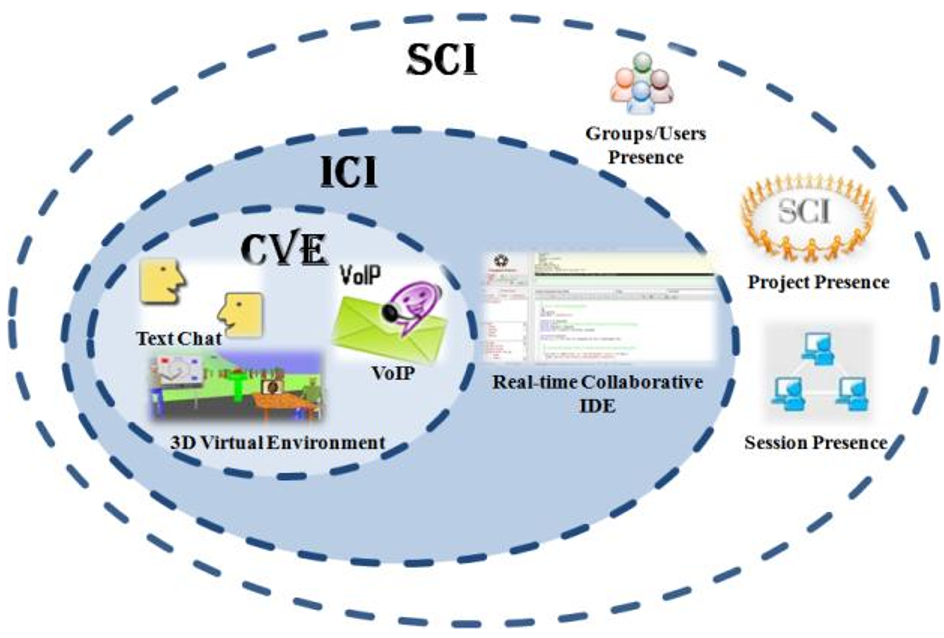 Figure 1: The layered architecture of SCI, moving from basic virtual space to a social-networked IDE.
Methodology: High-Fidelity Awareness
How does SCI solve the "blindness" of remote work? Through several high-fidelity awareness mechanisms:
- The ChangeBar: A color-coded gutter in the text editor that shows who modified which line most recently.
- Uncommitted Change Tracking: Unlike SVN or CVS which only show what was "checked in," SCI shows what colleagues are currently typing in their local workspace. This is a game-changer for avoiding merge conflicts before they even happen.
- Smart NPCs: In the 3D world, "Non-Player Characters" act as automated experts in specific rooms (e.g., a "Java Expert NPC") to answer common questions when no human is available.
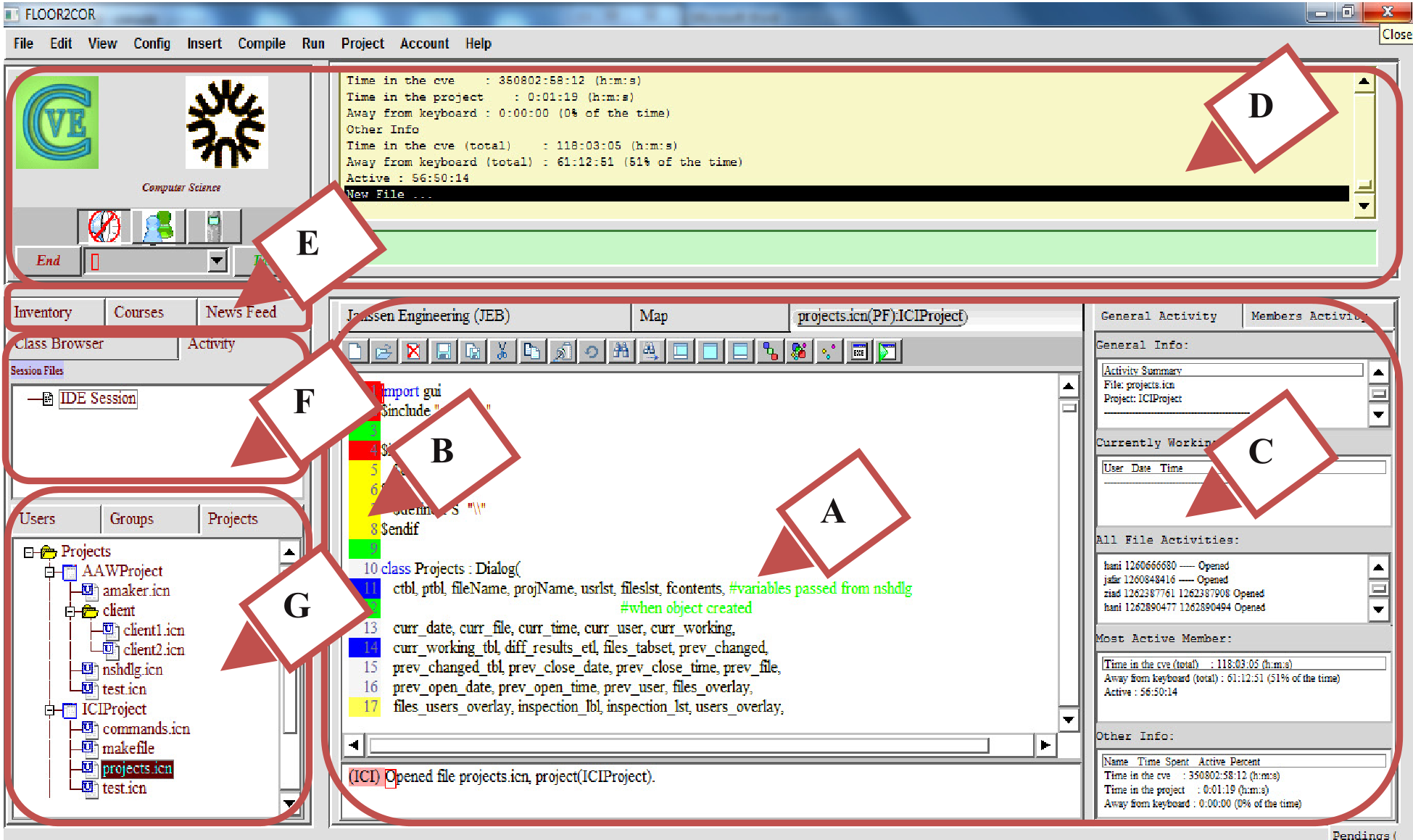 Figure 2: The SCI interface, showing the integration of the code editor (A), activity feeds (C), and the social project tree (G).
Performance and Comparison
The authors compared SCI against major competitors like IBM's Jazz and Microsoft's CollabVS. While Jazz has social features, SCI is the only one to integrate a 3D virtual environment, creating a stronger sense of "Social Presence."
| Feature | SCI | Jazz | Palantír |
|---|---|---|---|
| Synchronous Features | Yes | Yes | Partial |
| Uncommitted Awareness | Yes | No | No |
| 3D Virtual Environment | Yes | No | No |
| Social Network (Profiles) | Yes | No | No |
Deep Insight: Why Does a 3D World Matter?
One might ask: "Why do I need an avatar to code?" The authors' insight is that avatars provide a spatial metaphor for coordination. When an avatar "teleports" into a project room, it signals commitment and focus. Hovering over an avatar to see their recent file history feels more natural and less intrusive than searching through a database of logs.
Critical Analysis & Conclusion
SCI represents a vision of the "future office" where the digital tool is the office. While the 3D graphics might seem dated by today's standards (the paper's era), the underlying logic—that distributed developers need a "digital hearth" to gather around—is more relevant than ever in the age of remote work and Slack.
Takeaway: The next generation of IDEs shouldn't just be smarter at compiling code; they need to be smarter at connecting people. SCI proves that by treating a developer community as a social network, we can significantly reduce the overhead of collaboration.
Limitations: The paper notes that high traffic of invitations can become "cumbersome," a precursor to the "notification fatigue" we see today in tools like Teams or Discord.