
HeyStaks: Transforming Solitary Web Search into a Collaborative Social Experience
Social and collaborative web search : an evaluation study
This paper evaluates HeyStaks, a social search utility designed to transform solitary web search into a collaborative experience by harvesting search histories within social groups. Through a live-user study involving a complex knowledge quiz, the authors demonstrate that group-based collaboration significantly improves search efficiency and result relevance compared to traditional search.
TL;DR
Web search has long been a lonely endeavor, but HeyStaks changes the game by "socializing" the search engine. This study proves that by sharing "search staks" (topic-based repositories) with friends or colleagues, users can find relevant information faster, submit fewer queries, and leverage a recommendation engine that—in many cases—outperforms the default organic rankings of Google.
Context: Why is Search Still "Anti-Social"?
Despite the explosion of the Social Web, search engines have largely remained isolated tools. When you search for tech troubleshooting or travel advice, you are usually starting from scratch, ignoring the fact that your colleagues or friends might have already found the perfect solution yesterday. The problem is a lack of collaborative infrastructure for information seeking.
The authors argue that the "solitary world" of web search leads to wasted effort. Their solution, HeyStaks, attempts to bridge this gap by creating an overlay that captures social signals across standard search engines.
Methodology: Staks and Social Signals
The core innovation is the "Search Stak": a context-sensitive repository for search experiences.
- The Toolbar: Users install a browser extension that works on top of Google/Bing/Yahoo.
- Context Selection: Users choose a "stak" (e.g., "AI Research" or "Holiday Planning") to record their journey.
- Collaborative Filtering: When a group member searches for a query, HeyStaks promotes results that others in the same stak have previously voted for, tagged, or shared.
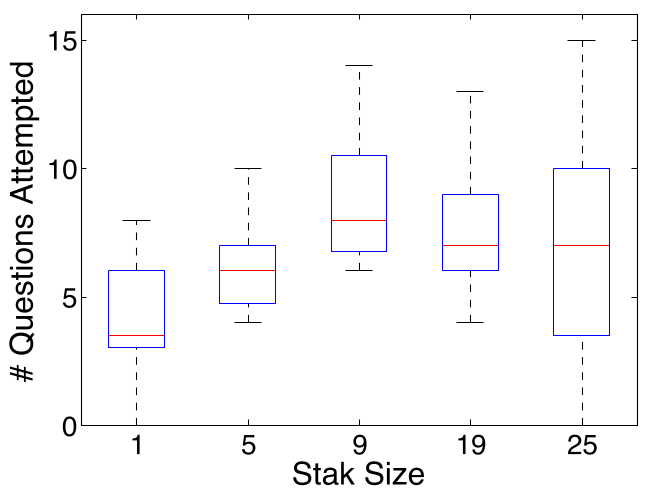 Figure 1: Comparison of (a) Questions Attempted, (b) Questions Correct, and (c) Activities per Query across different group sizes.
The Experiment: A High-Stakes Social Quiz
To test the system, the researchers conducted a closed-user trial with 64 students. They were tasked with answering obscure general knowledge questions within 60 minutes. The participants were split into "solitary" searchers and "shared staks" of varying sizes (5 to 25 people).
Key Findings:
- Efficiency: Solitary searchers had to work much harder, submitting up to 33% more queries to find answers.
- Productivity: In the 9-person stak, users answered 3x more questions correctly per query compared to those working alone.
- Relevance Overdrive: Perhaps most surprisingly, the recommendations provided by HeyStaks were objectively more relevant to the task than Google's own top organic results.
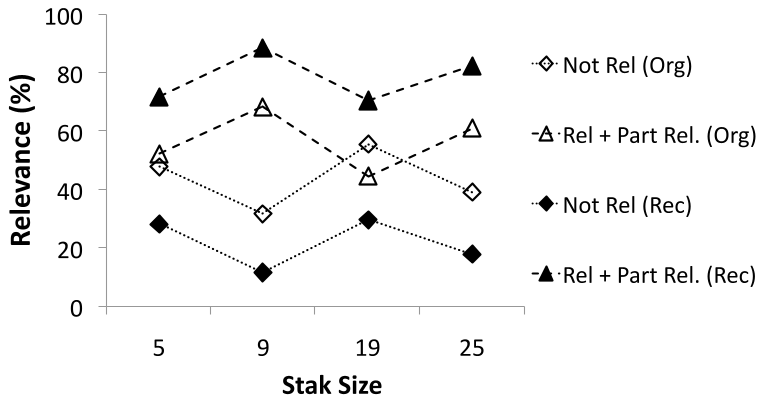 Figure 2: Analysis showing that HeyStaks recommendations (Rec) had a significantly higher percentage of relevant/partially relevant hits compared to organic (Org) Google results.
Deep Insight: The Power of Human Curation
The data reveals a "Relevance Ratio" (the ratio of relevant to irrelevant results). In every single group size, the HeyStaks recommended results maintained a higher ratio than organic results. For example, in a 5-person stak, the ratio jumped from 1.1 (Organic) to 2.5 (Recommended).
This efficacy stems from intentional human activity. When a user in your group "votes up" a page after a query, they are providing a high-confidence signal that no algorithm can perfectly replicate without social context.
Critical Analysis & Conclusion
While the study is limited to "fact-finding" queries (quiz questions), the implications are huge for enterprise search and specialized research.
Limitations: The study notes that stak size isn't everything—individual search expertise (as seen in the high-performing 9-person stak) plays a massive role. There is also a "critical mass" needed; if no one in your stak has searched for the topic before, the system provides no benefit.
Future Outlook: In the age of AI, the "HeyStaks" concept could evolve into Collaborative LLM Agents that not only share links but synthesize group knowledge in real-time. This paper laid the groundwork for understanding how community validation can solve the information overload problem.