
Social Commerce & Trust: The Multi-Stage Influence on Fashion E-Tailing
Social Commerce Constructs and Trust as Influencers of Consumer Decision Making With Reference to Fashion E-Tailing
This study investigates the influence of Social Commerce Constructs (SCCs) and Trust on the consumer decision-making process within the fashion e-tailing sector. By applying regression analysis to data from 581 active social networking users, the research identifies how Recommendations, Forums, and Ratings significantly impact various stages of the purchase journey.
TL;DR
With the rise of the Fourth Industrial Revolution, social networking sites have evolved from simple communication tools into powerful sales engines. This paper dissects how Trust and Social Commerce Constructs (SCCs)—specifically recommendations, forums, and ratings—impact four critical stages of the Indian fashion consumer's journey. It reveals that while social interaction is vital, its impact is nuanced, sometimes even showing inverse relationships with trust depending on the stage of the purchase.
The "Like-to-Buy" Paradox
In the hyper-competitive landscape of fashion e-tailing, simply having a social media presence is no longer enough. The core challenge for modern marketers is understanding the timing of influence. Why does a review help during comparisons but sometimes feel overwhelming during the initial discovery phase? The authors argue that existing frameworks fail to account for the specific phase of the consumer decision-making process where trust is either built or broken.
Methodology: Mapping the Social Journey
The researchers focused on 581 active users in Chennai who had purchased fashion items online within six months. They analyzed the interaction between two sets of variables:
- Independent Variables (The Decision Stages): Need Recognition, Pre-purchase, Purchase Decision, and Post-purchase.
- Dependent Variables (The Influencers): Trust, Recommendations & Referrals, Forums & Communities, and Ratings & Reviews.
Conceptual Framework
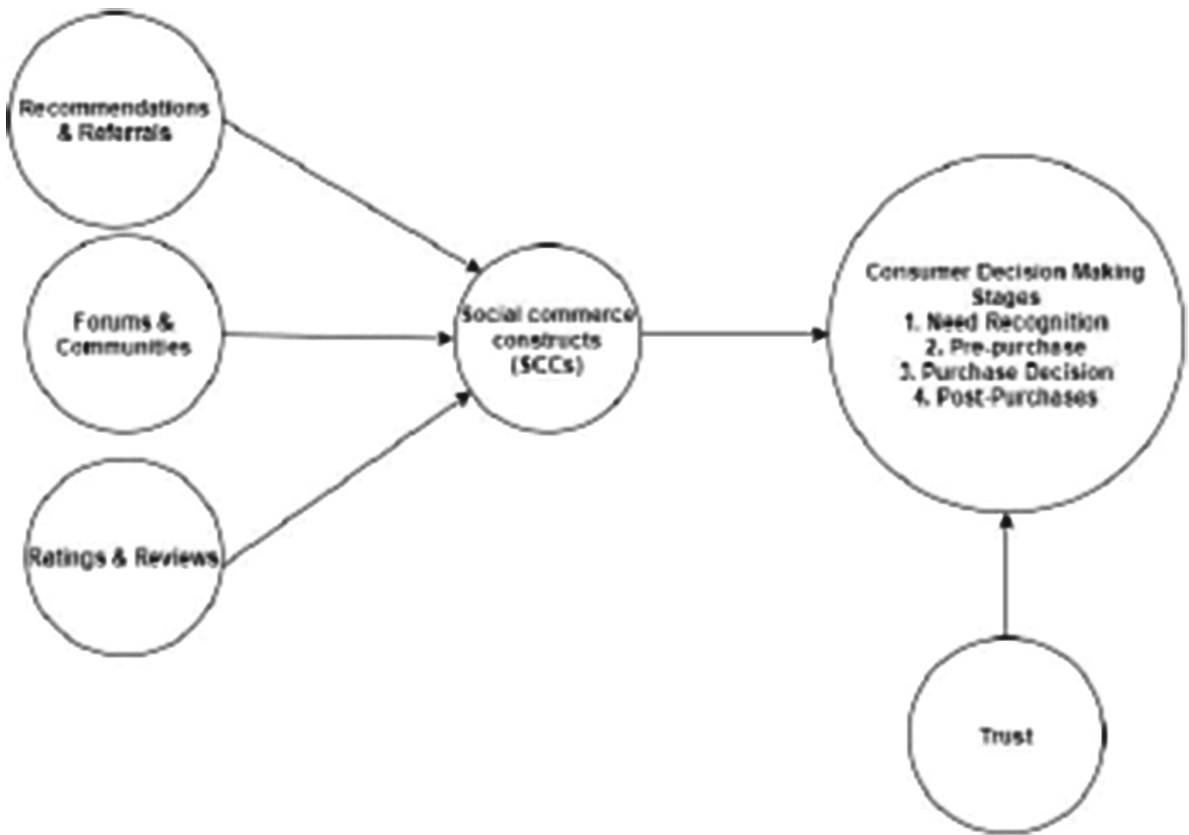
The study utilized Regression Analysis to quantify the variance. For instance, they looked at how much of the variation in "Trust" could be explained by the consumer's movement through different decision stages.
Key Insights: Not All SCCs Are Equal
The study’s findings challenge the "more is always better" approach to social content:
- The Dominance of Ratings & Reviews: Among all constructs, Ratings & Reviews had the strongest impact on the decision-making process, explaining nearly 11% of the statistical variance.
- The Trust Divergence: Interestingly, Trust showed a negative relationship with the "Need Recognition" stage (-0.261). This suggests that in the early exploratory phase, consumers might be skeptical of social signals or feel that high-trust environments are not yet relevant to their needs.
- The Post-Purchase Reinforcement: Trust showed a significant positive relationship (0.196) with the Post-Purchase stage, highlighting social commerce's role in reducing "buyer's remorse" and fostering brand loyalty.
Statistical Breakdown
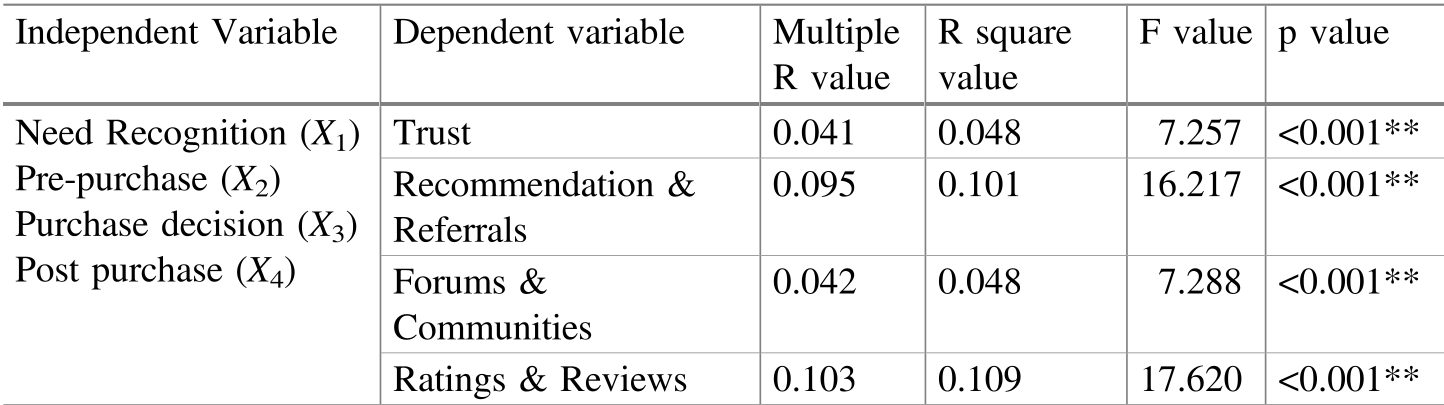
Navigating the Decision Matrix
One of the most valuable outputs of this research is the mapping of relationships (Positive vs. Negative) across the purchase funnel:
| Influence / Stage | Need Recognition | Pre-purchase | Purchase | Post-purchase |
|---|---|---|---|---|
| Trust | Negative | Positive | Negative | Positive |
| Recommendations | Negative | Positive | Positive | Negative |
| Ratings & Reviews | Positive | Positive | Negative | Positive |
Note: A negative relationship indicates that as one factor increases, the other decreases—often pointing to areas where current social commerce strategies are ineffective or counter-productive.
Takeaways for the Academic and Professional Community
- Stage-Specific Strategies: Marketers should focus on Ratings during the initial "Need" phase but pivot to Direct Recommendations during the "Pre-purchase" stage.
- Addressing the Trust Deficit: The negative correlation between trust and "Need Recognition" suggests that initial product discovery on social media still feels risky or intrusive to many consumers.
- Refining the Loop: Post-purchase interactions through forums and reviews are critical for sustaining long-term trust, especially in the volatile fashion sector where trends shift rapidly.
Conclusion & Future Outlook
This paper serves as a vital compass for navigating the "Digital India" retail landscape. While the study is limited to the Chennai region and specifically fashion, its methodology provides a blueprint for exploring other high-growth sectors like electronics or beauty. The next frontier in this research will likely involve Social Networking Site (SNS) specificity—understanding how these dynamics change between the visual-heavy Instagram vs. the community-driven environment of Facebook or Twitter.