
GREEDY Strategy: How Social Awareness Breaks the Latency Barrier in Multi-hop D2D Networks
Social community aware long-range link establishment for multi-hop D2D communication networks
This paper proposes a social-community-aware Long-range Link (LL) establishment strategy for multi-hop D2D communication networks. By introducing a critical-edge-based greedy algorithm that integrates social layer relationships with physical layer constraints, it significantly reduces the Average Path Length (APL) and transmission delay.
TL;DR
To solve the high latency in multi-hop Device-to-Device (D2D) communications, this paper introduces a social-community-aware strategy for establishing Long-range Links (LLs). By leveraging the "Critical Edge" greedily, the proposed algorithm reduces packet delay by up to 300% compared to traditional physical-only methods, making real-time content sharing viable in massive cellular underlay networks.
Problem & Motivation
The explosion of mobile video traffic has pushed cellular networks to their limits. D2D communication is a promising solution, but its short transmission range necessitates multi-hop relays. Here lies the bottleneck: more than three hops typically exceed the 250ms delay threshold required for live video or gaming.
Previous attempts to fix this involved adding Long-range Links (essentially "shortcuts" in the network graph). However, these methods (like Random Selection) ignored a fundamental truth: people share data with those they have social ties with. Establishing a high-power link between two strangers in different social communities is a waste of energy if they never exchange data.
Methodology: The Two-Tier Approach
The researchers proposed a framework that looks at the world through two layers simultaneously:
- Physical Layer (Spatial Graph): Governed by radio range ( and ) and path-loss models.
- Social Layer (Relational Graph): Defined by community structures where intra-community nodes share interests.
The Optimization Core
The objective is to minimize the total cost of adding LLs (defined by transmission power) while satisfying a strict Average Packet Delay () constraint. Since this is an NP-complete problem, they developed the Critical Edge Based Greedy Algorithm.
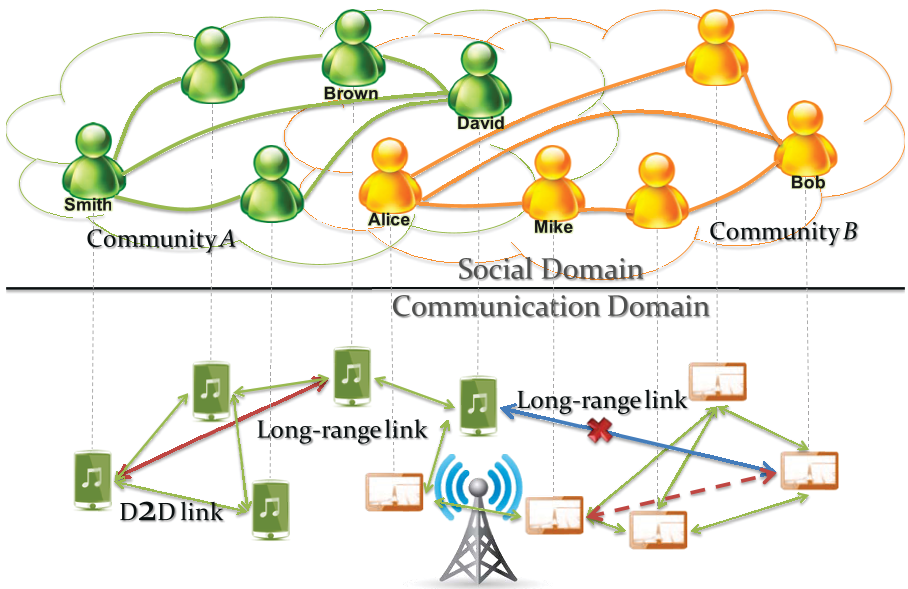 Fig 1: The interplay between the physical communication domain and the virtual social domain.
The algorithm calculates a "Critical Edge" () in each iteration: This formula identifies the link that offers the biggest "bang for the buck"—the largest delay reduction for the lowest cost, filtered through social community relevance.
Experiments & Results
The authors tested the algorithm in two scenarios: Distributed Sharing (peer-to-peer) and Single Sink (e.g., uploading to a local server).
Performance Gains
In the distributed scenario, the GREEDY algorithm achieved target delays with significantly fewer resources. While baseline methods like Furthest First (FF) or Random Selection (RS) struggled to keep latency down, the social-aware approach maintained high efficiency.
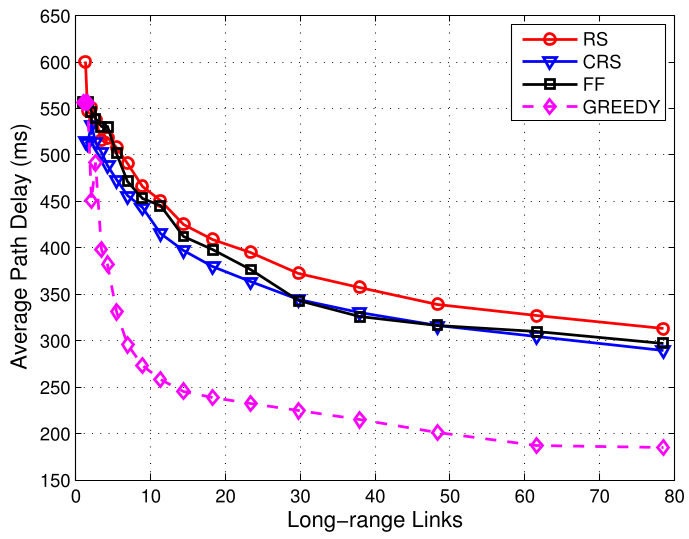 Fig 2: Average packet delay comparison. Note how GREEDY (bottom curve) consistently outperforms all others.
Key findings include:
- Efficiency: GREEDY outperformed other schemes by 200%-300% in delay reduction.
- Robustness: The performance remained stable even as node distribution patterns and the number of communities changed, proving the algorithm's adaptability to real-world social dynamics.
Critical Insight & Conclusion
This paper shifts the paradigm of network optimization from purely physical metrics to Integrated Social-Physical Engineering.
Takeaway: The "Small World" effect in wireless networks is most effective when the "shortcuts" align with social reality. By prioritizing links within social communities, we can build multi-hop networks that are not only faster but also more energy-efficient and purpose-driven.
Future Directions: The next step for this research involves accounting for node mobility—how does the strategy hold up when users (and their social clusters) are constantly moving?