
Breaking the Happiness Ceiling: How Social Comparison Creates Well-Being Traps
Social comparison and segregation reveal well-being traps
This study presents an Agent-Based Model (ABM) to investigate the "Easterlin Paradox"—the phenomenon where rising national incomes fail to increase long-term Subjective Well-Being (SWB). By integrating heterogeneous agents with hedonic adaptation and social comparison mechanisms, the model demonstrates that social comparison disrupts individual recovery from economic shocks, creating persistent "well-being traps" even when traditional theories predict full adaptation.
Why doesn't getting richer make us happier in the long run? This question, known as the Easterlin Paradox, has puzzled economists and psychologists since 1974. While we know that we "get used to" more money (Hedonic Adaptation) and "keep up with the Joneses" (Social Comparison), we haven't fully understood how these forces interact within a complex social web to create permanent psychological scars.
A recent paper by Dignum et al. (2026), titled "Social comparison and segregation reveal well-being traps," uses Agent-Based Modeling (ABM) to simulate a society of 500 heterogeneous individuals to uncover why some people bounce back from financial disaster while others remain "trapped" in low well-being.
The TL;DR: The Double-Edged Sword of Comparison
The study reveals that social comparison is not just about envy. It acts as a buffer when everyone is suffering together (reducing the stigma of a shock) but becomes a trap when you suffer alone while your peers stay wealthy. Most strikingly, the research identifies a specific "vulnerable class": Low-income individuals with high initial happiness set-points, who have the most to lose and the hardest time recovering in unequal societies.
1. The Anatomy of an Agent: How SWB is Calculated
The researchers moved beyond simple linear models. Their agents are governed by a dynamic system where:
- Hedonic Adaptation: Agents eventually "numb out" to their current income level.
- Social Comparison: Agents look at a specific quantile () of their friends' incomes.
- Feedback Loops: High well-being actually feeds back into income growth (the "broaden-and-build" effect), creating a virtuous or vicious cycle.
Methodology Breakdown
The model uses a Sigmoid function to determine SWB, incorporating Prospect Theory—the idea that losing 1,000 feels good.
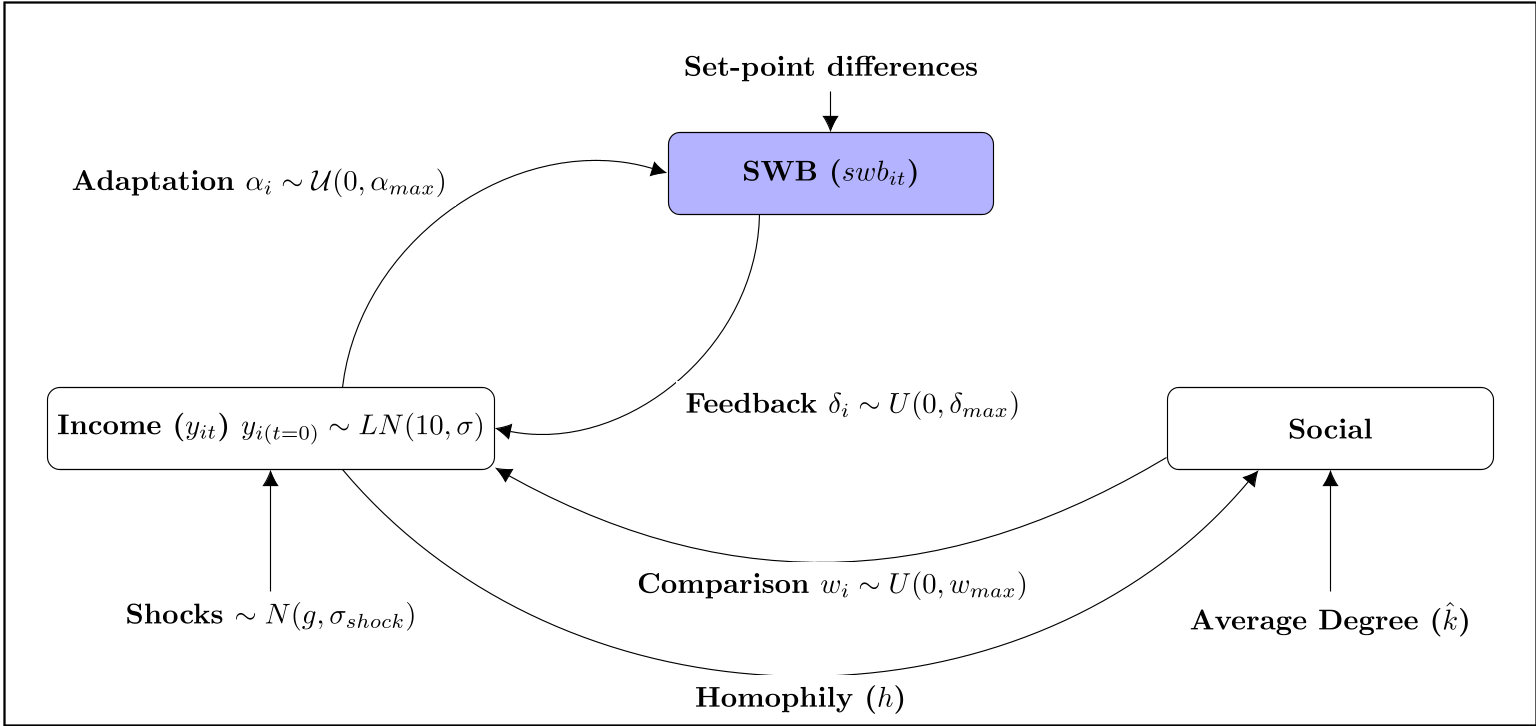 Figure: The interplay between individual traits, income shocks, and the social network.
2. The Easterlin Paradox in Action
The simulation successfully replicated the paradox. As shown in the results below, while cross-sectional data shows rich agents are happier (Plot B), the time-series data shows that as everyone gets richer, average happiness stays flat (Plot A).
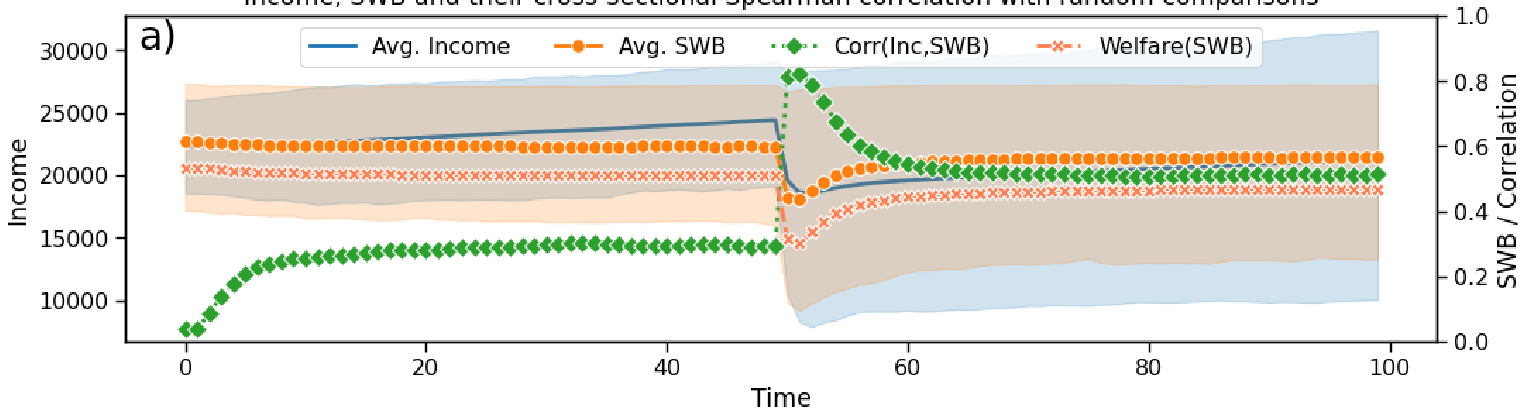 Key Result: Average income rises, but average SWB (Subjective Well-Being) remains stagnant due to rising reference levels.
3. The "Well-Being Trap"
One of the most profound insights is the identification of the Well-Being Trap. The authors find that if you are a "naturally happy" person (high set-point) but have a low income, a financial shock can be devastating.
Because your internal "expectation" (set-point) is high, the gap between your reality (low income) and your social reference (richer friends) becomes a permanent drag on your well-being. The model shows that these individuals often never return to their original happiness levels, defying the classic "Hedonic Treadmill" theory which suggests we always return to baseline.
The Role of Segregation
Surprisingly, segregation can be a protective factor. When we compare ourselves to people "like us" (homophily), the income variance is lower. In a highly integrated but unequal society, a low-income person is constantly forced to compare upward against extreme wealth, which increases their "Instability" and "Recovery Time" after a shock.
4. Policy Implications: Context is Everything
The paper argues for context-specific interventions:
- Localized Shocks (e.g., a factory closing): Rapid economic aid is crucial here because the affected individuals will compare themselves to their still-employed neighbors, leading to a rapid spiral in well-being.
- Widespread Shocks (e.g., a national recession): Policymakers should focus on "shared struggle" narratives. When everyone is in the same boat, the social comparison mechanism actually buffers the pain, as the "rank" of individuals doesn't change as drastically.
Conclusion
Dignum et al. demonstrate that we cannot understand human happiness by looking at bank accounts alone. Well-being is a relational property. By showing how social networks and income distributions create "traps," this study provides a roadmap for building more resilient societies—one where we worry less about absolute growth and more about the psychological gaps created by inequality.
Takeaway for the Reader: Your happiness isn't just about what you earn; it's about who you see when you look out your window. In an unequal world, staying in your "bubble" might actually be a survival strategy for your mental health.