
Social-Aware Sharing: Trust as a Metric for Resource Management
SPECIAL SECTION ON SOCIAL COMPUTING APPLICATIONS FOR SMART CITIES
The paper proposes a shared-resource management system for altruistic device sharing (e.g., smartphone tethering) that utilizes online social relationships to automate access control. By integrating an authentication server with Social Network Service (SNS) APIs, the system dynamically determines resource limits based on a "social closeness" metric between the owner and the guest user.
TL;DR
Sharing personal device resources—like a smartphone's 4G/5G data via tethering—often creates a conflict between helpfulness and cost (battery/bandwidth). This paper introduces a system that automatically manages these resources by looking at your Facebook friends. It calculates Social Closeness to determine exactly how much "altruism" you should afford a guest user, effectively turning social trust into a quantifiable network policy.
The Motivation: Why We Don't Share
The "Sharing Economy" (think Uber or Airbnb) has arrived for digital hardware, but it faces a psychological bottleneck: Altruistic Behavior Decay. Research shows humans are naturally less generous as social distance increases. If a stranger asks to tether to your phone, you might say no to save battery; if a close friend asks, you likely say yes.
Current systems are "socially blind." They either allow everyone or no one, or require the owner to manually set limits—a high-friction experience. The authors' insight is simple: Automate the "Yes" by leveraging the digital social graphs we already have.
Methodology: Quantifying Friendship
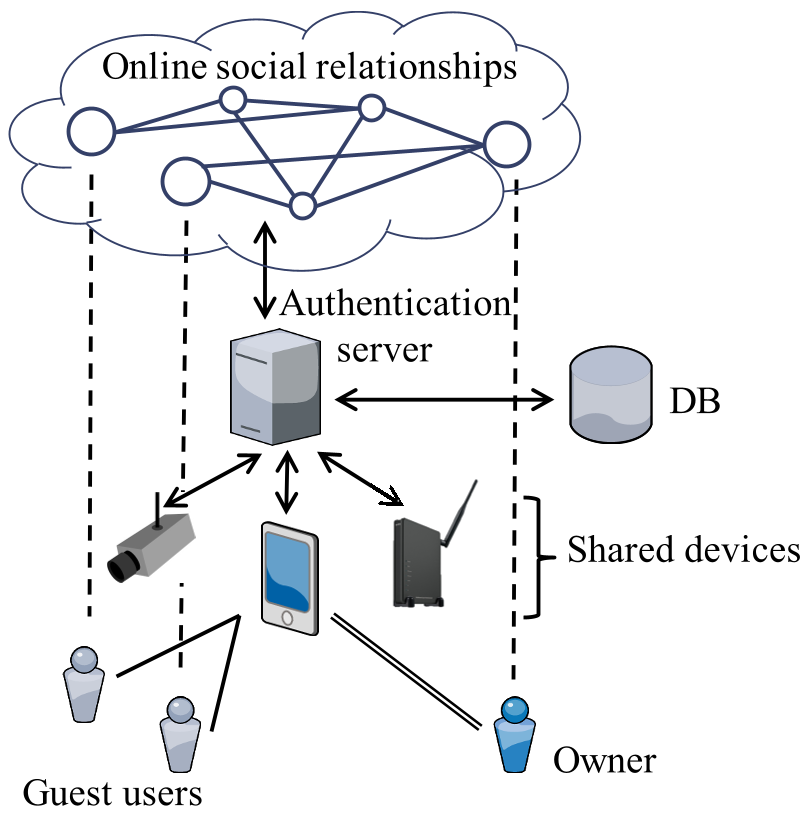
The system architecture relies on an authentication server that sits between the owner's device and the guest.
1. The Metric
The core of the system is the Social Closeness (SC) formula. It uses several established graph indices to measure the strength of a connection:
- Common Neighbors: How many friends do we share?
- Jaccard Index: What is the ratio of shared friends to our total unique friends?
- Adamic-Adar Index: Gives more weight to shared friends who are "rare" (nodes with fewer connections).
2. The Implementation
The authors built a real-world prototype using:
- Facebook API & OAuth: For secure, password-free guest identification.
- PacketFence: An open-source network access control tool that acts as the "bouncer," enforcing the connection duration.
Experiments: Does it Actually Work?
The evaluation was two-fold: measuring the "tax" of authentication and simulating a massive urban environment.
Authentication Overhead
Is the system too slow? Tests on an iPhone 7 showed that the social look-up and authorization took about 5.4 seconds. While slightly longer than a "social-blind" reference system (~5.0s), the difference is nearly imperceptible to a human user waiting for a WiFi connection.
Large-Scale Simulation
Using the Brightkite dataset (location-based social network data from Japan), the authors simulated thousands of users.
- For Strangers: The system successfully capped the connection time, protecting the owner's resources.
- For Close Friends: The system granted longer durations, with the 5-second authentication delay being an insignificant fraction of the total usage time.
 (Note: As social indices like the Jaccard Index increase, the actual connected duration climbs linearly for the proposed system, whereas the comparison system remains static.)
Deep Insight: Beyond Tethering
This paper marks a shift from purely technical resource management to Socially-Aware Computing. By treating a "friendship" as a quantifiable variable (), we can build networks that mirror human society.
Limitations & Future Work
- Privacy: Accessing social graphs involves significant privacy risks. The authors acknowledge that future iterations need to ensure users don't inadvertently leak private info while trying to share a connection.
- The "Stranger" Problem: While the system protects the owner, it doesn't solve provide an incentive for sharing with total strangers who might be in urgent need (e.g., in an emergency).
Conclusion
The proposed system elegantly solves the "burden of management" for device sharing. By automating the authorized connection time based on online social ties, it enables a more sustainable and psychologically comfortable sharing economy for our digital age.
Takeaway: In the future, your phone won't just ask "Who are you?" but "How well do I know you?" before it helps a neighbor.