
SEBMoSo: Turning Enemies into Allies for Secure Content Broadcasting in Mobile Social Networks
SPECIAL SECTION ON SOCIAL COMPUTING APPLICATIONS FOR SMART CITIES
This paper introduces SEBMoSo, a decentralized broadcasting scheme designed for large content delivery in infrastructure-free Mobile Social Networks (MSNs). By combining multi-secret sharing with a credit-based forwarding mechanism, it achieves secure data dissemination even in the presence of malicious nodes that attempt to filch content and block transmissions.
TL;DR
When communication infrastructure—like cell towers and the internet—fails during a crisis, how do you broadcast large files (like emergency videos) through a network full of "selfish" or "malicious" devices? SEBMoSo solves this by fragmenting data using secret sharing and introducing a credit-based "tit-for-tat" rule. It forces malicious actors to help relay data; if they don't help, they can't decode the content.
Context & Motivation
Most mobile social apps (Facebook, WeChat) assume a working backbone. But in a catastrophe or a military conflict, we rely on Pocket Switched Networks (PSNs)—the physical movement of people carrying phones.
The problem? Malicious users. They want to download your data (e.g., a movie star's content or a politician's broadcast) but refuse to use their battery/bandwidth to pass it along to others. Current encryption solves privacy but ignores "availability." SEBMoSo changes the paradigm: instead of trying to identify and block malicious users (which is hard in a decentralized mess), it utilizes them.
Methodology: The "Secret" Strategy
SEBMoSo operates in two distinct stages:
1. Robust Fragmentation (Setup)
The source node (S) doesn't just send a file. It uses a (c, d; k, m)-multi-secret sharing scheme.
- The file is split into chunks.
- These are encoded into "multi-shares" ().
- The Insight: You need any unique shares to recover the file. If is high, it takes more "work" (relaying) to get the file.
2. The Credit Exchange Rule (Forwarding)
This is where the game theory kicks in. Every time User A gives a chunk to User B, User B must provide a BLS-signed receipt. This receipt acts as a "Credit."
- Rule: When two users meet, the one with more credits can demand multiple missing chunks from the other, while the one with fewer credits can only ask for one.
- Physical Intuition: If a malicious user wants the full file, they must accumulate credits by helping others. If they stay silent, they will eventually lag behind and never reach the threshold .
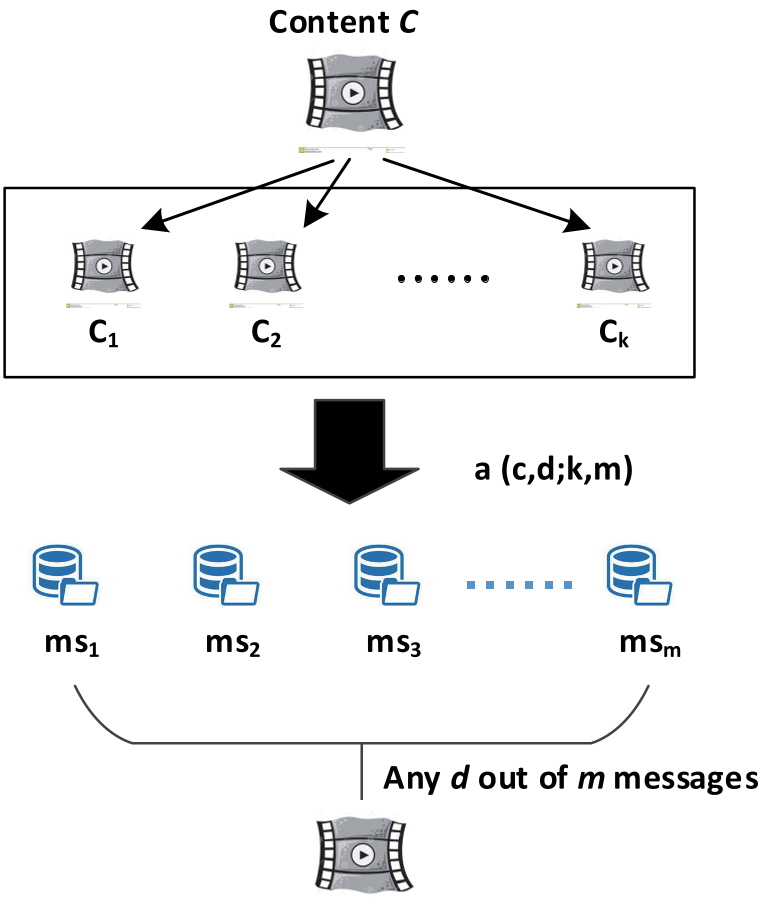 Figure 1: Illustration of content fragmentation and the multi-share secret sharing process.
Experiments: Performance in a Risky Network
The authors tested SEBMoSo against two baselines:
- SADF: Simple fragmentation with no security.
- SeS: Secret sharing but without the credit system.
Key Result 1: Delivery Ratio
In a high-risk scenario (24 malicious vs. 47 friendly users), SEBMoSo maintained a 100% delivery ratio for friendly users as long as the threshold was balanced. Baseline methods crashed to nearly 0% because malicious nodes successfully hoarded data chunks.
Key Result 2: Malicious Filching
SEBMoSo ensures that friendly users reconstruct the file before or at the same time as adversaries. By the time a malicious user collects shares, the broadcast is already widespread among the target audience.
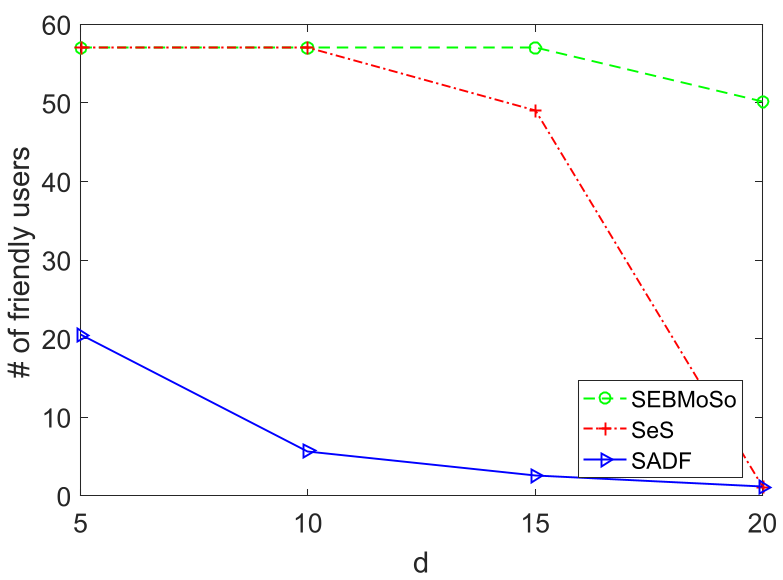 Figure 2: Number of delivered friendly users vs. threshold (d). SEBMoSo remains stable while others fail.
Critical Insight & Conclusion
The genius of SEBMoSo lies in its Incentive Alignment. In a decentralized network, security isn't just about "keeping people out"—it's about making sure the "bad guys" have to follow the "good guy" rules just to satisfy their own interests (filching the content).
Takeaways:
- Scalability: The system complexity is , making it feasible for real-time mobile deployment.
- Parameter Tuning: Setting and provides the best balance of overhead and security.
- Future Work: Integrating TTL (Time-to-Live) for chunks could further reduce storage waste in very large crowds.
SEBMoSo proves that even in a network where you don't trust anyone, you can still broadcast to everyone.