
The IoT Urban Evolution: Social Dilemmas and the Quest for Privacy
SPECIAL SECTION ON SOCIAL COMPUTING APPLICATIONS FOR SMART CITIES
Summary
Problem
Method
Results
Takeaways
Abstract
This paper investigates the multifaceted impact of the Internet of Things (IoT) on urban evolution, specifically within Smart and Ubiquitous Cities (U-cities). It identifies critical socio-technical barriers and proposes a hierarchical privacy framework involving local and international regulatory associations to mitigate vulnerabilities emerging from high-density sensor networks.
## TL;DR
The transition toward IoT-based cities promises unprecedented efficiency through hyper-connectivity, but it carries a hidden cost: the potential erosion of human privacy and social cohesion. This paper explores why the "Smart City" might become a "Human Graveyard" if we don't implement rigorous privacy-preserving frameworks and international legal standards to protect residents from digital over-surveillance.
## Background: From Smart Cities to Ubiquitous Realities
Urban planning is no longer just about bricks and mortar; it is about bits and sensors. The evolution from traditional cities to **Ubiquitous Cities (U-cities)**—pioneered in South Korea—set the stage for a world where services are available "anytime, anywhere." However, the shift to a full **Internet of Things (IoT)** paradigm, powered by IPv6 and its near-infinite address space, introduces a radical change: humans are now addressed and monitored as "things."
## The Invisible Pain Points
The authors argue that current urban ICT implementations suffer from several critical flaws:
* **The Privacy Paradox**: Sensors designed for safety (e.g., acoustic monitoring for shattered glass) can easily be subverted for unauthorized eavesdropping.
* **Social Isolation**: Hyper-connectivity via screens and "smart" objects may satisfy functional needs but fails to meet psychological needs for face-to-face interaction, potentially making residents more antisocial.
* **Technological Fragility**: A city dependent on IoT for traffic, utilities, and shopping faces existential risks. A system failure or cyberattack could paralyze urban life, leaving residents unable to navigate their own neighborhoods.
## Methodology: Mapping the IoT Layers
The paper uses a three-layer model to analyze these risks across different scales of human life.
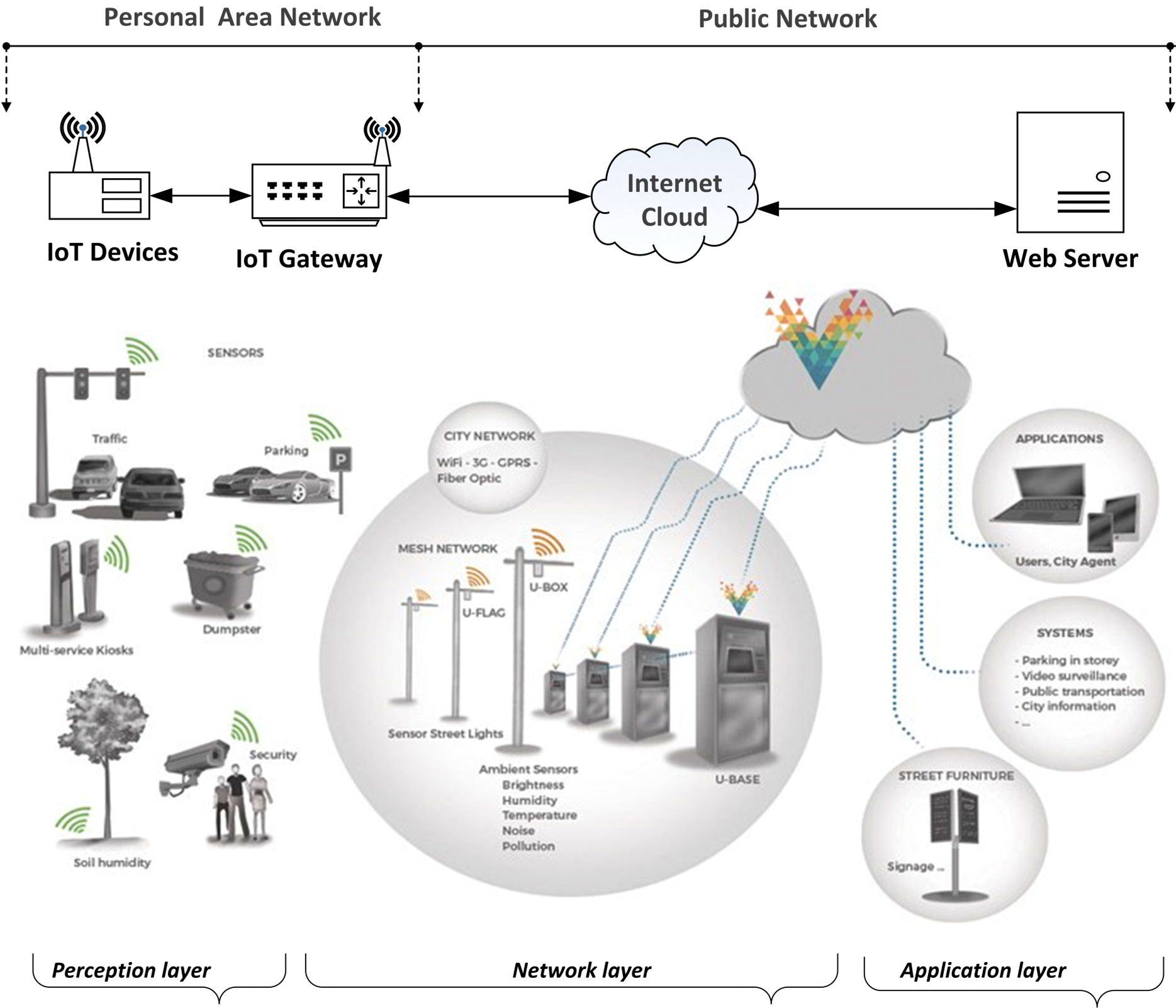
1. **Perception Layer**: Where RFID, sensors, and smartphones identify objects.
2. **Network Layer**: The wired/wireless transmission "nervous system."
3. **Application Layer**: The end-user interface where smart homes and logistics operate.
The authors highlight that most current research focuses on the "What" (connectivity) and ignores the "How" (ensuring the human right to remain unobserved).
## Regional and Micro-Scale Implications
On a **Regional Scale**, the authors warn of a "New Union of Nations" based on technological wealth. Poor countries might be excluded from the global electronics trade or forced to accept invasive tracking as a condition for international cooperation.
On a **Micro-Scale (The Home)**, the sanctity of private life is threatened. Smart TVs and appliances can record private conversations. The paper suggests that even architectural materials might change—traditional stone and wood may be replaced by expensive "smart building skins" designed to block wireless eavesdropping.
## The Proposed Solution: A Privacy Framework
To counter these threats, the study proposes a structured governance model.
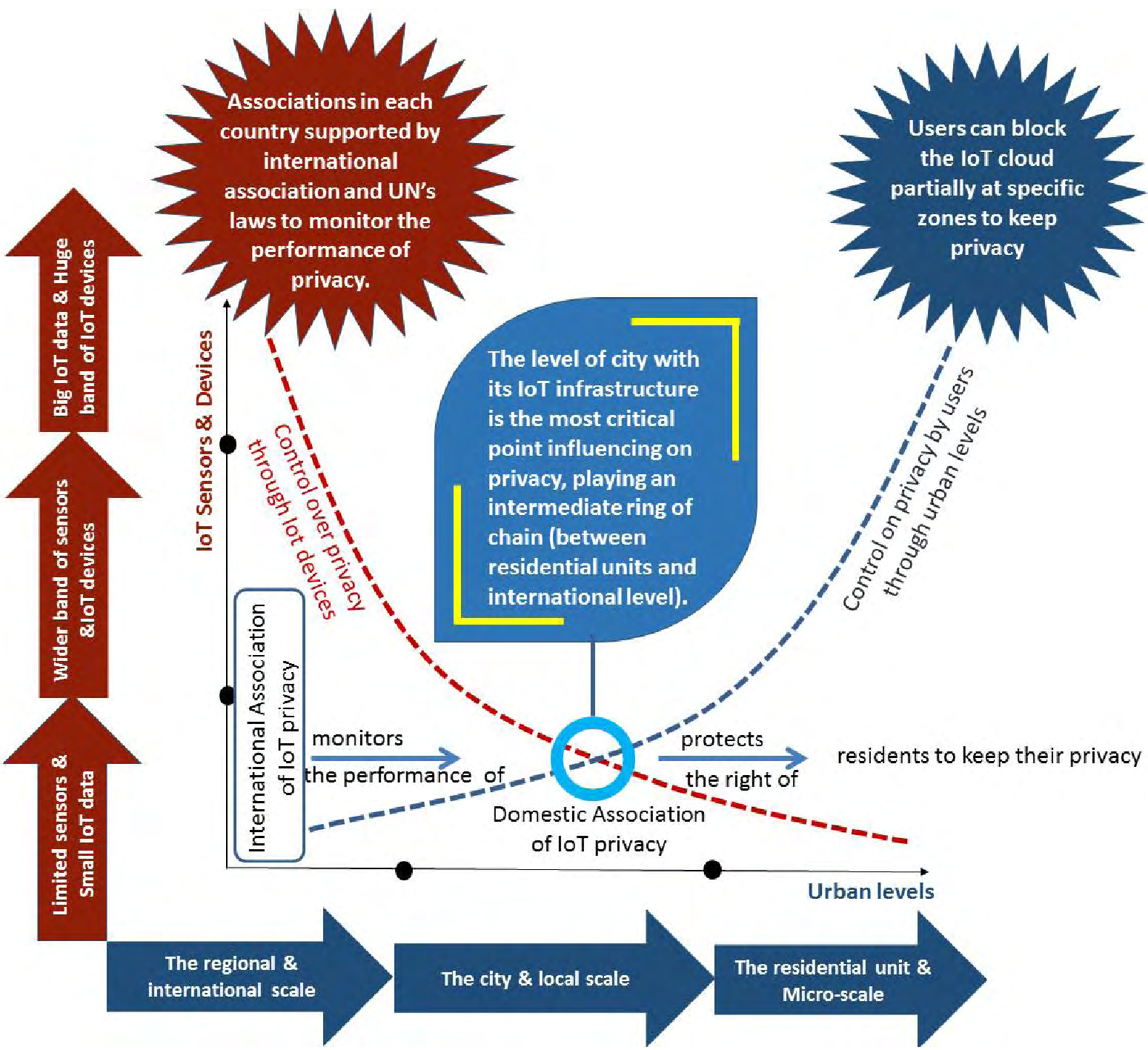
The framework argues that privacy cannot be solved by tech alone; it requires:
* **Local Associations**: Specialist bodies within cities to audit sensor security.
* **IoT-Free Zones**: Areas dedicated to sensitive government or military operations where sensors are prohibited.
* **International Protocols**: A United Nations-led effort to establish global privacy norms, ensuring that data crossing borders remains protected.
## Critical Analysis & Conclusion
The authors conclude that while technology is "endless," our humanity has limits. The success of projects like the **Korean U-eco-city** shows that energy and environmental benefits are real, but they must not come at the cost of the "Personal Right to Privacy."
**Takeaway for the Future**: The next decade of urban design won't be measured by the speed of the 5G/6G network, but by the robustness of the legal and ethical "shields" we build around it. If we ignore the social trepidation surrounding surveillance, the cities of the future will be smart, efficient, and hauntingly empty of human connection.