
Social Computing: Breaking Silos with a Unified Graph Model
3646_Social computing an intersection of recommender systems, trustreputation systems, and social networks.
This paper explores "Social Computing" at the intersection of recommender systems, trust/reputation systems, and social networks. It proposes a novel heterogeneous two-layer graph model to bridge these services and alleviate data sparsity and cold-start issues.
TL;DR
Social computing services like Netflix (recommendations), eBay (trust), and Facebook (socializing) are fundamentally interconnected, yet traditionally treated as separate entities. This paper by Tavakolifard and Almeroth argues that by merging these services into a unified two-layer graph model, we can solve the persistent "Cold-Start" and "Sparsity" problems by letting data from one domain (like a friend list) inform another (like a product recommendation).
The Silo Problem: Why Your Systems Feel "Cold"
The most significant hurdle in social computing is the Cold-Start problem. When a new user joins a platform, the system knows nothing about them. In a recommender system, this means no personalized suggestions; in a trust system, it means no one is willing to transact with them because their reputation score starts at zero.
Existing solutions usually stay within their own "silo." A recommender system tries to look at item similarities, while a trust system looks at transaction history. But as the authors observe, these systems are naturally overlapping: your social circle (Social Network) often reflects your tastes (Recommender) and your reliability (Trust).
The Methodology: A Two-Layer Hypergraph
The core contribution of this work is the shift from simple matrices to a Heterogeneous Two-Layer Weighted Directed Hypergraph.
Architecture Breakdown
Instead of a simple table of "User A rated Item B," the authors propose a structure with two distinct layers:
- User Layer: Contains nodes representing people. Links here represent social ties, demographic similarity, or trust levels.
- Item Layer: Contains nodes representing products or content. Links here represent content similarity (e.g., two books in the same genre).
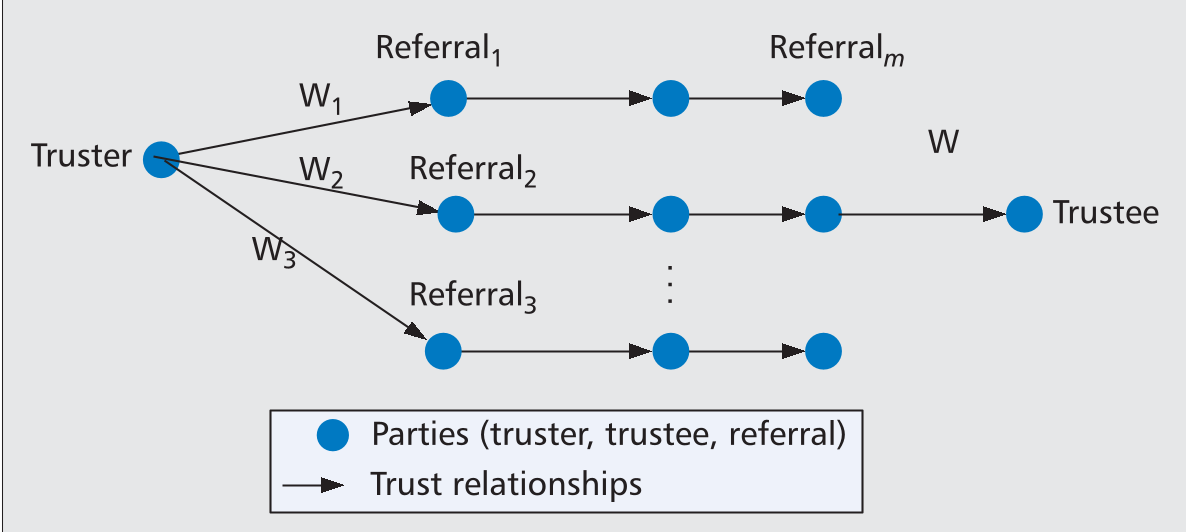 Figure: The proposed unified graph model showing the intersection of user relations, item similarities, and transactions.
Hyperedges (edges connecting more than two nodes) are used to represent affiliation networks—groups of people who belong to the same event or community.
Link Prediction as a Universal Tool
By using this graph, the task of "recommending a movie" or "calculating trust" becomes a Link Prediction problem. If User A is socially connected to User B (Social Network), and User B has a transaction link to Item C (Recommender), the model can mathematically infer a potential link between User A and Item C, even if User A is brand new to the system.
Bridging the Services
The paper classifies social computing methods into a clear taxonomy, comparing how different algorithms treat data.
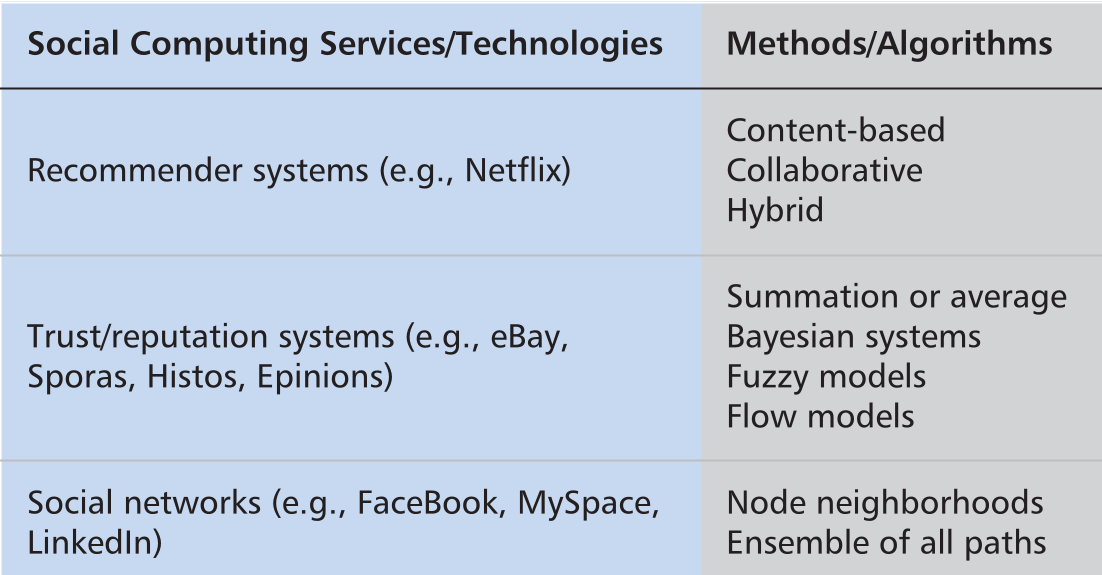 Table: Summary of methods across Recommender Systems, Trust Systems, and Social Networks.
Key Insights:
- Social Networks Recommenders: Your "neighbors" in a social graph provide the best proxy for collaborative filtering when your own history is empty.
- Trust Social Networks: Transitive trust (I trust A, A trusts B) can be used to bootstrap social connections in "small world" networks.
- Identity cost: In an integrated system, "milking" a reputation (cheating and restarting with a new ID) becomes much harder because the user would lose their established social and recommendation history simultaneously.
Critical Analysis & Future Outlook
The strength of this paper is its Taxonomic Rigor. It doesn't just propose a workaround; it provides a geometric language (Graph Theory) to describe human interaction.
Limitations: While the paper excels at data representation, it leaves the specific computational complexity of running such a massive, multi-modal hypergraph for future exploration. In 2026, we might solve this with Graph Neural Networks (GNNs), but the foundational logic presented here—that context is the cure for sparsity—remains a gold standard.
Takeaway: For developers and researchers, the message is clear: Stop looking for better recommendation algorithms in isolation. Instead, look for ways to tap into the "Contextual Metadata" of the user's wider social existence.