
Are You a Social Conformer? Unveiling the Impact of Peer Pressure on User Ratings
Are You a Social Conformer?
The paper introduces the Conformity Rating Model (CRM), a novel social recommendation framework that accounts for how users' ratings shift to align with their friends' opinions. By framing expressed ratings as a weighted combination of personal preference and social conformity, the model achieves over 2% improvement in prediction accuracy for socially influenced users.
TL;DR
This research tackles a hidden bias in social networks: Social Conformity. While most recommenders focus on how friends help us discover items, this paper explores how friends change our opinion of items after we use them. By introducing the Conformity Rating Model (CRM), the authors demonstrate that over 76% of users tweak their ratings to match their social circle, and accounting for this shift improves rating prediction accuracy significantly.
Background: The Price of Fitting In
In the world of social recommendation, two phenomena are often conflated: Homophily (we are friends because we like the same things) and Social Influence (I like this because my friends like it). However, there is a third, more subtle effect: Social Conformity.
Imagine reading a book and thinking it's a "2/5." You then see all your friends giving it a "5/5." Under social pressure or the "bandwagon effect," you might record a "3/5" instead. Existing models like Probabilistic Matrix Factorization (PMF) ignore this "calibration" step, treats the "3" as your true preference, and thus fails to capture your genuine taste.
Methodology: The CRM Architecture
The authors propose the Conformity Rating Model (CRM), which defines the observed rating () as a linear interpolation between an internal preference and the social consensus:
Key Components:
- Inner Rating (): Calculated using standard PMF (User/Item latent vectors). This represents what the user actually feels.
- Conformity (): Modeled as , where represents the specific influence a friend has on user .
- Social Opinion: A weighted average of ratings from "active neighbors" (friends who rated the item before the user).

Experimental Insights
The model was tested on a massive Goodreads dataset comprising 55k users and 9.4M ratings.
1. Accuracy Gains
The CRM outperformed the baseline PMF across all metrics. For users identified as having "high conformity," the RMSE improved by over 2%. This suggests that pure collaborative filtering is fundamentally limited if it doesn't account for the social "noise" in the data.
| Model | RMSE (All Ratings) | RMSE (High Conformity Users) |
|---|---|---|
| PMF | 0.8556 | 0.8476 |
| CRM | 0.8520 | 0.8254 |
2. Who are the Influencers?
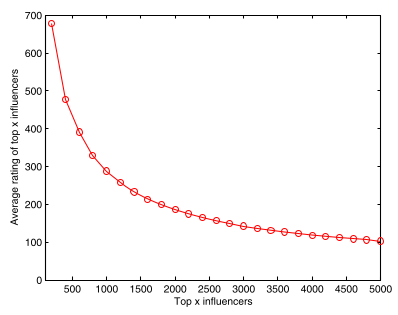
The model successfully identified high-influence individuals. The top 200 "influencers" identified by the learned parameters had a significantly higher average degree (number of friends) and a much higher percentage of verified book authors (45% vs. a 9% baseline).
Deep Dive: The Nature of Conformity
The study reveals three fascinating patterns about human behavior online:
- Ubiquity: 76% of users conform to some degree. Most aren't "blind followers," but they do adjust their scores by roughly 0.1 to 0.5 points.
- Positivity Bias: Social influence makes us nicer. Ratings were more likely to shift upward than downward after seeing friends' reviews. This is a crucial insight for viral marketing—social groups don't just spread information; they inflate perceived quality.
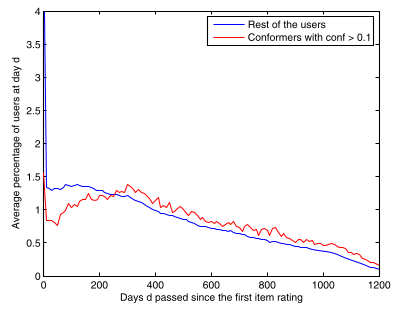
- Temporal Dynamics: Conformity is a "late-game" phenomenon. "Independent" users (low conformity) tend to rate items early in their lifecycle. "Conformers" appear much later, peaking around 300 days after an item's release.
Critical Analysis & Conclusion
The CRM provides a robust mathematical bridge between social psychology and machine learning. By quantifying "conformity" as a weight, it allows systems to "clean" user data to find true intrinsic preferences.
Limitations: The model currently assumes a static influence () between friends. In reality, influence might be category-specific (e.g., I trust a friend’s taste in Sci-Fi but not in History).
Future Work: This framework opens doors for "de-biased" recommendation engines that provide more personalized suggestions by filtering out the pressure of the crowd. It also provides a more realistic foundation for predicting how information—and opinions—cascade through a network.