
Beyond Balanced Calling: How Social Connectivity Reshapes Network Competition
Social Connections and Access Charges in Networks
This paper presents a game-theoretic model of competition between two interconnected network operators (e.g., telecom firms) where consumer demand is governed by an underlying social network structure. Using random regular graphs to represent social ties, the authors evaluate how access charges and linear pricing impact equilibrium under regulated versus unregulated environments.
TL;DR
Most economic models for telecommunications assume you are just as likely to call a stranger as your best friend—a convenience known as the "balanced calling pattern." This paper explodes that myth by embedding consumers in a formal social network. By simulating competition on random regular graphs, the authors find that while unregulated firms do jack up "access charges," high social connectivity actually protects consumer surplus, making strict regulation less vital than previously thought.
The "Balanced" Fallacy and Social Intuition
For decades, the standard literature (notably Laffont et al., 1998) assumed that the percentage of calls staying within a network perfectly matched that network's market share. This allowed for elegant math but ignored the Social Manifold: we call the people we know.
The authors argue that your utility from a call isn't just about the price; it's about the social distance (). If a friend is 1 link away in your social graph, the call is highly valuable; if they are 10 links away, it’s worth much less. This intuition creates a network effect where market shares are not just a product of price, but of how many "tight-knit groups" a provider can capture.
Methodology: Gaming the Social Graph
The paper utilizes a two-stage game played over a social network represented by a Random Regular Graph:
- Stage 1 (Access Charges): Firms set the fees () they charge each other for "terminating" calls on their network.
- Stage 2 (Retail Pricing): Firms set prices for consumers () based on their specific location and preferences ().
The Utility Function
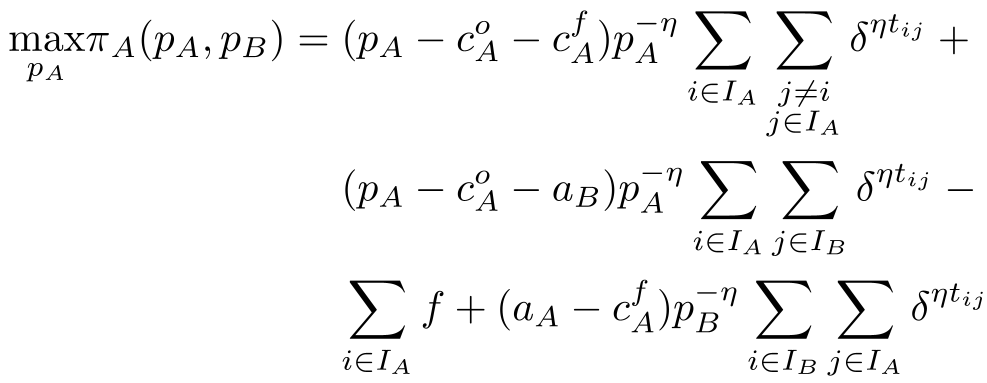
The core technical contribution is the utility function that incorporates a discount factor based on distance :

As distance increases, the value of the call decays. This forces the firm's profit maximization problem to account for the specific "cliques" and connections of its subscriber base.
Experiments and Results
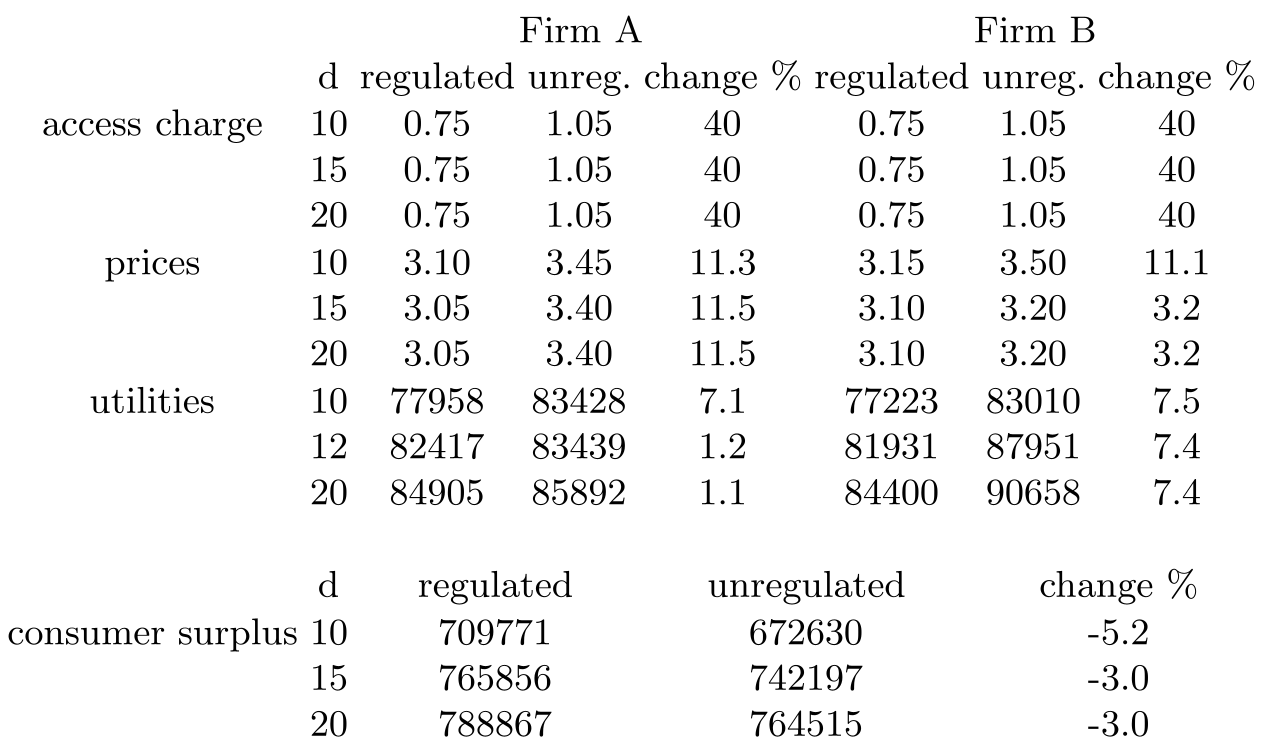
The authors ran simulations with 1,024 agents. They compared a Regulated Case (access charges fixed at marginal cost) against an Unregulated Case (firms set charges to maximize profit).
Key Findings:
- Access Charge Spikes: In unregulated markets, firms agreed on access charges ~40% higher than the cost. This confirms the classic theory that firms use access charges as a collusive device to keep retail prices high.
- The Connectivity Buffer: Interestingly, as the "Degree" () of the social network increases (meaning more friends per person), the negative impact of deregulation shrinks.
- Consumer Surplus: While deregulation hurts consumers, the damage is smaller in highly connected societies.
Critical Analysis: Is Regulation Necessary?
The most provocative takeaway is that deregulation might be more attractive than we thought. Traditional models under linear pricing schemes usually demand heavy-handed regulation to prevent firms from overcharging each other (and by extension, the consumer).
However, this paper shows that when social connections are explicit:
- Firms have a harder time extracting "pure" monopoly rents because local network preferences create "sticky" demand.
- High connectivity () yields significantly higher consumer surplus regardless of the regulatory regime.
Limitations: The study uses Random Regular Graphs, which lack the "heavy-tail" distribution (influencers/super-connectors) found in real-world social networks like Facebook or WeChat. Future research should apply this to Scale-Free networks to see if "super-connectors" give firms even more leverage over prices.
Conclusion
This work shifts the focus of telecom regulation from "price parity" to "social topology." In an increasingly connected world, the "social demand" for communication might be a stronger market force than the regulator's pen.