
SCCF: Bridging Social Circles and Personal Attributes for Robust POI Recommendation
Social and Content Based Collaborative Filtering for Point-of-Interest Recommendations
The paper introduces SCCF (Social and Content based Collaborative Filtering), an integrated model for Point-of-Interest (POI) recommendation. It combines social propagation influence and individual attribute matching to achieve SOTA performance on Yelp datasets.
TL;DR
The Social and Content based Collaborative Filtering (SCCF) model tackles the perennial "cold-start" and data sparsity problems in Location-based Social Networks (LBSNs). By bifurcating user check-in influences into a Social Propagation Space and an Individual Attribute Space, it achieves a massive performance leap (up to 337% improvement in new POI recommendation) over existing SOTA methods like ICCF.
Context: The Sparsity Trap
POI recommendation is uniquely challenging because human mobility data is inherently sparse. Most users only visit a fraction of available locations. When a new POI appears or a new user joins (the Cold-Start problem), traditional Matrix Factorization fails because there is no history to rely on.
The authors identify a critical gap: existing models either over-rely on geographical proximity or fail to reconcile social influence with personal content profiles (tags, attributes, etc.).
Methodology: The Separate-Space Logic
The core "Insight" of SCCF is that our decisions are driven by two distinct forces:
- Social Propagation: What our influential friends like.
- Individual Attributes: How well a location's features (e.g., cuisine, price) match our personal profile.
1. Social Relation Preference-Based Model (SRPB)
Instead of looking at all friends equally, SRPB identifies Top-Z influential friends (based on fan count). It aggregates their preference grades, weighted by their social impact, to suggest locations to the user.
2. User-Location Content-Based Model (ULCB)
In contrast to prior work (ICCF) that bloats the matrix dimension by including user/location IDs as features, ULCB uses only user attributes and location features. This reduces computational complexity and forces the model to learn the latent relationship between characteristics rather than just IDs.
 The objective function (Eq 5) integrates a modified confidence matrix W that incorporates both visit frequency and explicit star ratings.
Experiments: Dominating the Cold-Start
The model was tested on real-world Yelp datasets, specifically partitioned to simulate data sparsity across different US states.
Key Breakthroughs:
- New User Scene: SCCF outperformed ICCF by over 35% in recall and precision.
- New POI Scene: This is where SCCF truly shines. In the "SC and NC" dataset, it achieved a 277.4% improvement over ICCF at K=1.
- Ablation Study: The integrated SCCF consistently outperformed its standalone sub-models (SRPB and ULCB), proving that social and individual factors are complementary.
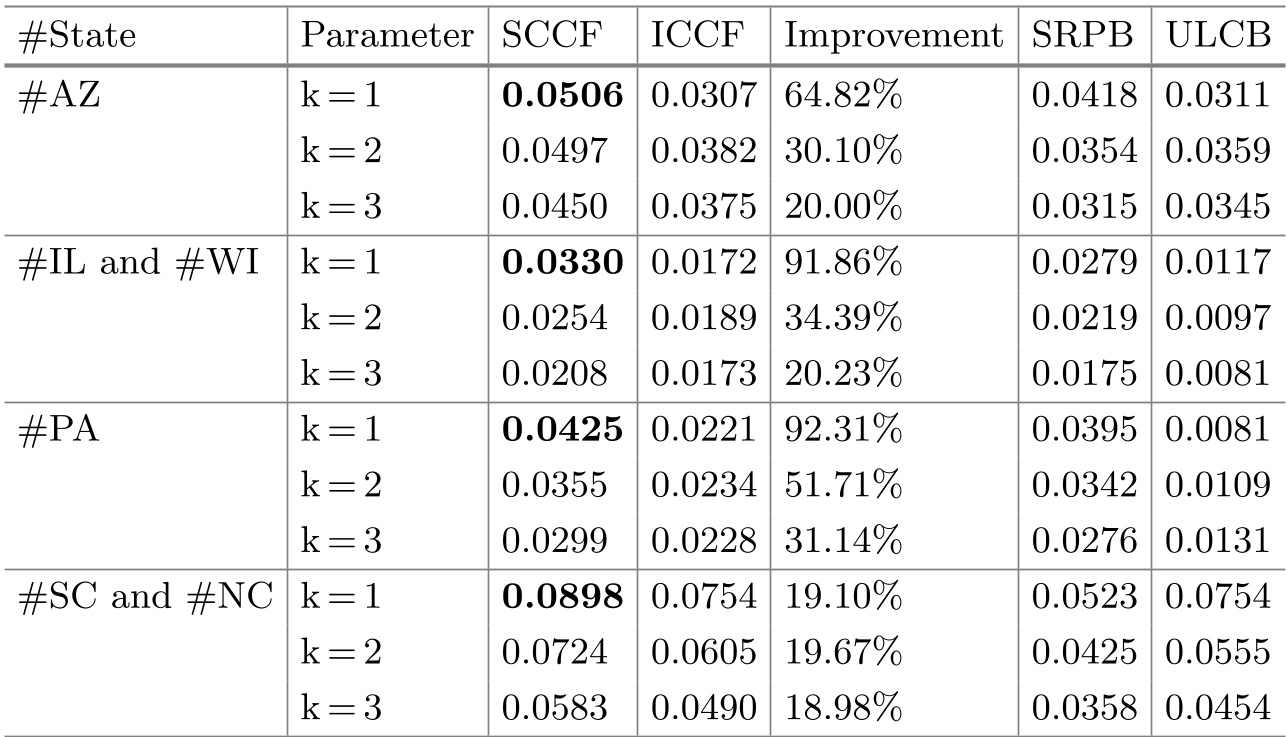 Table showing significant improvements over ICCF across multiple geographic datasets.
Critical Insight & Future Outlook
The success of SCCF lies in its refined confidence mechanism. By transforming implicit check-ins into explicit preference grades (using review scores and vote weights), the model filters out "noise" and focuses on high-intent behaviors.
Limitations: While SCCF is efficient, it relies on the availability of social fan counts and explicit ratings. In networks where social links are hidden or ratings are absent, the SRPB component would require alternative influence metrics.
Takeaway: For technical architects building LBSNs, the lesson is clear: don't just stack features. Partitioning influence into social and attribute latent spaces is the key to solving the sparsity of human movement.
References
- Lian, D., et al. "Content-aware collaborative filtering for location recommendation." (ICDM 2015).
- Li, H., et al. "Point-of-interest recommender systems: a separate-space perspective." (ICDM 2015).