
SocialTrust: Why Your Best Friend Shouldn't Recommend Your Next Surgeon
Social context-aware trust inference for trust enhancement in social network based recommendations on service providers
The paper introduces SocialTrust, a novel probabilistic framework for social context-aware trust inference in service-oriented social networks. It aims to enhance recommendation quality by calculating trust between non-adjacent participants using a multi-faceted contextual model and an iterative algorithm for complex network structures.
TL;DR
Most recommender systems assume that if A trusts B and B trusts C, A should trust C. But this ignores context. This paper introduces SocialTrust, a framework that models social characteristics (expertise, intimacy, and preference) to calculate context-aware trust. It effectively solves the data sparsity problem in service recommendations while ensuring you don't get a car repair tip from a coding expert.
The "Context" Blind Spot in Recommender Systems
Traditional Collaborative Filtering (CF) has a "cold start" and "sparsity" problem—if there's not enough history, the system fails. To fix this, researchers turned to Social Networks. However, early social trust models were naive. They used simple multiplication (A trusts B 0.8 * B trusts C 0.8 = A trusts C 0.64).
The research intuition here is that trust doesn't flow like electricity; it flows like expertise. If I trust my professor to teach me C++, I don't necessarily trust their taste in car mechanics. The authors argue that trust inference must be Social Context-Aware.
Methodology: The Anatomy of SocialTrust
The authors break down context into two core categories:
- Independent Social Context: Who are you? (Role Impact Factor / Expertise and personal preferences).
- Dependent Social Context: How do we relate? (Social Intimacy Degree and historical trust values).
The Probabilistic Inference Engine
Instead of simple math, they use the Law of Total Probability. The trust in a node is calculated based on the trustworthiness of its predecessors and the "transference degree" (how much of that trust actually carries over in a specific context).
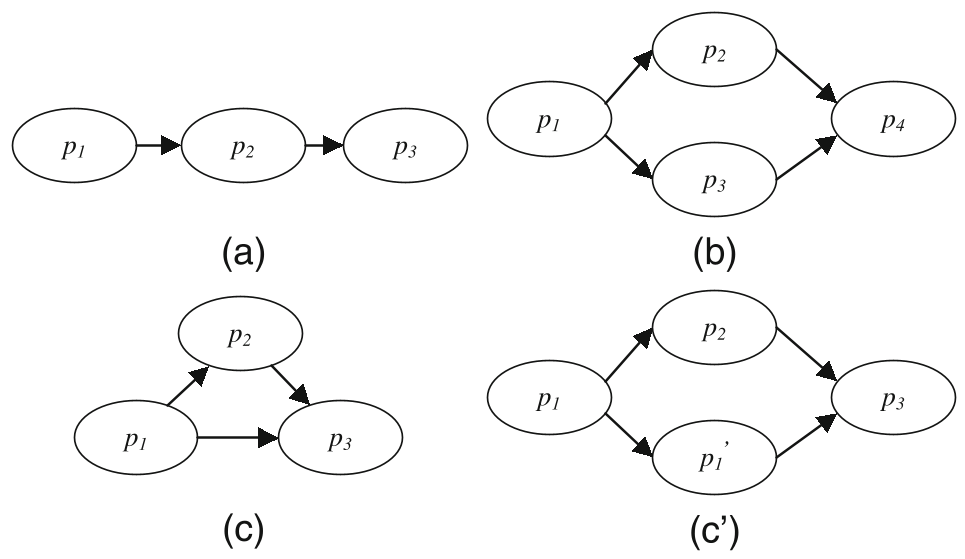
The model classifies connections into three types:
- Strong: The interaction context perfectly matches the target context.
- Weak: The contexts are different but semantically relevant (e.g., C++ vs. Java).
- No Connection: The contexts are entirely unrelated.
Solving the "Cycle" Problem
Real social networks are messy and full of loops (A trusts B, B trusts C, C trusts A). Simple algorithms get stuck in infinite loops. The authors proposed an Iterative Algorithm (Algorithm 2) that updates trust values until they reach a "steady state."
Experimental Battleground: Enron Email Analysis
Using the famous Enron dataset (over 87k nodes), the authors compared SocialTrust against Multiplication (MUL) and Averaging (AVG) strategies.
Key Result: Semantic Filtering
When searching for a "Car Repair" service, the MUL and AVG models recommended nodes with high "Teaching" trust. SocialTrust correctly returned "No Inference," preventing the system from making a high-confidence but logically flawed recommendation.
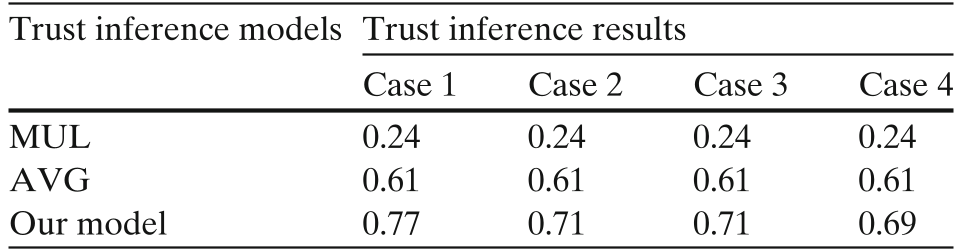
As shown in the data, SocialTrust's results vary dynamically based on the Role Impact Factor (RIF) and Social Intimacy (SID), whereas competitors are "context-blind" and provide the same score regardless of the situation.
Critical Insight & Future Outlook
The brilliance of this work lies in the differentiation of social roles. By grounding the model in Social Psychology principles (like the impact of expertise on credibility), the authors moved trust inference from a purely mathematical problem to a socio-technical one.
Limitations: The model relies on the ability to "mine" these RIF and SID values. In an era of increasing privacy regulations (GDPR), obtaining the deep behavioral data required for this model (like email content analysis) is becoming more difficult.
Future Work: The next leap will be integrating this with Large Language Models (LLMs) to automatically categorize "Interaction Contexts" without manual labeling, making SocialTrust truly autonomous.
Takeaway for Engineers: If you are building a recommendation engine, "Similarity" isn't enough. You must build a Contextual Trust Layer to prevent "Expertise Leakage" between unrelated domains.