
SCOUT: Bridging Online Social Contexts with Physical Ubiquity
SCOUT: Social Context-Aware Ubiquitous System
SCOUT is a generic, social-based context-aware ubiquitous system that integrates online social network (OSN) data with localization technologies. It supports both reactive (user-initiated) and proactive (system-initiated) recommendation modes, achieving sub-second matching delays for up to 350 concurrent users.
TL;DR
SCOUT (Social Context-Aware Ubiquitous System) is a architecture designed to merge our digital social lives (Facebook profiles, interests) with our physical surroundings. Unlike previous siloed attempts, SCOUT is technology-agnostic regarding localization and emphasizes a "Proactive" mode where the environment alerts you to opportunities—like a friend nearby or a sale on your favorite author's books—before you even ask.
Background Positioning
In the landscape of pervasive computing, we've moved from simple "Where am I?" (Localization) to "Who is around me and what do we share?" (Social Context). SCOUT acts as a middleware layer, sitting between varying localization hardwares (WiFi, Bluetooth) and specific mobile applications, providing a unified engine for social matching.
The Core Challenge: Beyond Static Zones
Previous systems like WhozThat or MobiClique were limited by the physical range of Bluetooth or fixed RFID readers. If you weren't in the specific "hotspot," the system was blind. SCOUT's designers realized that context-awareness must be:
- Technology Independent: It shouldn't matter if the location comes from a Quad-core server or a simple beacon.
- User-Driven: Users should define their own "Zone of Interest" dynamically.
- Real-Time Responsive: Matching social graphs in a mobile environment requires extreme low latency.
Methodology: The SCOUT Architecture
The system follows a Client-Server model. The server is the "brain," housing a Task Manager, a Recommendation Engine, and a triple-database setup (Social, Location, and Settings).
Architecture Highlight
The secret to SCOUT’s speed lies in its Memory-Based (MB) Storage. By consolidating a user's social graph and current location into memory rather than performing expensive disk I/O, the system facilitates lightning-fast matching.
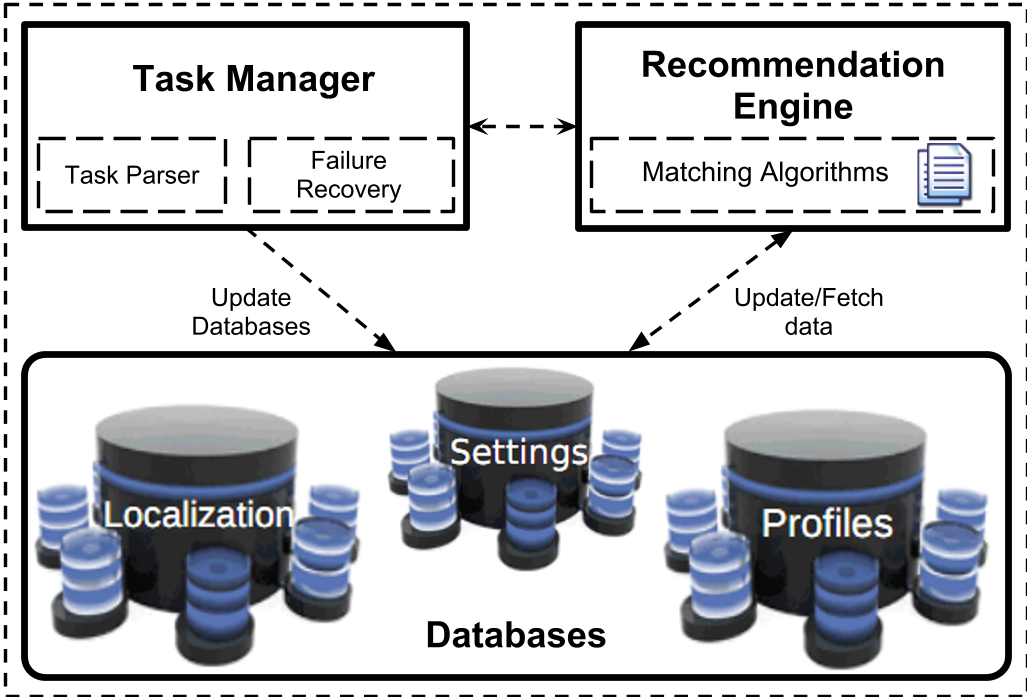
Reactive vs. Proactive Modes
- Reactive: You ask, "Are any of my Facebook friends in this mall?"
- Proactive: The server monitors your location and interests. When you enter a bookstore, it pushes a notification: "There is a sale on Dan Brown books here, and your friend Victor is also in the food court."
Experiments: Performance Under Pressure
The researchers evaluated the system using synthesized Facebook profiles (via a tool called ProfGen) and simulated 1,000 concurrent clients to stress-test the middleware.
Key Result: Memory vs. Disk
The shift to a memory-based design was transformative. For 350 concurrent tasks, the matching delay dropped from roughly 60 seconds (Disk-Based) to under 1 second (Memory-Based). This validates that for ubiquitous systems, the bottleneck is often data retrieval rather than the matching algorithm itself.
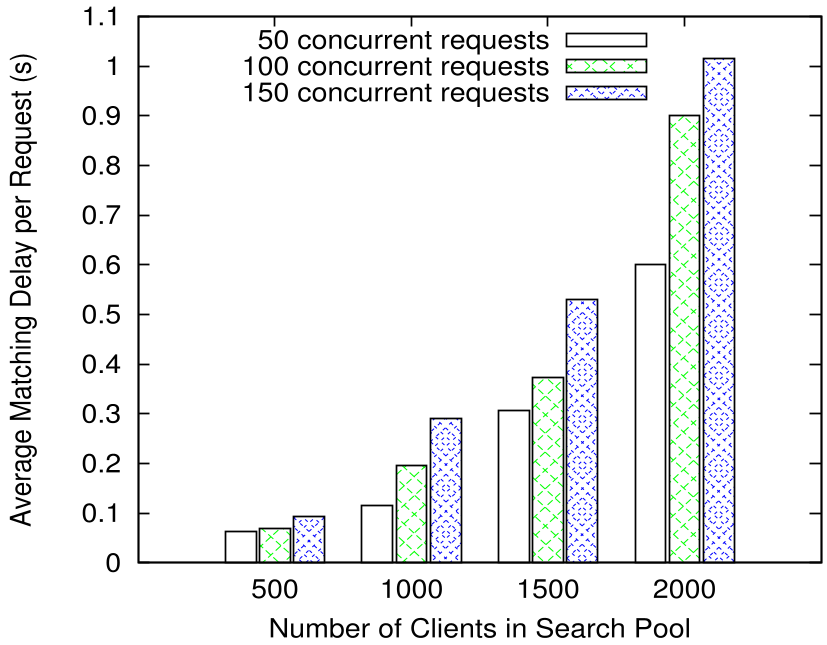
Scalability Insights
- Parsing Delay: Remained constant and negligible (most under 0.1ms).
- Matching Complexity: As the pool of clients grows to 2,000, the delay increases exponentially, but even at peak load (150 active requests), the service time remains around 1 second, which is acceptable for most non-critical social apps.
Critical Analysis & Future Outlook
Takeaway: SCOUT successfully demonstrates that a generic, social-aware middleware is feasible and can handle significant loads if architected with memory-locality in mind.
Limitations:
- Privacy: The paper acknowledges that housing massive amounts of OSN data and real-time locations raises significant security concerns, which are not yet fully addressed in this prototype.
- Algorithm Scaling: While sub-second for 2,000 users, "Global City" scales (millions of users) would require distributed matching or more advanced heuristic-based pruning.
Future Work: The integration of real-world WiFi fingerprinting and large-scale deployment to model actual human social-location behavior are the logical next steps for the SCOUT framework.