
Decoupling Proximity: Social Context Awareness in Ad Hoc Networks
Social Context Awareness in Ad Hoc System of Systems
The paper introduces a generic framework for Mobile Ad Hoc Social Networks (MSNs) using Bluetooth technology. It features a novel "Aggressive Matchmaking" algorithm and the concept of "Conceptual Distance" to provide real-time, infrastructure-independent social matching based on user profiles and search criteria.
TL;DR
This paper proposes a decentralized framework for Mobile Ad Hoc Social Networks (MSNs) that breaks the reliance on Wi-Fi and SMS. By hacking the Bluetooth stack for real-time pairing and implementing an "Aggressive Matchmaking" algorithm, the authors introduce Conceptual Distance—a metric that maps social compatibility as a spatial dimension, allowing users to navigate social settings through data rather than just physical proximity.
Background: The Infrastructure Trap
Traditional social networks are tethered to the cloud. Even early mobile attempts like Dodgeball or Hummingbird were either centralized notification systems or relied on static access points. This creates a bottleneck in dynamic, highly mobile environments where infrastructure might be absent or unreliable. The authors argue that a true System of Systems (SoS) approach to social networking must be decentralized, real-time, and context-aware.
The Problem: Why Proximity Isn't Enough
Most proximity-based systems struggle with two things:
- Hardware Limits: Accurate indoor localization is notoriously difficult without specialized sensors.
- Relevance Gap: Just because someone is 2 meters away doesn't mean they are a relevant social match.
Current service discovery protocols (like Jini or UPnP) are designed for stable distributed systems, not the "volatile" world of moving pedestrians with smartphones.
Methodology: The "Aggressive" Matchmaker
The authors tackle these issues through a two-pronged technical approach:
1. Protocol Modification
Using the Java Bluetooth API (JSR82), the team modified the standard authentication/pairing loop. By automating pairing at the application layer (NOAUTHENTICATE_NOENCRYPT), they enabled "seamless" discovery where devices can exchange profile data instantly as users pass each other, without the friction of manual PIN entries.
2. Aggressive Matchmaking Algorithm
Instead of simple keyword matching, they adapted an algorithm used in Asynchronous Transmission Mode (ATM) networking. This logic treats social matching like an "aggressive marriage" problem (a variation of the Stable Roommates problem), where the system constantly re-pairs nodes as better matches (based on age, hobbies, and interests) enter the piconet.
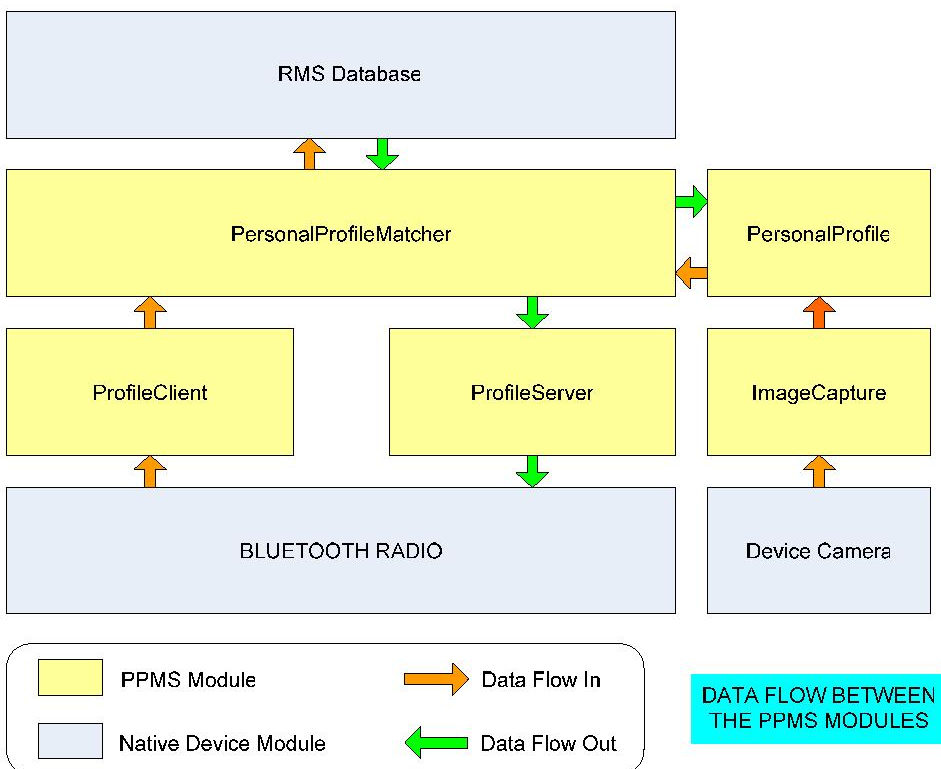 Figure 1: The Multi-layered System Architecture, featuring the ProfileClient for scanning and PersonalProfileMatcher for user interaction.
Conceptual vs. Physical Distance
The most innovative contribution is the distinction between Physical Distance (where you are) and Conceptual Distance (who you are).
- Physical Distance: The 10-meter radius of a Bluetooth piconet.
- Conceptual Distance: A calculated score representing the "gap" between two users' social profiles.
The system uses Spring Embedding techniques to visualize the social environment. A person physically across the room might be "conceptually closer" than the person sitting right next to you if your interests align.
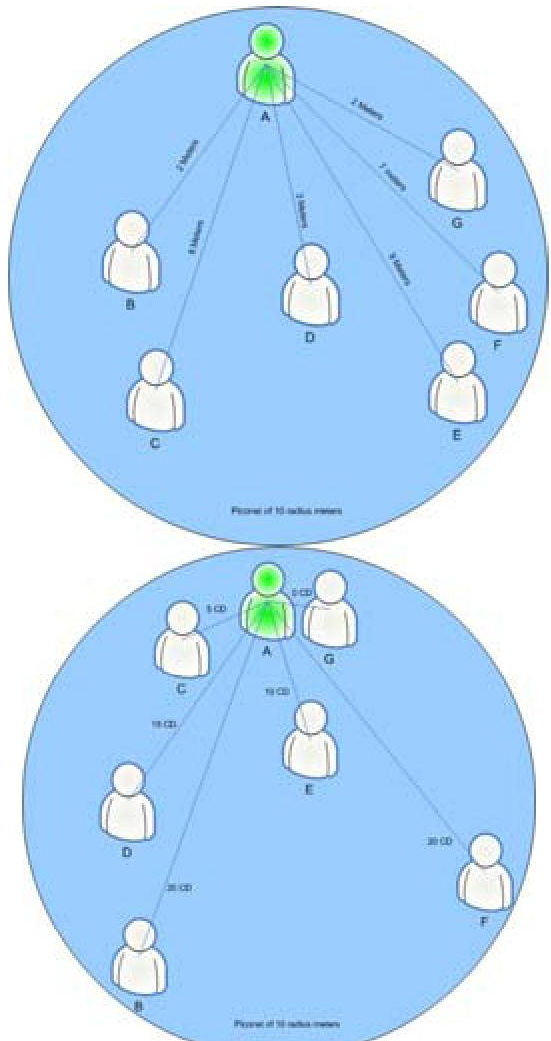 Figure 2: Physical vs. Conceptual Distance. Note how nodes shift positions based on profile similarity rather than radio signal strength.
Experiments & Critical Insight
The prototype involved 10 mobile users in a 5-meter piconet. The experiment proved that by using attributes like age and gender as "search filters," the system could identify targets significantly faster than by using distance-based RSSI (Relative Signal Strength Indicator) alone, which is often noisy and inaccurate in indoor settings.
Key results included:
- Successful real-time profile exchange via Bluetooth OBEX.
- The ability to schedule service priorities when multiple users request a match simultaneously.
Final Thoughts: The Future of "Social Piconets"
While the 2006-era Bluetooth limitations (maximum of 7 active slaves per piconet) restricted the scale, the logic remains highly relevant for today's BLE (Bluetooth Low Energy) and Mesh network applications.
The paper's focus on reducing "interpersonal communication barriers" via prior knowledge is a precursor to modern dating apps and professional networking tools, yet it offers a vision of privacy and decentralization that many modern, cloud-heavy apps have abandoned. The primary limitation remains the security of "automatic pairing," a challenge that future researchers must solve to prevent unauthorized data harvesting in public spaces.