
Social Context Congestion Games: When Friendship Influences Efficiency
Social context congestion games
The paper introduces and analyzes Social Context Congestion Games, a theoretical framework combining linear congestion and Shapley cost-sharing games with social network structures. Using aggregating functions (min, max, sum) to define "perceived costs," the authors characterize conditions for the existence of Pure Nash Equilibria and provide bounds on the Price of Anarchy (PoA) across various social cost functions.
TL;DR
Human decision-making is rarely solitary; we are influenced by the well-being of our social circles. This paper provides a rigorous mathematical foundation for Social Context Congestion Games, analyzing how social graphs and different ways of "caring" about others (min, max, or sum of costs) affect the existence of stable Nash Equilibria and the overall efficiency (Price of Anarchy) of systems like traffic routing and cost-sharing networks.
Background & Positioning
In classical game theory, a player only cares about their own cost. In "Social Context Games," a player's perceived cost is a function of their own immediate cost and the costs of their neighbors in a social graph. This paper sits at the intersection of Algorithmic Game Theory and Social Network Analysis, moving beyond specific "Resource Selection" models to more general classes like Linear Congestion Games and Shapley Cost Sharing.
The Core Problem: Do Equilibria Even Exist?
The introduction of social dependencies often breaks the "Individual Strategy" logic. If my cost depends on your cost, can we ever reach a stable state where no one wants to move (a Pure Nash Equilibrium)?
The authors specifically look at three aggregation functions:
- MIN: I am as happy as my most successful friend.
- MAX: I am only as happy as my most burdened friend.
- SUM: I care about the total cost incurred by my social circle.
The challenge is that for most graph topologies, these social influences prevent the game from being a "Potential Game," potentially leading to infinite loops of strategy changes.
Methodology: The Power of the "Sum" Function
The authors' most significant theoretical breakthrough is regarding the Sum aggregation function.
Architecture of Perceived Cost
For a player , the perceived cost is defined as: Where is plus their neighbors, and is the standard cost.
Key Insight: In Linear Congestion Games, if every player uses the Sum of their neighbors' costs as their objective, the game remains an exact potential game. This means that no matter how complex the social network is, players will always eventually settle into a Nash Equilibrium. This is not true for MIN or MAX, which only guarantee stability on "trivial" graphs (either everyone knows everyone, or no one knows anyone).
Experimental Analysis: The Price of Social Awareness
The paper calculates the Price of Anarchy (PoA)—the ratio of the worst Nash Equilibrium to the optimal social welfare.
Performance in Linear Congestion
When players care about the SUM of their neighborhood's immediate costs:
- The PoA is remarkably low (between 5 and 5.67) for the social objective of minimizing total immediate costs.
- However, if the social goal is to minimize the maximum cost (fairness), the PoA scales with .
Performance in Shapley Cost Sharing
In cost-sharing games (where players split the cost of resources), social context generally increases the PoA. The PoA typically scales with (number of resources) or (number of players), indicating that social awareness can sometimes lead to significantly less efficient outcomes than purely selfish behavior.
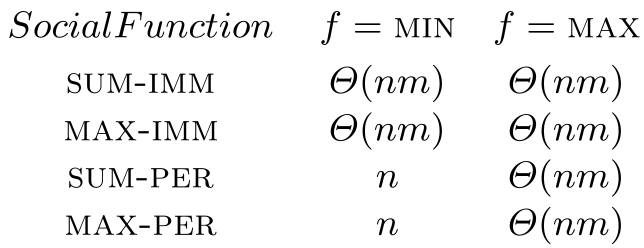 Table 1: Price of Anarchy bounds for Linear Congestion Games under MIN/MAX aggregations.
Critical Analysis & Takeaways
The paper proves a fascinating dichotomy: Altruism (as modeled by SUM) preserves stability, while comparative welfare (MIN/MAX) destroys it.
Limitations:
- The model assumes an undirected social graph (knowledge is mutual). In many modern digital contexts (like Following on X/Twitter), knowledge is directed, which may change the results.
- The PoA bounds for Shapley games are quite high, suggesting that while social context is interesting, it might not always be "efficient" for the system as a whole.
Future Outlook:
This work opens the door for designing Socially-Aware Mechanisms. For instance, if a network designer knows the social graph, they could potentially nudge players toward better equilibria by highlighting different "aggregations" of peer performance. The realization that "Sum-based" social awareness maintains mathematical stability is a high-value insight for decentralized system design.