
ChitChat: Solving the Sparsity Crisis in Delay Tolerant Networks through Social-Context Semantics
Effective social-context based message delivery using ChitChat in sparse delay tolerant networks
This paper introduces ChitChat, a novel social-context-based routing system specifically designed for message delivery in sparse Delay Tolerant Networks (DTNs). By integrating Opportunistic Transient Social Relationships (OTSR) and Geographic Social Heatmaps (GSH), ChitChat leverages human mobility patterns and multi-hop social associations to achieve superior delivery performance in intermittent environments.
TL;DR
ChitChat is a specialized DTN routing protocol that tackles the challenge of extreme spatial-temporal sparsity. Unlike traditional methods that depend on direct node-to-destination encounters, ChitChat "learns" the social landscape by modeling multi-hop relationships (OTSR) and the social value of geographic locations (GSH), delivering messages more effectively in environments like battlefields or disaster zones.
Background: The Myth of Dense DTNs
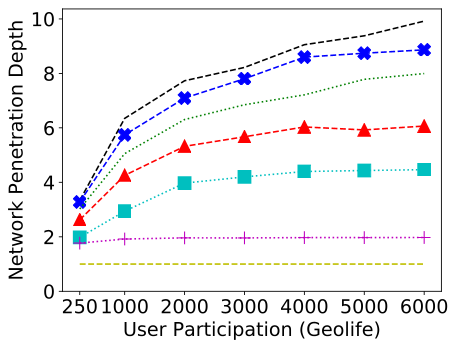
Most Delay Tolerant Network (DTN) research relies on datasets like INFOCOM 2006, where participants are packed into a conference hall. However, real-world opportunistic networks—such as those formed by civilians after a disaster or soldiers on a battlefield—are often sparse. The authors' analysis shows that while INFOCOM 2006 has a connectivity density of nearly 80%, real-world urban mobility datasets like Microsoft’s GeoLife show a measly 0.3% density. In such "ghost town" networks, messages must travel across long, multi-hop paths spanning hours or days.
The Core Insight: Why Social-Context Matters
If you want to deliver a message about "photography" in a sparse city, you don't just look for a photographer. You look for:
- People who frequently hang out with photographers (Transient Social Relationships).
- People heading toward a location where photographers gather, like a scenic park (Geographic Social Heatmaps).
Methodology: The ChitChat Engine
ChitChat operates through three distinct yet interlocking modules:
1. Opportunistic Transient Social Relationship (OTSR)
Instead of static interest profiles, ChitChat uses a Growth and Decay model.
- Growth: If Alice (interested in Hiking) stays near Bob (interested in Photography), Alice’s weight for "Photography" grows. This allows her to act as a more effective relay for photography-related messages.
- Decay: If Alice stops meeting people interested in "Photography," her relay potential for that topic gradually decays over time, ensuring the network isn't flooded with outdated information.
2. Geographic Social Heatmap (GSH)
Recognizing that mobility is intent-driven, ChitChat maps "Social Staypoints."
- When nodes meet, they exchange "Heatmaps"—metadata about what kinds of interests are prevalent at specific GPS coordinates.
- This allows a node to realize: "I am going to the town square; my heatmap says people interested in 'First Aid' gather there, so I should carry this medical alert message."
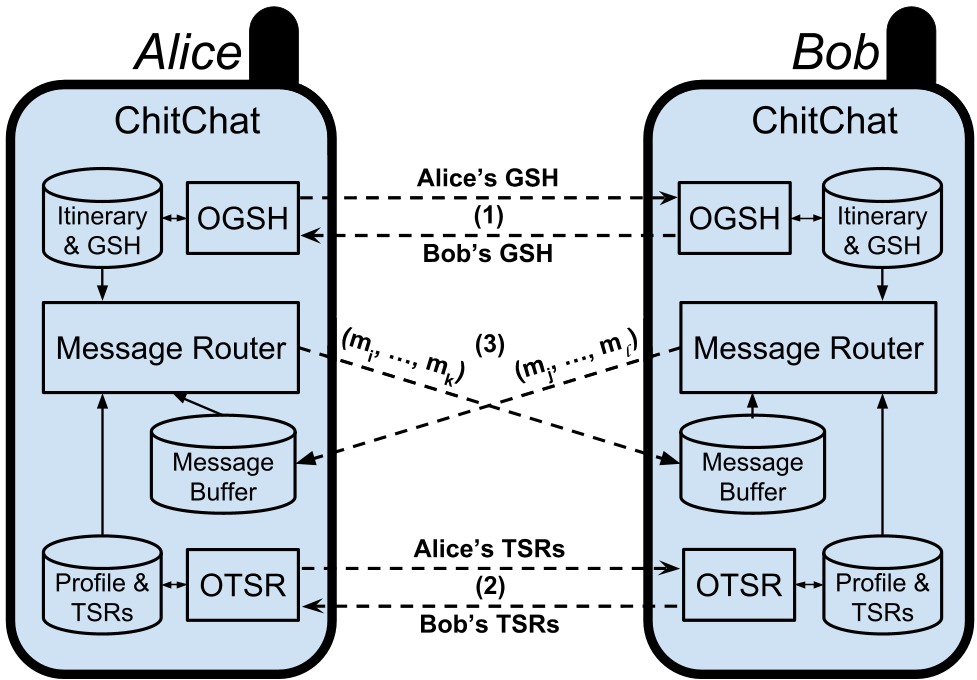
3. Smart Routing Protocol
When two nodes encounter each other, they don't just dump all data. They compare:
- TSR Strength: Who has better social connections to the message topic?
- Itinerary Strength: Whose future path leads to a socially relevant "Hotspot"? If the neighbor is "stronger," the message is forwarded.
Experimental Performance
The researchers tested ChitChat against benchmark algorithms (Epidemic, SANE, SEDUM, SEBAR) using the sparse GeoLife and MDC datasets.
- Delivery Ratio: ChitChat significantly outperformed SANE and SEBAR, reaching up to 68% of the delivery performance of theoretical flooding (Epidemic) but at a fraction of the cost.
- Efficiency: Even as communication range was reduced, ChitChat's performance remained stable, suggesting it is highly power-efficient for battery-constrained mobile devices.
- Latency: It achieved the lowest latency among non-flooding protocols, proving that social-context intelligence finds shorter multi-hop "journeys" through the sparse network.
Critical Insight & Conclusion
ChitChat’s primary contribution is shifting the DTN routing paradigm from "Who do you know?" to "Where are you going, and what is the social value of that place?"
While the paper shows impressive results, a remaining challenge is Privacy. Exchanging heatmaps and interest weights could reveal sensitive user habits. The authors suggest using encrypted SIDs (Social Interest Identifiers) to decouple semantic meaning from routing functionality—a crucial area for future research in secure tactical communications.
For practitioners in disaster management or ad-hoc networking, ChitChat provides a blueprint for building resilient communication layers that thrive on human social patterns rather than fighting against network sparsity.