
Social Context and Network Formation: Why Incentives Shape Our Connections
Social context and network formation: An experimental study ଝ
This paper presents a behavioral game theory study on strategic network formation, identifying how social contexts (Burtian vs. Colemanian) influence structural outcomes. Using computer simulations and laboratory experiments (n=108), the authors demonstrate that network characteristics like density and closure are predictable consequences of individual utility optimization under varying incentives.
TL;DR
Why do some groups form tight-knit cliques while others remain loosely connected? This study proves that the "vibe" of a social context—whether it rewards being a bridge (brokerage) or being part of a group (closure)—dictates the entire network's architecture. By combining game theory with human experiments, the researchers found that while people act strategically to maximize points, they have a surprising "fairness filter" that leads them to equal and efficient outcomes more often than math alone predicts.
Background: The Burt vs. Coleman Debate
In sociology, two giants offer conflicting advice:
- Ronald Burt argues for Structural Holes: You win by being the only link between unconnected people (the "Broker"). Redundancy is a waste.
- James Coleman argues for Network Closure: You win through density and trust. Closed triangles facilitate monitoring and collective action.
This paper treats these not as competing theories, but as context-dependent incentives.
Problem & Motivation: The Missing Link
Most economic models of network formation ignore the "social" part of social networks. They miss three things:
- The sociological "why" behind tie formation.
- Systematic comparison of different contexts.
- Empirical proof. Do real people actually reach the "stable" states predicted by equations?
Methodology: Simulating the Rational Actor
The authors define three worlds:
- Neutral: You just care about how many friends you have.
- Burtian: You get a "penalty" if your friends are friends with each other (punishing closed triads).
- Colemanian: You get a "bonus" if your friends are friends with each other (rewarding closed triads).
They used Pairwise Stability as their yardstick: a network is stable if no one wants to delete a tie and no two people want to add one.
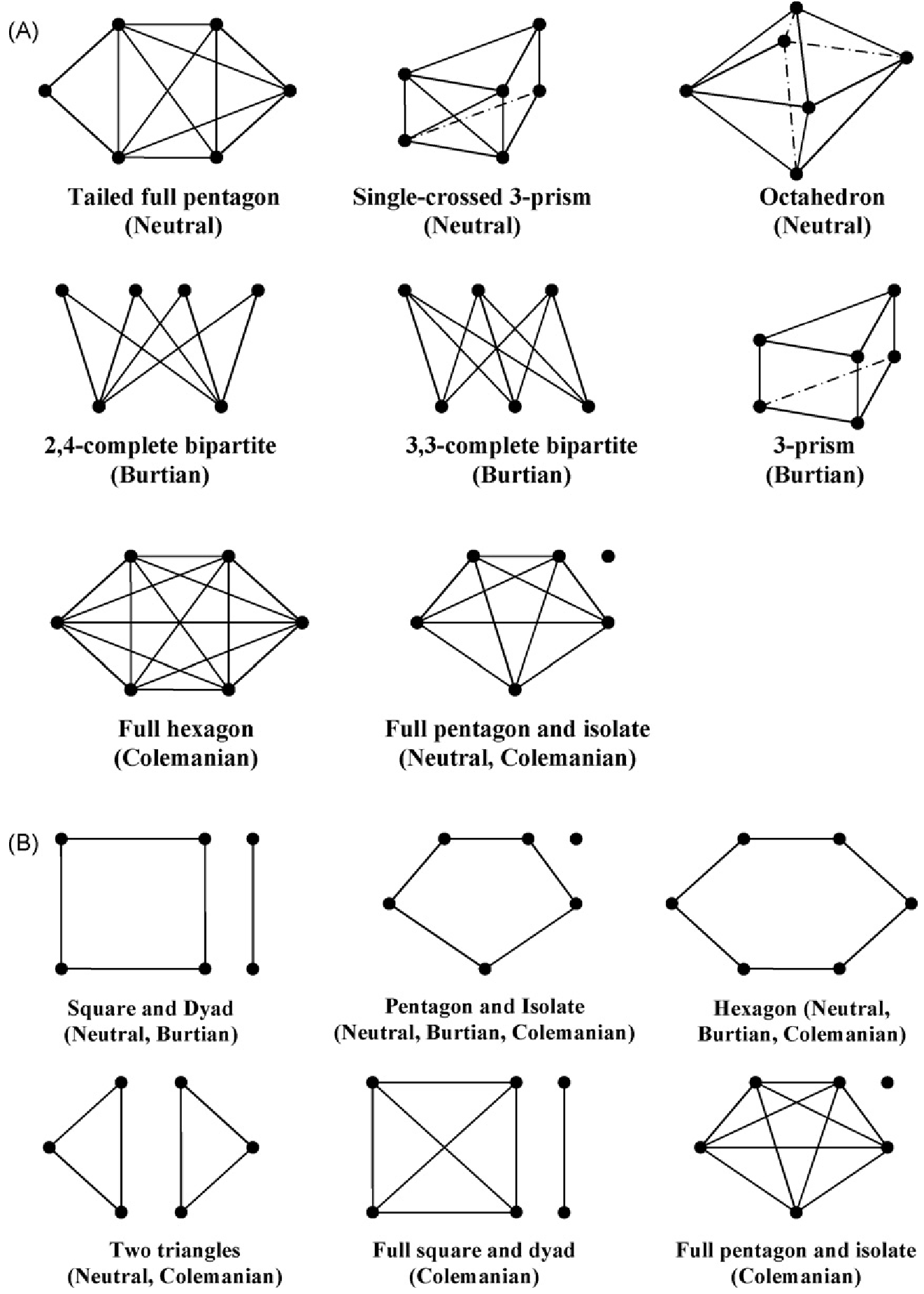 Above: The variety of stable structures discovered across different constraints and contexts.
Experimental Insights: Humans vs. Machines
The researchers ran 162 trials with 108 students. The results were striking:
- Context is King: In the Burtian context, networks were sparse. In Colemanian, they were dense cliques.
- Unintended Consequences: Complex traits like "centralization" and "segmentation" emerged naturally as byproducts of simple utility-seeking.
- The Fairness Bias: This is the paper's most "PhD-level" insight. While computer simulations predicted a wide spread of stable networks, humans converged on Equal and Efficient networks almost every time.
 The table shows that "Dominant" networks in experiments were almost always those where payoffs were both high and distributed evenly.
Critical Analysis & Takeaways
The study successfully bridges the gap between abstract game theory and messy human behavior. It proves that Pairwise Stability is a robust predictor, but it's incomplete without accounting for human Preferences for Equality.
Limitations: The networks were small (6 people). In the real world, "indirect brokerage" (who your friends' friends know) matters immensely. Furthermore, the study assumes all actors are identical, whereas real networks are driven by heterogeneity—some people are naturally "social butterflies," while others are introverts.
Future Outlook: For AI researchers, this provides a blueprint for "socially aware" agents. If we want multi-agent systems to mirror human society, we must program them not just for raw utility, but for the "Efficiency + Equality" heuristic found here.