
Beyond Passive Reception: How Social Curiosity Fuels Information Outbreaks
The Impact of Social Curiosity on Information Spreading on Networks
This paper introduces a novel information propagation model by integrating a dynamic social curiosity mechanism into the classical Susceptible-Spreader-Stifler (SIR) framework. The core finding is that social curiosity significantly accelerates spreading and increases final informed densities, particularly in spatial networks compared to online social networks.
TL;DR
Why did Pokémon GO become a global obsession in days? Standard epidemic models can't fully explain it because they ignore Social Curiosity. This paper proposes a dynamic SIR model where "curiosity" acts as a susceptible-centric force, showing that when individuals actively seek out information because their friends have it, spreading efficiency can double—especially in spatial networks like road maps.
Context: The Missing Psychological Variable
In classical Network Science, we treat information like a virus: it's something that "happens" to you when you come into contact with a "spreader." This passive view ignores human agency. In reality, humans are curious; if five of your friends are playing a new game, you don't just wait to be "infected"—you go looking for it.
The authors argue that "Openness to experience" is a critical driver of the "early adopter" phenomenon. By ignoring this, current SOTA models (SIR, IC) underestimate the speed and reach of modern viral trends.
Methodology: Modeling the "Pull" of Curiosity
The researchers introduce a dynamic parameter, Curiosity Strength (). Unlike the static infection rate (), represents the probability that a susceptible node i asks a neighbor for information.
The Formula of Interest
At the Mean-Field level, the probability of a susceptible vertex getting informed becomes:
Here, the term represents the additional pathway to infection created by the individual's own curiosity. If you are curious (), there are two ways to get the news: they tell you (), or you ask them ().
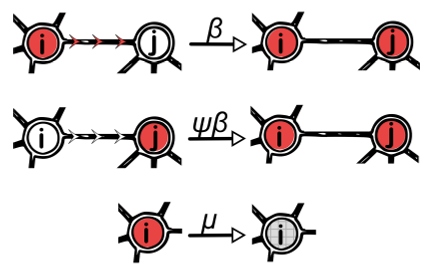 Fig 1: The dual pathway—traditional spreading (top) vs. curiosity-driven seeking (middle).
Experimental Insights: Networks Matter
The authors tested this on artificial models (BA, ER, SSF) and real-world datasets (Google+, Facebook, USAroad).
- The Phase Transition Shift: Curiosity lowers the epidemic threshold (). In "Utopian" cases where everyone is 100% curious, the threshold for a global outbreak is essentially halved.
- Peak Intensity: Curiosity doesn't just make the spread wider; it makes it sharper. The "peak of spreaders" is significantly higher and reached faster compared to non-curiosity models.
- Spatial vs. Social: Interestingly, curiosity has a larger impact on spatial networks (like road maps) than on social networks. Why? Social networks are already "Small Worlds" where information travels easily via hubs. In spatial networks, where connections are limited by geography, curiosity acts as a vital bridge that helps information jump across local clusters.
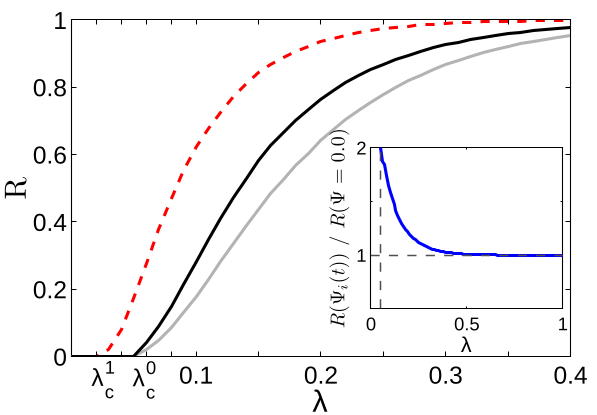 Fig 2: Comparison of informed densities across different network topologies. The insets show the "Curiosity Gain"—the ratio of informed people with vs. without curiosity.
Analytical Validation: Mean-Field Accuracy
The paper doesn't just rely on simulations. They provide a Mean-Field approach that matches Monte Carlo results with high precision. They derive an analytical solution for the final density of stiflers (), proving that: This elegant relation shows that a fully curious population spreads information as if the infectivity were exponentially boosted.
Critical Analysis & Future Outlook
Takeaway for Practitioners
For viral marketers or public health officials, the "sweet spot" for triggering curiosity is just above the transition point. Below this point, curiosity isn't enough to start a fire; far above it, the "virus" spreads so easily that curiosity becomes redundant.
Limitations
- Uniform Curiosity: The Mean-Field approach assumes an average curiosity level. In reality, some individuals are "curiosity hubs" while others are indifferent.
- Content Neutrality: The model assumes curiosity is driven by quantity (how many friends know) rather than quality (what the information actually is).
Future Work
The next step in this research lineage would be to investigate content-aware curiosity—where the specific topic (politics vs. entertainment) interacts with an individual's specific personality profile to create heterogeneous "curiosity landscapes" across a network.