
Beyond Accuracy: Leveraging Social Curiosity to Break the Recommendation Bubble
A Social Curiosity Inspired Recommendation Model to Improve Precision, Coverage and Diversity
The paper introduces a Social Curiosity-inspired Recommendation model (SC) that leverages the psychological theory of social curiosity—the desire to acquire information about unexpected behaviors of others. By integrating Matrix Factorization with a "surprise" mechanism from social circles, it achieves SOTA performance in precision, coverage, and diversity.
TL;DR
Most recommender systems tell you what you already know. This paper introduces a Social Curiosity-inspired model that identifies "surprising" behaviors from your friends to trigger your innate curiosity. By balancing what you like (Preference) with what surprises you (Curiosity), the model significantly boosts recommendation Precision, Coverage, and Diversity on large-scale datasets like Douban and Flixster.
Context & Motivation: The "Obviousness" Trap
In the current landscape of Social Recommendation, the common wisdom is: "If your friend likes it, you might like it too." While this improves rating accuracy, it often leads to a "filter bubble." You are recommended popular items you've already heard of, or items so similar to your history that there's no incentive to explore.
The authors argue that Interestingness is driven by Curiosity, which is sparked by Unexpectedness. In a social context, if a friend who usually hates horror movies suddenly gives a 5-star rating to "House of Wax," you become curious. Why did they like it? This "Social Curiosity" is a powerful, underutilized signal for discovery.
Methodology: Quantifying the "Surprise"
The proposed model follows a two-pillar architecture: User Preference and User Curiosity.
1. Modeling User Preference
The system uses standard Matrix Factorization (MF) to predict a baseline rating . This represents the "safe" choice—what the user is expected to like based on historical patterns.
2. Modeling Social Curiosity (The "Innovation")
This is the core contribution. Surprise is defined as the gap between a friend's actual rating and their expected rating (the "pseudo-predicted" rating).
- Positive Surprise: Occurs only when a friend gives a rating much higher than predicted.
- Surprise Correlation (): Measures how much user reacts to user 's surprises based on historical alignment.
3. Strategy for Aggregation
When multiple friends have "surprising" experiences with the same item, the model uses three strategies:
- SC_Min (Conservative): Takes the minimum curiosity response.
- SC_Ave (Average): The middle ground.
- SC_Max (Bold): Takes the maximum curiosity signal.
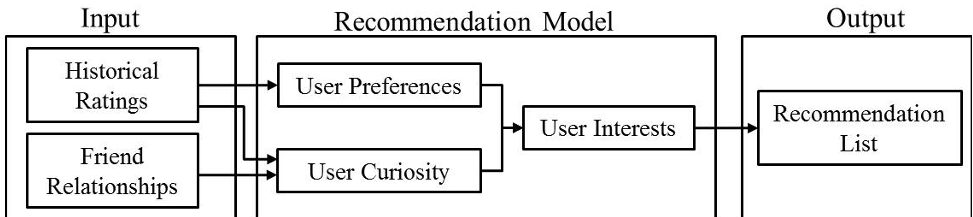 Figure 2: The overview of the proposed recommendation model blending Preference and Curiosity.
Experiments & Deep Insights
The authors tested their model against baseline MF and various popularity-based ranking methods (PopR, AbsLikeR).
Performance Breakthrough
On the Douban dataset, the Precision of social curiosity methods was found to be two orders of magnitude higher than the baseline. This suggests that "curious" items are much more likely to be actually clicked or rated by users in the test set than "predicted" items.
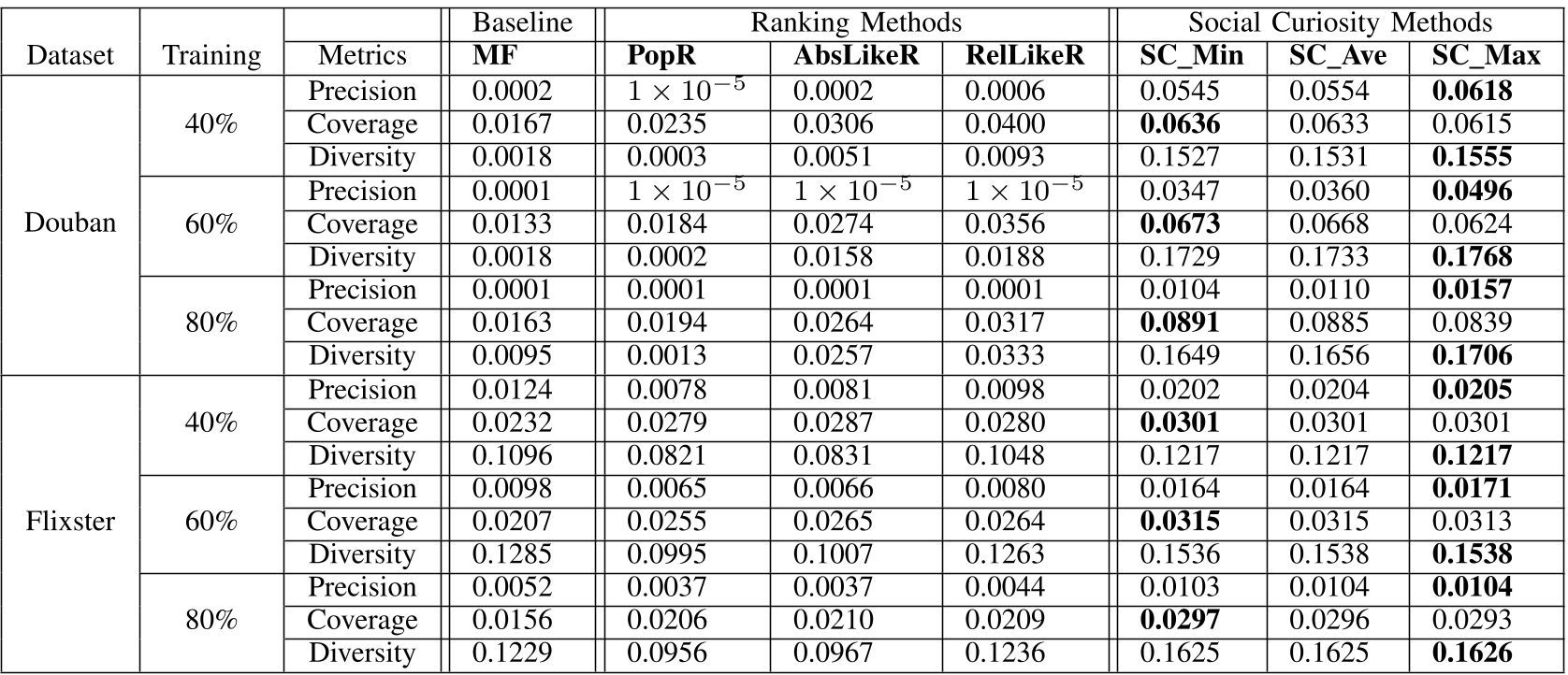 Table 1: Performance comparison across Douban and Flixster datasets.
The Trade-off: Precision vs. Coverage
The "Bold" strategy (SC_Max) consistently achieved the highest Precision and Diversity. Because it chases the strongest surprise signals, it effectively pulls users toward idiosyncratic items. Conversely, SC_Min (Conservative) achieved higher Coverage, as it doesn't over-rely on a few highly surprising "star" items.
The Impact of Social Degree
As shown in the charts below, the model's effectiveness scales with the user's social circle size. For users with more friends (higher degree), the "Social Curiosity" signal becomes even more robust, whereas traditional MF performance stays flat.
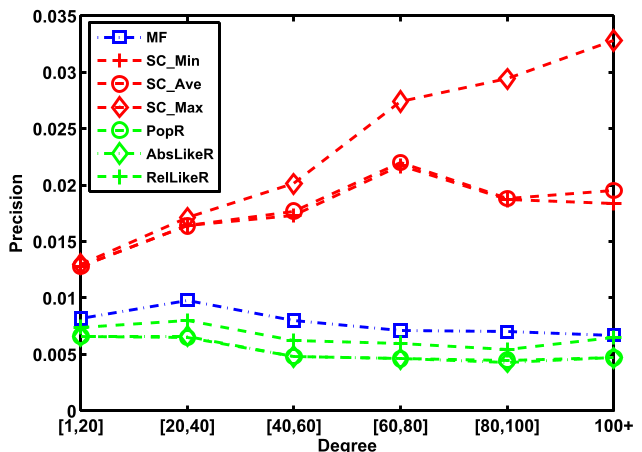 Figure 4: Resilience and growth of Precision across different user social degrees.
Critical Analysis & Takeaways
- Human-Centric AI: This paper is a great example of translating a psychological phenomenon (Social Curiosity) into a mathematical constraint.
- Long-tail Value: By prioritizing "surprises," the model naturally avoids the popularity bias, helping "long-tail" items surface and increasing the overall coverage of the catalog.
- Limitations: The model relies on the existence of explicit ratings. In modern apps where "likes" or "clicks" are more common, the definition of "surprise" might need to be adapted to implicit feedback.
Final Conclusion: If you want your users to stay engaged, don't just give them what they like—give them what their friends surprisingly liked.