
Unmasking Digital Puppeteers: The Power of Social Cyber Forensics (SCF)
Social cyber forensics: leveraging open source information and social network analysis to advance cyber security informatics
The paper introduces Social Cyber Forensics (SCF), a framework that integrates social network analysis and open-source intelligence (OSINT) to identify hidden relationships among Online Deviant Groups (ODGs). It specifically showcases the use of the Maltego tool to map cross-media affiliations and track cyber propaganda campaigns targeting NATO forces.
TL;DR
Cyber propaganda is no longer confined to single accounts; it is a multi-platform ecosystem. This paper formalizes Social Cyber Forensics (SCF), a method to unmask the hidden infrastructure of Online Deviant Groups (ODGs) using social metadata and network analysis. By moving beyond text analysis to Web Tracker Codes (WTC) and Focal Structure Analysis, the researchers successfully de-anonymized complex propaganda networks targeting NATO military exercises.
The Motivation: Why Monitoring Words Isn't Enough
Most digital forensics tools were born in the era of "dead disks"—analyzing hard drives and file systems. However, modern influence operations exist in the Latent Space of Social Affiliations.
The authors identified a critical gap: Online Deviant Groups (ODGs) often operate "bridge blogs" and botnets that appear independent to avoid detection. Traditional sentiment analysis tells us what they are saying, but it fails to prove coordination. The researchers' intuition was that even the most careful actors leave technical "breadcrumbs" in their website metadata and social following patterns.
Methodology: The "Seed and Pivot" Strategy
The core of the SCF methodology lies in the use of Maltego, an OSINT tool that allows for "pivoting" between different types of technical entities.
The methodology follows a specific logic flow:
- The Seed: Start with a known Twitter handle or a blog URL.
- Metadata Pivot: Extract Web Tracker Codes (WTC) like Google Analytics (UA-XXXXX) or AdSense IDs. Because one person often manages multiple sites under one analytics account, these IDs act as a digital fingerprint.
- Infrastructure Mapping: Transform these IDs back into a list of other websites sharing the same code.
- Social Convergence: Layer on Social Network Analysis (SNA) to see how these newly discovered sites are promoted by botnets.
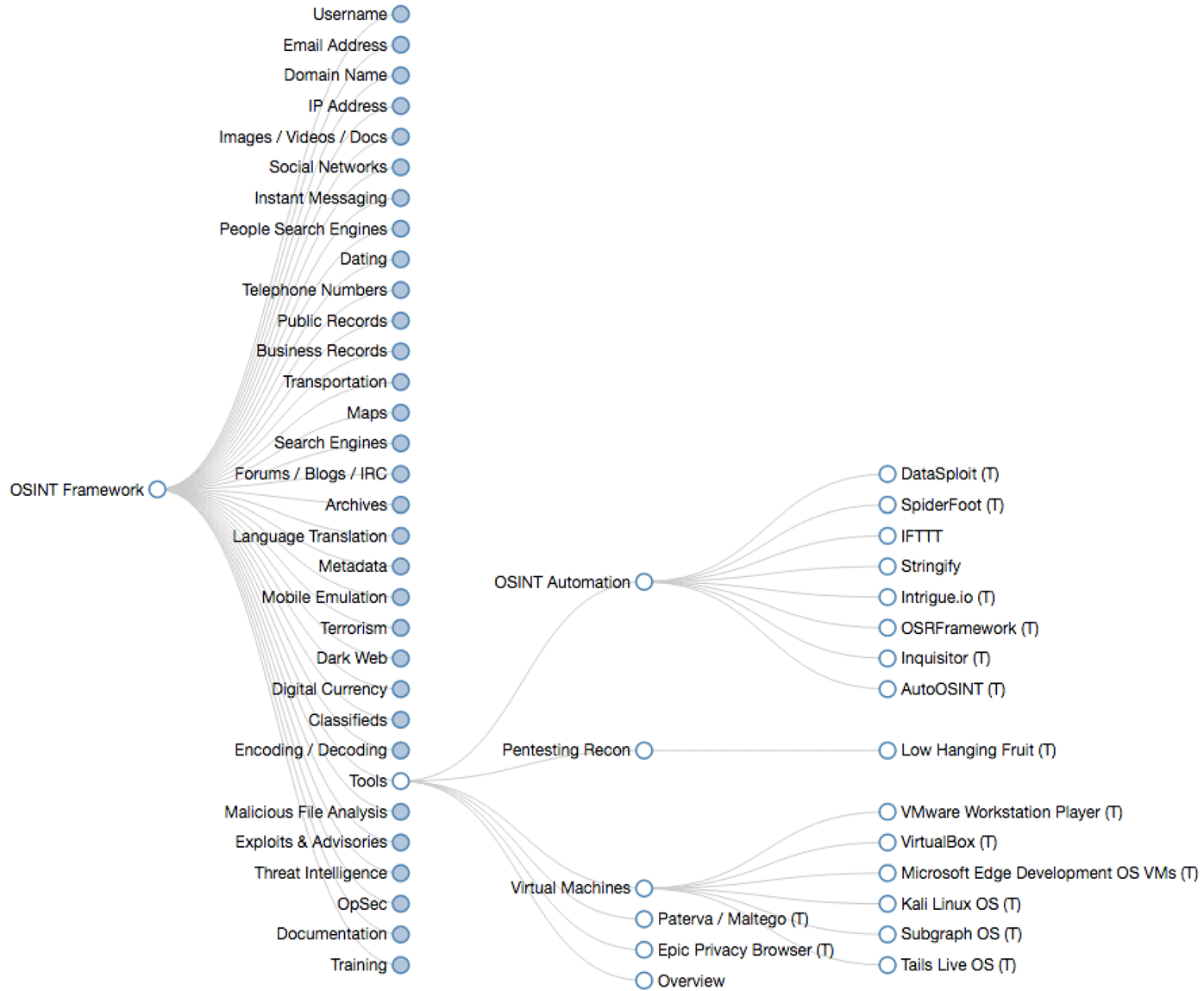 Figure: The technical pipeline for transforming social handles into physical infrastructure footprints.
Real-World Battlefield: NATO Trident Juncture 2015
During the NATO Trident Juncture exercise, a campaign of "offensive memes" and misinformation attempted to delegitimize the military operation. Using SCF, the authors didn't just find the tweets; they mapped the entire Anti-NATO propagation engine.
Key Finding: The Bridge Blog Network
By analyzing tracking codes, the researchers discovered that a single entity was running 21 different blogs. These blogs were "Bridge Blogs"—identical content translated into different regional languages to give the illusion of a local, grassroots "organic" protest.
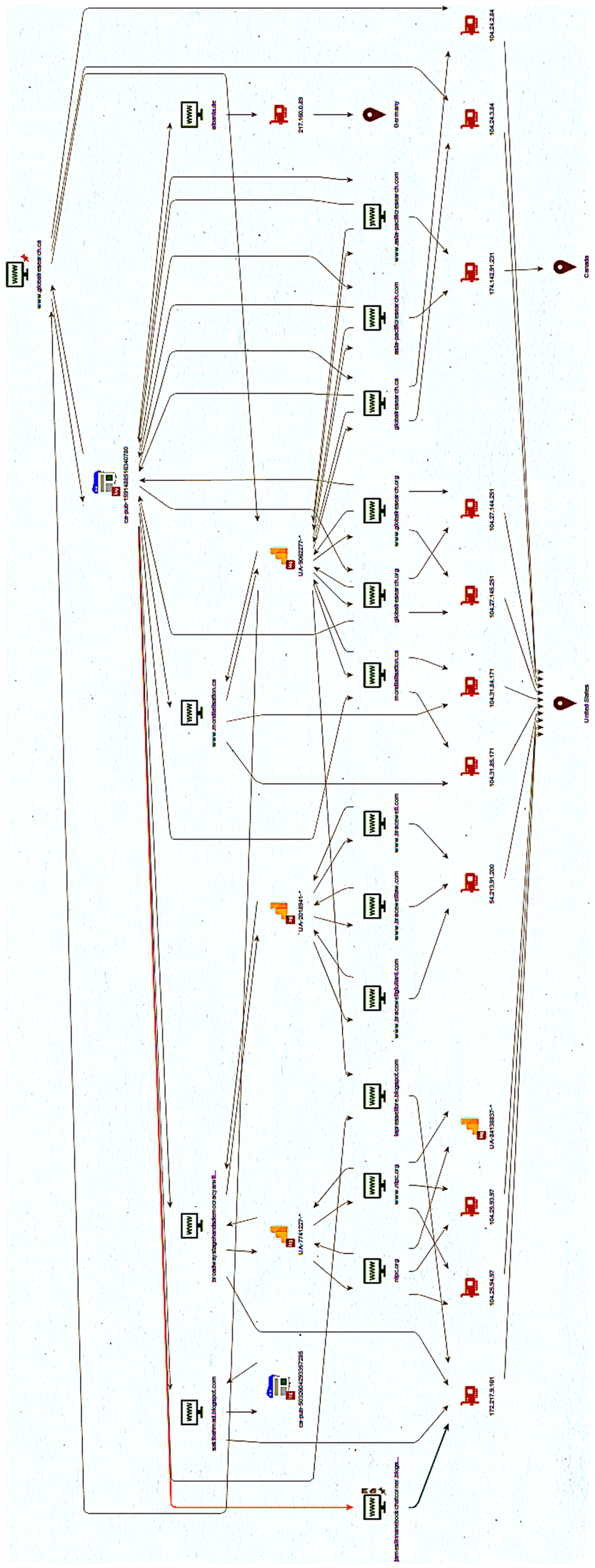 Figure: Maltego visualization showing how a single Twitter account pivots to various websites and underlying server IP addresses.
From Networks to Forensics: Focal Structure Analysis (FSA)
One of the most sophisticated parts of this research is the use of Focal Structure Analysis (FSA). In many botnets, there is no "Kingpin" (a central node with high degree centrality). Instead, they operate as a Syndicate.
FSA allows investigators to find groups of nodes that are "densely connected" and act in coordination, even if no single node stands out. During the Dragoon Ride exercise, this revealed a "Follow Me and I Follow You" (FMIFY) structure, where 90+ bots were systematically inflating each other’s influence to bypass Twitter's spam filters.
Critical Analysis & Future Outlook
Summarizing the Impact: This paper moves cyber security from "passive monitoring" to "active forensic investigation." The ability to link a Twitter bot to a specific Google Analytics ID is a "smoking gun" that proves intent and organization.
Limitations:
- Adversarial Adaptation: Sophisticated state actors are now aware of WTC tracking and are moving toward "one-time-use" analytics IDs or removing trackers entirely.
- Privacy Concerns: The line between "forensic investigation" and "open-source surveillance" is thin, necessitating a clear ethical framework for how these tools are used by government agencies.
Conclusion: Social Cyber Forensics represents the next frontier in information warfare. As we move toward an era of AI-generated misinformation, the technical "fingerprints" left in the website infrastructure may be the only way to distinguish human-driven dissent from machine-driven propaganda.