
CSAR: Redefining Social-Aware Routing via Hybrid Metrics and Community Evolution
On Social Delay-Tolerant Networking: Aggregation, Tie Detection, and Routing
This paper introduces CSAR (Connection Strength Aware Routing), a comprehensive social-aware routing framework for Delay-Tolerant Networks (DTNs). It leverages a novel hybrid connection metric, a Distributed Community Detection Algorithm (DCDA) capable of capturing community evolution, and a bridge node identification mechanism to significantly optimize message forwarding.
TL;DR
In the world of Delay-Tolerant Networks (DTNs), where "carry-and-forward" is the law of the land, routing efficiency hinges on predicting human social patterns. This paper introduces CSAR, a protocol that builds a superior social graph using a hybrid metric of contact frequency and duration. Unlike its predecessors, it dynamically tracks how communities form and split, utilizing "bridge nodes" to leapfrog data across social clusters, achieving a 50% boost in delivery ratio over established baselines.
Problem & Motivation: Beyond Simple Contacts
Traditional DTN routing protocols like Epidemic are resource-intensive "flooders." Social-aware protocols (e.g., BubbleRap) improved this by using social structures, but they suffer from three major flaws:
- Metric Myopia: They often use either contact frequency or duration. As shown in the authors' analysis, frequency ignores long-lasting "occasional" meetings, while duration ignores frequent "brief" encounters.
- Static Community Assumption: Most algorithms detect when a community forms but ignore evolution—what happens when a node leaves a group?
- The Priority Problem: In a brief encounter, which of the 100 messages in your buffer should you send first? Most existing work just picks at random.
Methodology: The Three Pillars of CSAR
1. The Hybrid Connection Metric
The authors propose a hybrid metric () that balances frequency and duration: This formula allows the network to adapt to different environments (e.g., a conference where people meet briefly vs. an office where they sit together for hours).
2. DCDA: Capturing Community Evolution
CSAR doesn't just look for "cliques"; it calculates intra-connection density () vs. inter-connection density (). Crucially, the Distributed Community Detection Algorithm (DCDA) includes a "Partition" mechanism. If an edge is removed and the density drops, the community is restructured or disbanded, ensuring the routing table isn't filled with "ghost" social ties.
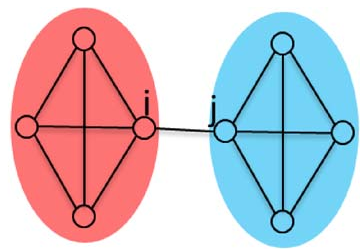 Fig 1: Illustrative cases of how communities dynamically form and merge based on edge density.
3. Routing Strategy: CSAR
The routing engine uses three clever tactics:
- Forwarding Order: Messages are sorted by "utility gain" (). Nodes prioritize messages that see the biggest jump in connection strength toward the destination.
- Bridge Node Identification: Using a "Weighted Bridging Centrality," nodes identify themselves as vital links between social clusters.
- Mixed Copy Policy: To save energy, CSAR uses multi-copy when a message is searching for the destination's community (inter-community) and switches to single-copy once it arrives "in the neighborhood" (intra-community).
Experiments & results
The researchers tested CSAR against BubbleRap, PeopleRank, and Epidemic using famous real-world datasets like Infocom06 and MIT Reality Mining.
- Delivery Ratio: CSAR consistently outperformed social baselines, coming closest to the theoretical maximum of the Epidemic protocol.
- Overhead: CSAR achieved significantly lower overhead (up to 29% less than PeopleRank), proving that targeted "bridge" forwarding is more efficient than blind replication.
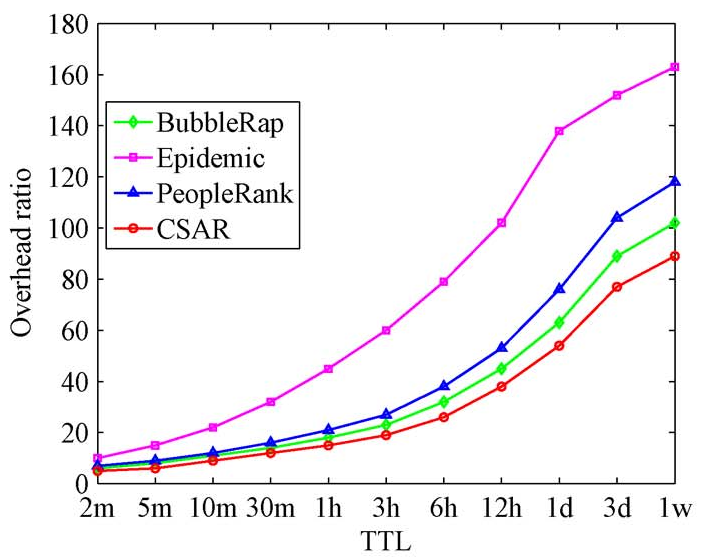 Fig 2: Performance comparison across different datasets. CSAR (red line) maintains a dominant lead over other social-aware protocols.
Critical Analysis & Conclusion
The true value of this work lies in its holistic view of the social graph. By acknowledging that social ties are weighted and dynamic, CSAR moves DTN routing from "best-guess" heuristics to a more rigorous, topology-aware science.
Limitations: The parameter (weighting frequency vs. duration) is currently tuned empirically. Future work could benefit from an automated, adaptive that changes based on local node density or historical entropy.
Final Takeaway: For anyone building opportunistic networks—be it for disaster recovery or peripheral computing—this paper proves that precision in social modeling is the best way to bypass the bandwidth bottlenecks of intermittent connectivity.