
Social Devices: Balancing Proactive Surprise with User Control in Co-located Interactions
Exploring usage scenarios on social devices: balancing between surprise and user control
The paper introduces "Social Devices," a framework where mobile phones act as proactive agents using natural language to trigger face-to-face interactions between co-located users. By conducting bodystorming and lab studies with 39 participants, the authors explore novel usage scenarios and establish a design balance between proactive "surprising" social effects and necessary user control.
TL;DR
Is your smartphone making you more social or more isolated? While most social tech connects us to people miles away, this paper explores Social Devices—smartphones that use natural language to act as proactive social agents, "talking" to each other to spark conversations between people in the same room. Through bodystorming and lab sessions, the authors identify a critical design tension: users love the surprise of discovering shared interests but fear the social risk of a device that speaks out of turn.
Problem & Motivation: The Local Social Gap
Current mobile devices are primarily windows to the remote. We use them to text friends across the city but rarely to interact with the person sitting at the next table in a cafe. The authors argue that while technology has become "calm" and invisible (following Mark Weiser's vision), it has lost the ability to be engaging and explicit.
The core research intuition is that smartphones—packed with sensors and social data—can act as "Social Devices." By proactively triggering interactions based on proximity (Proxemics), they can serve as icebreakers, lowering the social barrier to starting a conversation with a stranger or deepening an interaction with a friend.
Methodology: Bodystorming the Future
To explore this uncharted territory, the researchers didn't just ask questions; they used Bodystorming. Participants role-played scenarios where they acted as both themselves and their devices.
1. The Social Device Concept
The system utilizes:
- Proximity Services: Actions triggered when devices are nearby.
- Natural Language Interaction: Using speech synthesis to make the interaction "audible" and "socially embedded."
- Proactivity: Devices initiating actions (e.g., a phone saying, "Hey, both of you like the same indie band!") rather than waiting for a command.
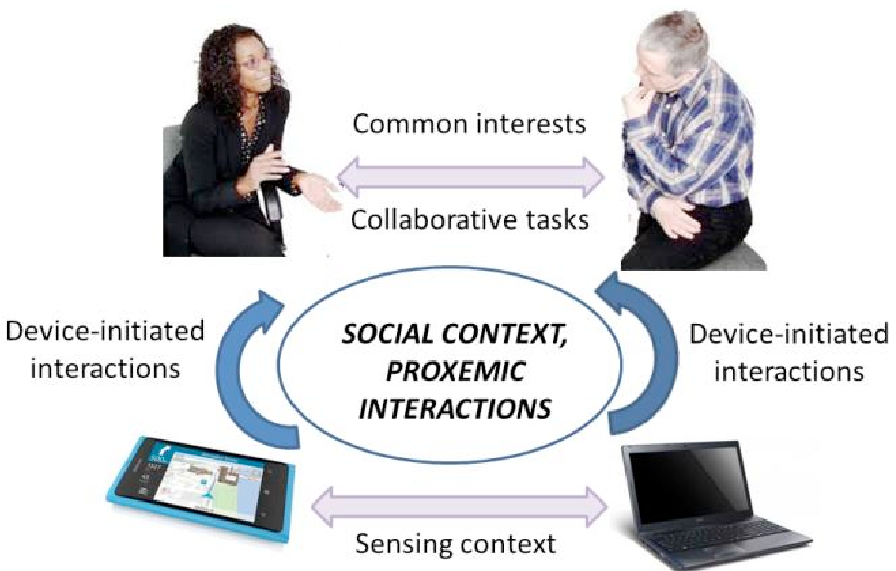 Figure 1: The Basic Concept of Social Devices - Devices communicating to facilitate human interaction.
2. Experimental Setup
The study involved 39 participants across:
- Phase 1: Bodystorming in home and pub-like environments.
- Phase 2: Lab evaluations of functional prototypes, including a "Car Game" where users had to shout to move digital cars, testing the limits of social embarrassment and proactivity.
Experiments & Results: The "Price" of Proactivity
The study yielded 25 novel usage scenarios. The most popular ones involved shared discovery—the device acting as a "human-like" character that offers useful tidbits.
Key Findings:
- The Best Scenarios: Users loved when devices answered questions mid-conversation (Scenario 1.1) or alerted them to friends nearby (Scenario 2.1).
- The Embarrassment Factor: While games like the "Car Game" were fun, they were rated as socially "embarrassing" due to the loud volume required.
- The Privacy Paradox: Users expressed high anxiety about "Social Risk." For example, a phone reading Facebook updates out loud in front of a boss was a major concern.
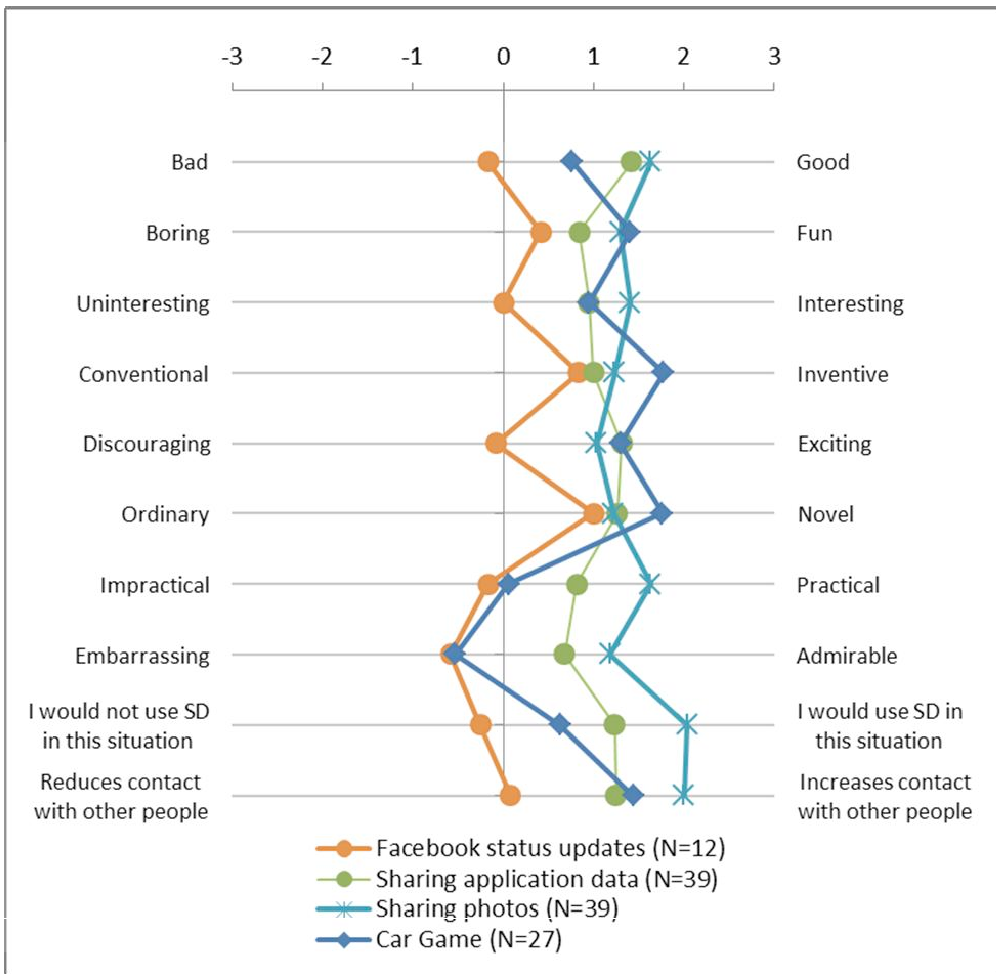 Figure 2: Semantic differential evaluations showing the trade-off between "Fun/Social" and "Professional/Practical" traits across prototypes.
Deep Insights: Five Design Implications
The authors distilled their findings into five mandates for future "Social Device" designers:
- Define Social Risk: Implement a hierarchy of autonomy based on how sensitive the information is.
- Purposeful Speech: Keep device-to-device "chatter" brief. Humans don't want to wait for two robots to finish talking.
- Postponable Actions: Give users a "Snooze" or "Log" function to revisit social triggers later when it's more convenient.
- Contextual Modes: Move beyond "Silent" vs. "Loud." Devices need "Work," "Leisure," and even "Mood" modes (e.g., "Unsociable" or "Open for experiences").
- Polite Interruptions: Use subtle cues (vibration/whispering) before going full "public speaker" mode.
Critical Analysis & Conclusion
This work provides a foundational look at Proxemic Interaction. The takeaway is clear: while proactivity is what makes a device "smart," it is also what makes it "dangerous" in a social context.
Limitations: The study used mid-to-low fidelity prototypes. In a modern era of LLMs (like GPT-4o-voice), the "speech" aspect would be much more natural, yet the Social Risk identified by the authors in 2013 remains the primary hurdle for proactive AI today.
Future Outlook: As we move toward AI wearables (like the Rabbit R1 or Humane Pin), the tension between "Surprise" and "User Control" will be the battleground for user adoption. The "Work vs. Leisure" mode suggested here is more relevant today than ever.