
Beyond Visuals: Leveraging Social Diffusion for Accurate Image Annotation
3644_Social Diffusion Analysis With Common-Interest Model for Image Annotation.
This paper proposes a social diffusion analysis framework for automatic image annotation by exploiting how images spread through online social networks. Using a novel "Common-Interest Model," the method links image diffusion patterns to the shared preferences of pairwise users, significantly outperforming traditional content-based and individual-interest methods.
TL;DR
Researchers have moved past the pixels to solve the "semantic gap" in image tagging. By analyzing how images travel through social networks and modeling the common interests between users, this paper introduces a framework that predicts both content-related and abstract tags (like camera brands or aesthetic awards) more accurately than traditional Computer Vision or individual-interest models.
Context: The Semantic Gap and the Metadata Dilemma
For decades, automatic image annotation has been a battleground of content-based analysis. However, Computer Vision often hits a wall: the semantic gap. While a model might recognize a "cat," it can rarely infer that a photo was taken with a "Canon EOS" or that it belongs in a "Gold Star Award" group simply by looking at the pixels.
Existing social-tagging methods attempted to use individual user interests, but these are notoriously noisy. This paper argues that the "Why" of an image's journey—its social diffusion—is the missing key. If Alice shares a photo and Bob re-shares it, it's likely because of a specific shared interest that corresponds to the image's hidden attributes.
Methodology: The Common-Interest Model
The core innovation lies in the Common-Interest Model. Instead of looking at what Alice likes in isolation, the authors look at the overlap between Alice and Bob.
1. Learning Common Interests
The authors formulate the learning of common-interest vectors as an optimization problem. They use the Bregman Divergence (specifically the Itakura-Saito distance) to measure the distance between common interests and image labels.
A critical addition is the Triple-Constraint. If we know the common interests between (Alice, Carol) and (Bob, Carol), we can mathematically constrain and refine our estimate of the interests between (Alice, Bob).
2. From Diffusion Graphs to Features
Each image creates a "Diffusion Graph." By applying the learned common-interest vectors, the authors split this graph into tag-specific subgraphs. They then extract:
- Diffusion Features: Measuring the range and weight (strength) of the spread.
- Structure Features: Identifying "Triangle Structures" and "Hub" users (in/out-degree) within the social community.
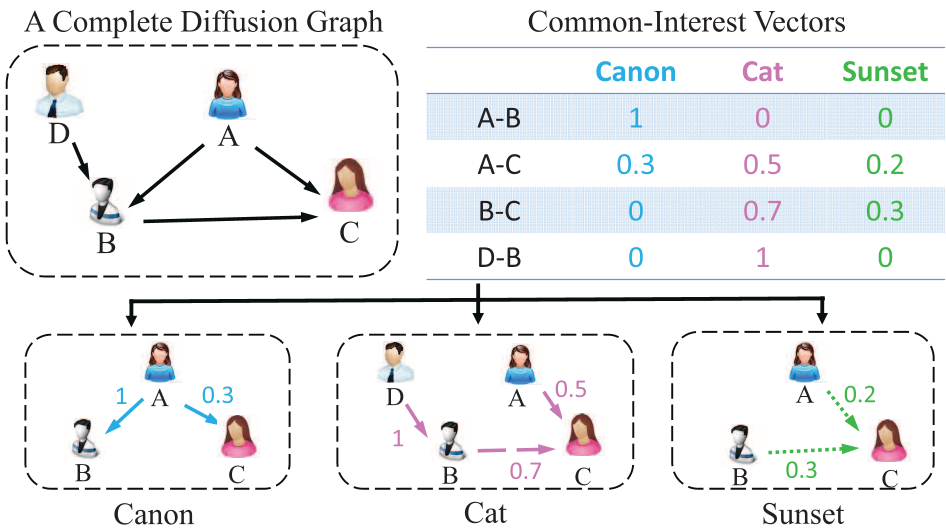 Figure 1: The proposed Social Diffusion-based Image Annotation Framework.
Experiments: Superiority Over Visual Models
The authors tested their approach (CIA) against Linear Distance Coding (LDC)—a heavy-hitter in visual content analysis—and Tag Voting (TV).
Key Findings:
- Indirect Tags: For concepts like camera models or aesthetic labels, CIA crushed the competition, achieving over 40% improvement in F1-score compared to visual-only models.
- Direct Tags: Even for "Sky" or "Cat," CIA performed comparably to content-based methods, proving that social behavior is a strong proxy for visual content.
- Niche Interests: CIA was significantly better at recalling low-frequency tags, thanks to its ability to model "niche" common interests that are often lost in general popularity models.
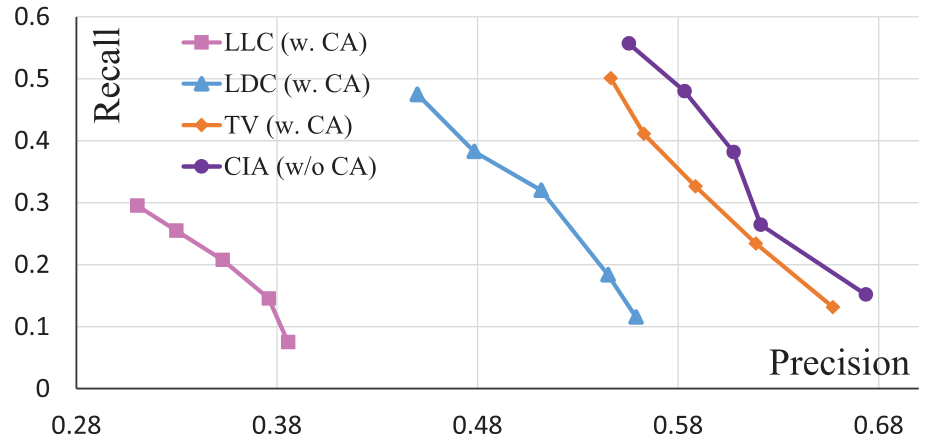 Figure 2: Precision-Recall curves showing CIA's dominance in indirectly content-related tags.
Critical Insight: Social Intelligence as the New Frontier
This work demonstrates that social networks are not just platforms for consumption; they are massive, decentralized labeling machines. The way an image "flows" through a network is a high-dimensional signal of its content and context.
Limitations: The primary hurdle is the "Cold Start" problem. If an image hasn't been shared enough (less than 50 edges in this study), the diffusion signal is too weak. Therefore, the future of image annotation likely lies in a Hybrid Model: using Computer Vision for the first 5 minutes of an image's life and Social Diffusion Analysis as it gains viral momentum.
Conclusion
By shifting the focus from "what is in the image" to "who is sharing the image and why," this paper provides a robust blueprint for the next generation of recommendation and retrieval systems. The concept of Common Interests provides a cleaner, more mathematically stable foundation for user profiling than individual history ever could.