
SIoV: Giving Vehicles a Social Life to Solve the VANET Scalability Problem
On adding the social dimension to the Internet of Vehicles: Friendship and middleware
This paper introduces the Social Internet of Vehicles (SIoV), an integration of Vehicular Ad-hoc NETworks (VANETs) with the Social Internet of Things (SIoT) paradigm. It proposes a novel middleware that extends the ETSI/ISO Intelligent Transportation Systems Station Architecture (ITS SA) to enable autonomous social relationship establishment among vehicles and infrastructure for improved service discovery and trust.
TL;DR
The Social Internet of Vehicles (SIoV) transforms cars from simple message routers into social agents. By establishing autonomous "friendships" based on common routes and manufacturers, vehicles can navigate a massive network to find trustworthy services and traffic data far more efficiently than traditional ad-hoc routing allows.
Problem & Motivation: The Navigability Crisis
In a typical Vehicular Ad-hoc Network (VANET), nodes move at high speeds, and topology changes every second. For a driver looking for a petrol station or a reliable accident report, the sheer volume of heterogeneous data is overwhelming.
The Pain Point: Existing systems treat every vehicle as a stranger. This leads to:
- Discovery Difficulty: How do you find the right node for a service in a sea of 10,000 cars?
- Trust Issues: Without a historical relationship, why should a vehicle trust the traffic data broadcast by a random passerby?
The authors suggest that by applying Social Internet of Things (SIoT) principles, we can create a persistent "overlay" network of friendships that mirrors human social trust, making the network "navigable."
Methodology: The Architecture of Vehicular Friendships
The core innovation lies in the classification of relationships and the middleware required to manage them.
1. The Three Pillars of SIoV Relationships
- Parental Object Relationship (POR): Built-in "kinship" between vehicles of the same brand and production period. Used for sharing diagnostic and maintenance insights.
- Social Object Relationship (SOR): Established through repeated V2V encounters. If two cars take the same commute every morning, they become "friends," increasing the weight of the information they exchange.
- Co-Work Object Relationship (CWOR): Formed between vehicles and Road Side Units (RSUs) that interact regularly to provide traffic management.
2. Middleware: Extending the ITS Standard
The researchers didn't just propose a theory; they mapped it to the ISO/ETSI Intelligent Transportation Systems Station Architecture (ITS SA).
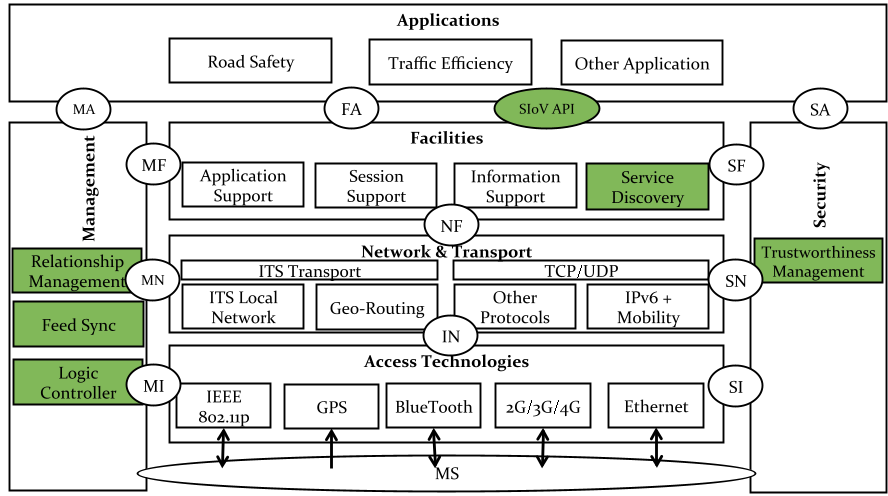
Key additions to the standard stack include:
- Management Pane: Handles "Relationship Management" (deciding who is a friend based on owner rules) and "Feed Sync."
- Security Pane: A "Trustworthiness Management" module that calculates reliability scores based on a friend's past behavior.
- Facilities Layer: "Service Discovery" logic that crawls the social graph to find specific resources.
Experimental Results: Is the Social Graph Connected?
Using SUMO (Simulation of Urban MObility) with realistic traces from the city of Cologne, the team analyzed whether these "friendships" actually form a functional network.
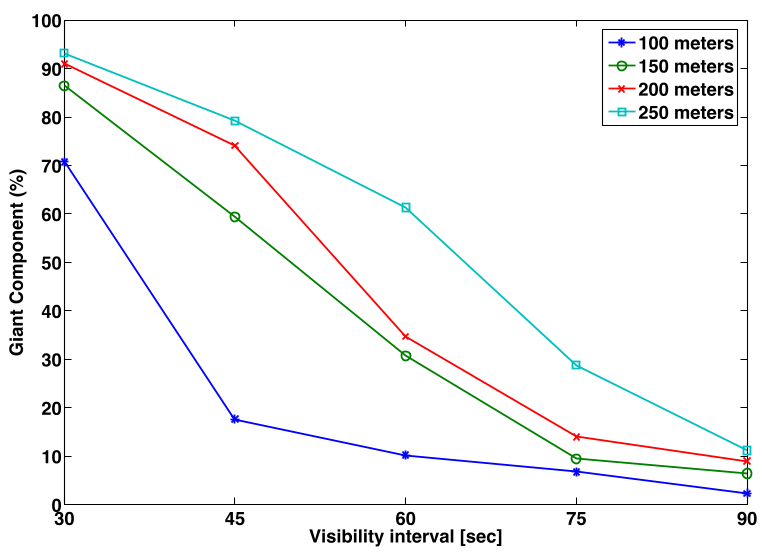
The study focused on SOR (Social Object Relationships). The graph above shows the "Giant Component"—the largest connected group of nodes.
- Insight: Even with high mobility, a significant portion of the network remains connected through social links if the visibility range is at least 150m.
- Efficiency: Unlike pure ad-hoc flooding, a SIoV-enabled vehicle can "crawl" its friend list to reach a destination, significantly reducing network overhead.
Critical Analysis & Future Outlook
Takeaway
The SIoV provides a structured way to handle the "identity" and "reputation" of moving objects. It effectively uses mobility as a feature rather than a bug; the more vehicles move and meet, the richer the social graph becomes.
Limitations
- Privacy Concerns: The paper focuses on functionality, but creating a social network of vehicles raises massive privacy questions regarding location tracking.
- Breadth of Data: The simulation only utilized SORs. Adding PORs (brand-specific) would likely make the network even more robust, but such data remains proprietary to manufacturers.
Future Work
The next frontier is integrating subjective trust models—where machines don't just connect, but learn to detect "malicious" friend requests or false traffic data autonomously.
Senior Editor's Note: This work is a foundational bridge between IoT sociality and vehicular engineering. It sets the stage for a future where your car doesn't just drive you; it "talks" to its friends to ensure you're taking the safest, most efficient path.