
SDHT: Bridging Social Context and DHT Efficiency for the Mobile Era
Social Distributed Hash Table Share and collaborate in your social network
This paper introduces the Social Distributed Hash Table (SDHT), a two-layer architecture combining the efficiency of DHT algorithms with social network graphs. It targets mobile environments to enable fast, context-aware content sharing across IMS and SIP-based systems.
TL;DR
Social Distributed Hash Table (SDHT) is a hybrid architecture designed to make mobile P2P content sharing feasible. By combining the deterministic routing of Distributed Hash Tables (DHT) with the trust and relevance of Social Networks, it sidesteps the bandwidth-heavy flooding of early P2P systems and the rigid "exact-match" limitations of standard DHTs.
Problem & Motivation: The Mobile P2P Paradox
In the mid-2000s, porting P2P (like BitTorrent or Kazaa) to mobile phones faced a "triple threat":
- Search Inefficiency: Flooding-based search destroys battery and data plans; DHT search is too rigid (no partial matches).
- Privacy: Users don't want to share private photos with the whole world, but only with friends/family.
- Churn: Mobile devices disconnect constantly, making standard P2P overlays unstable.
The authors observed that humans communicate in groups. Your call logs and SMS history already define a "Social Network." Why not use this human graph to route data?
Methodology: The Two-Layer Architecture
SDHT splits the network into two distinct functional planes:
1. The DHT Layer (Structural)
This layer consists of stable nodes (often super-nodes or Application Servers) that handle the heavy lifting of indexing.
- Mapping: User Identities (UIDs) like
sip:john@example.comare hashed into the DHT. - Persistence: Even if John's phone goes offline, the DHT node responsible for his hash keeps his resource metadata alive.
2. The Social Layer (Semantic)
This layer maps social ties (Friends, Family, "Foo Fan Club").
- Virtual Groups: Locally defined in your phonebook.
- Formal Groups: Managed via Group IDs (GIDs).
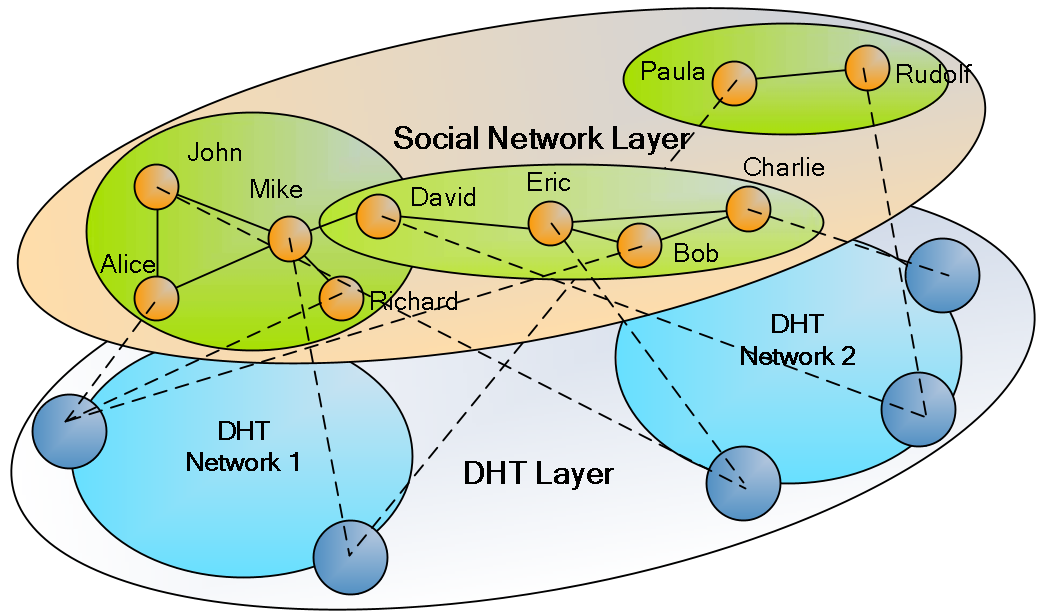
The Intuition: When you search, you don't ask the "entire world." You ask your social circle. If they don't have it, the system uses the hash table to find their friends’ nodes, creating a "controlled flood" that follows the path of social trust.
Implementation: SIP and IMS Integration
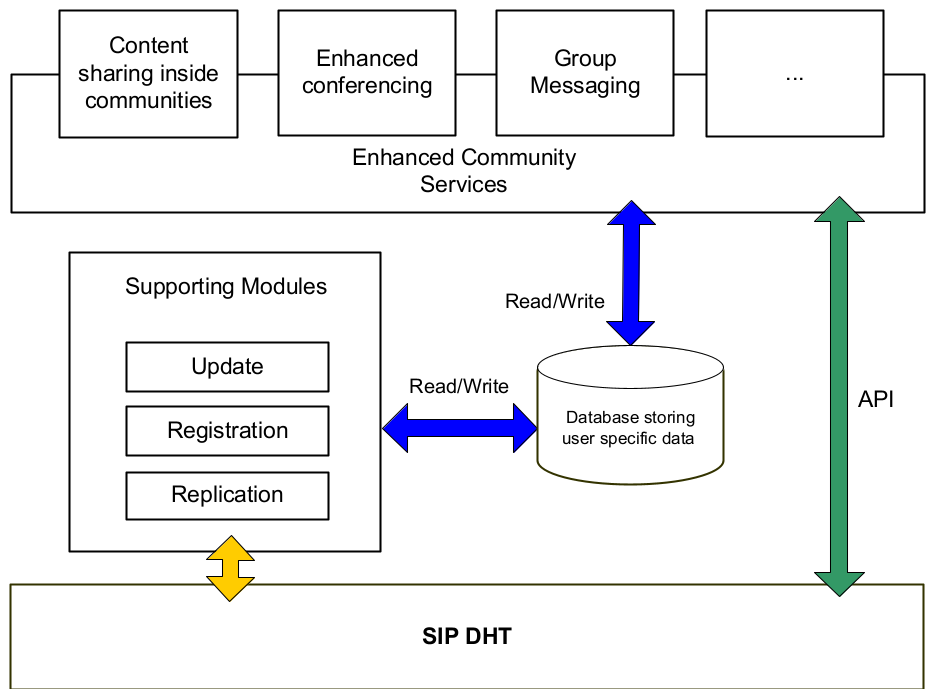
The paper detail how this works within the IP Multimedia Subsystem (IMS). By implementing SDHT nodes as IMS Application Servers, operators can provide p2p-like services (file sharing, chat) while maintaining control over billing and QoS.
Experiments & Case Study: Social Search
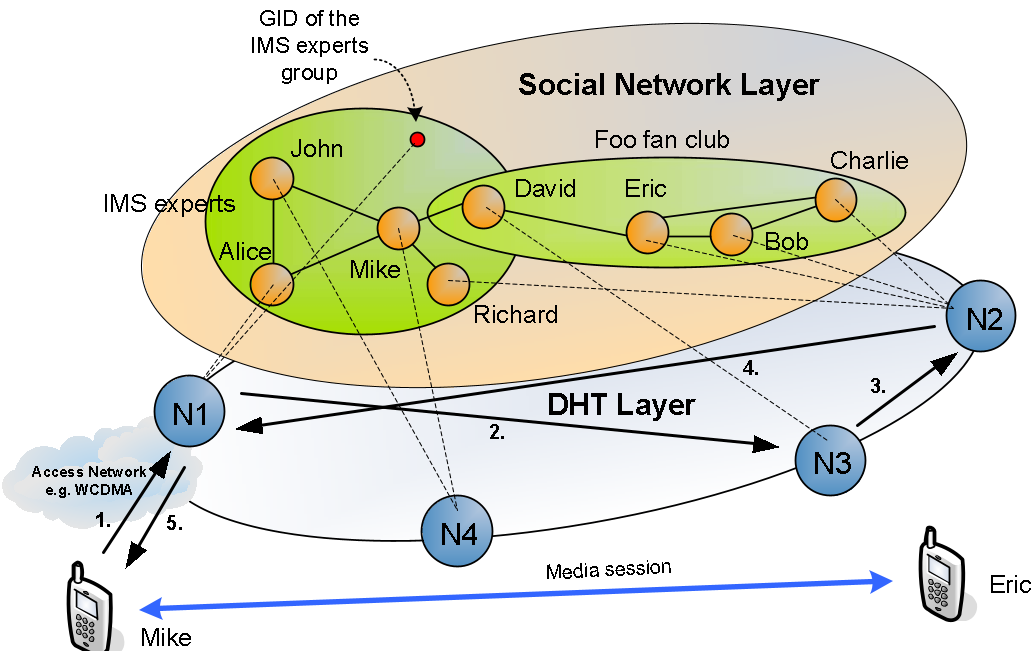
Consider a user, Mike, searching for a video of a concert. Instead of a global broadcast:
- Mike sends a request to his friend David’s UID.
- The DHT routes this to the node managing David's data.
- If David doesn't have it, the system checks David's virtual group "Foo Fans" and forwards the request to Eric (David's friend).
- Eric has the clip. Because Mike is a "friend of a friend," Eric's privacy policy automates the authorization.
Critical Analysis & Conclusion
Key Takeaways
- Context-Awareness: SDHT doesn't just find bits; it finds relevant bits from trusted sources.
- Scalability: Using DHT for user location ensures that finding a person takes only steps, regardless of network size.
Limitations
- Human Emulation: "Controlled flooding" still relies on users or simple heuristics to decide who to forward to. Emulating complex human sharing logic in software remains a challenge.
- Phonebook Fragmentation: Social links are only as good as your contact list. The paper suggests an "automatic update" mechanism, but this raises further privacy concerns.
Final Thought: SDHT was ahead of its time, pre-dating the modern "social graph" obsession of Web3. It reminds us that for mobile systems, the most efficient routing protocol is often the one that mirrors our real-world relationships.