
Engineering Influence: Strategic Modification of Social Power in Networks
Modification of social dominance in social networks by selective adjustment of interpersonal weights
This paper investigates the DeGroot-Friedkin model of opinion dynamics, proposing strategic modifications to disrupt "star topologies" where social power naturally concentrates in a single central autocrat. By introducing "attacker nodes" or new interpersonal relationships, the authors derive necessary and sufficient conditions for shifting social dominance away from the center individual.
TL;DR
In social networks where issues are discussed sequentially, power tends to pool in a single individual (the autocrat) if the network follows a "star topology." This paper provides the mathematical "blueprints" for how to disrupt this concentration of power by strategically introducing new people or shifting trust levels between existing members using only local interaction data.
Context: This work bridges the gap between sociological theory and control systems engineering, moving beyond descriptive models to prescriptive interventions for social influence.
The "Autocratic" Trap: Why Star Topologies Dominate
The DeGroot-Friedkin model suggests that as a group discusses issues, individuals adjust their self-confidence based on how much they influenced the final consensus. In a star topology—where everyone talks to a central person, and that person talks to everyone—a feedback loop occurs. The center node’s influence is "reflected" back to them, eventually making their self-weight 1 and everyone else’s 0.
The authors identify a critical gap: How can we break this "autocracy" without having to redesign the entire network?
Methodology: The Geometry of Power
The core insight lies in the relationship between the dominant left eigenvector () of the interaction matrix and the equilibrium social power .
The authors analyze several "Topology Variations" (perturbations to the star):
- Single Attack: One new "attacker" node connects to a "subject" of the center node.
- Coordinated Attack: Multiple attackers target the same subject node.
- Dissent: Existing subjects form a sub-alliance.
By adjusting the "interpersonal weights" (trust levels), they prove exactly when the center node’s power will drop below another's.
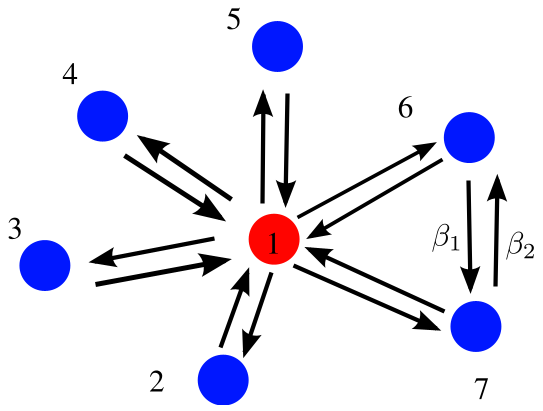 Above: Figure 1 & 2 illustrate the transition from a pure Star Topology to a Single Attack configuration.
Key Finding: Coordination is Key
One of the most profound mathematical results in the paper is found in Topology Variation 3 vs. 2.
- In an Uncoordinated Attack (two attackers targeting different people), the attackers must individually overcome high thresholds of trust.
- In a Coordinated Attack (targeting the same person), the required threshold for trust is significantly lower.
This provides a mathematical basis for the sociological intuition that organized dissent is more effective at displacing a leader than fragmented opposition.
Experimental Validation
The authors used simulations to show the "tipping points" of social power. In a network of 8 agents, they varied the trust () that a subject placed in an attacker.
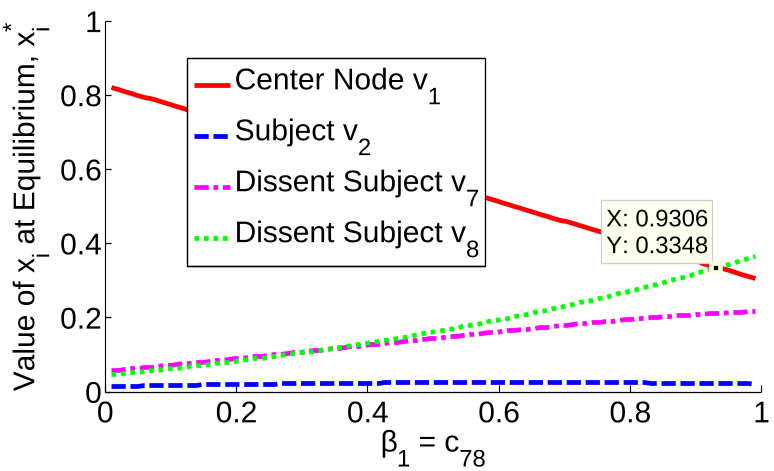 Figure: When trust exceeds the derived threshold (approx 0.93 in this case), the attacker (v8) overtakes the center node (v1) in social power.
As seen in the simulation of Topology Variation 4, a "Dissenting" subject can only gain power if they receive reciprocal trust from their partner. Without a bilateral relationship, the center node remains dominant.
Deep Insight & Conclusion
This paper shifts the study of social power from a static observation to a dynamic control problem.
Takeaways:
- Strategic Placement: To displace a leader, an attacker should target the subject whom the leader trusts the most (Corollary 1).
- The Power of Reciprocity: Leadership groups (Variation 5) can maintain dominance over subjects simply by trusting each other equally, even if they don't trust their subjects much at all.
Limitations: The model assumes "rational" reflective appraisal. It does not yet account for emotional bias or "stubborn agents" who refuse to change their opinions, which are common in real-world human interactions.
Future Work: Expanding these local strategies to complex, non-star topologies will be the next frontier in the "control" of social network structures.