
Social DTN Routing: Bridging the Gap Between Facebook Friends and Physical Encounters
Social dtn routing
This paper introduces Social DTN Routing, a novel approach that utilizes self-reported social networks (SRSNs) from platforms like Facebook to construct routing tables for Delay-Tolerant Networks. By comparing SRSNs with detected social networks (DSNs) from physical encounters, the authors demonstrate that SRSNs can significantly reduce delivery costs in intermittently connected mobile environments.
TL;DR
In the challenge of routing data through intermittently connected Delay-Tolerant Networks (DTNs), researchers from the University of St Andrews have found that who you say you know (Self-Reported Social Networks, or SRSNs) might be more important than who you actually bump into (Detected Social Networks, or DSNs). By using Facebook data to guide message forwarding, they slashed network delivery costs by 66% with only a marginal hit to delivery success.
The Motivation: The Bootstrapping Bottleneck
Delay-Tolerant Networks (DTNs) are the "couriers" of the digital world, moving data across regions where standard IP connections fail—such as disaster zones or rural areas—by hopping from one mobile device to another.
Traditionally, these networks "learn" how to route by recording every time two devices meet. However, this creates a Bootstrapping Problem: the network is useless until it has spent weeks or months recording encounters. Furthermore, physical encounters are "noisy"—you might stand next to a stranger on a bus every day, but that doesn't mean they are a reliable person to deliver a message to your family. The authors' insight was to bypass this discovery phase by leveraging the social graphs we've already built online.
Methodology: Perception vs. Reality
The researchers launched a 79-day experiment where 25 participants carried IEEE 802.15.4 sensors (motes) to track physical proximity while volunteering their Facebook social graphs.
To compare these two different views of the same group, they used Role Equivalence, a social science technique that clusters nodes based on their structural role in the network rather than just who they are connected to.
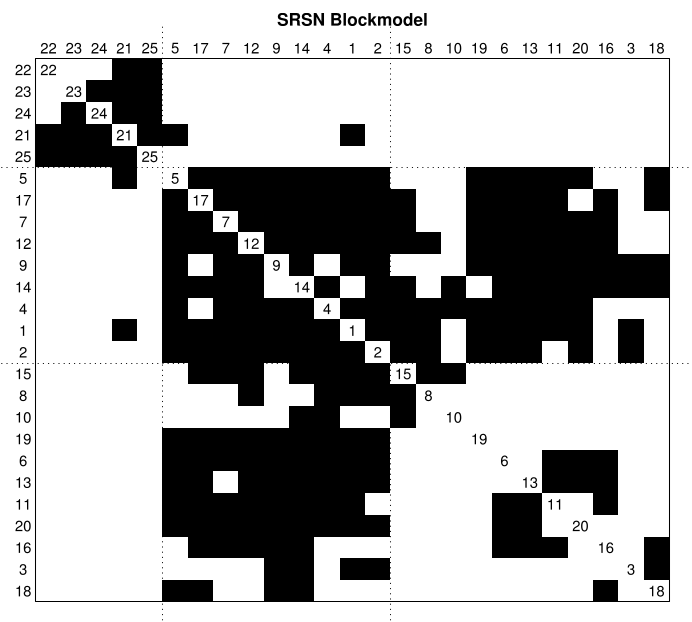 (Above: The study discovered that SRSNs from Facebook have clearer, "blockier" structures, whereas DSNs are more cluttered due to random physical encounters.)
Key Findings: Efficiency at a Small Price
The experiment revealed a fascinating dichotomy:
- The Structural Difference: DSNs (physical encounters) have more ties but are less organized. SRSNs (Facebook) are sparser but possess "key nodes" that bridge distinct social clusters.
- The Routing Performance: Using the Facebook graph for routing decreased the delivery ratio by a small 6%. However, it reduced Delivery Cost—the number of transmissions required—by a factor of three.
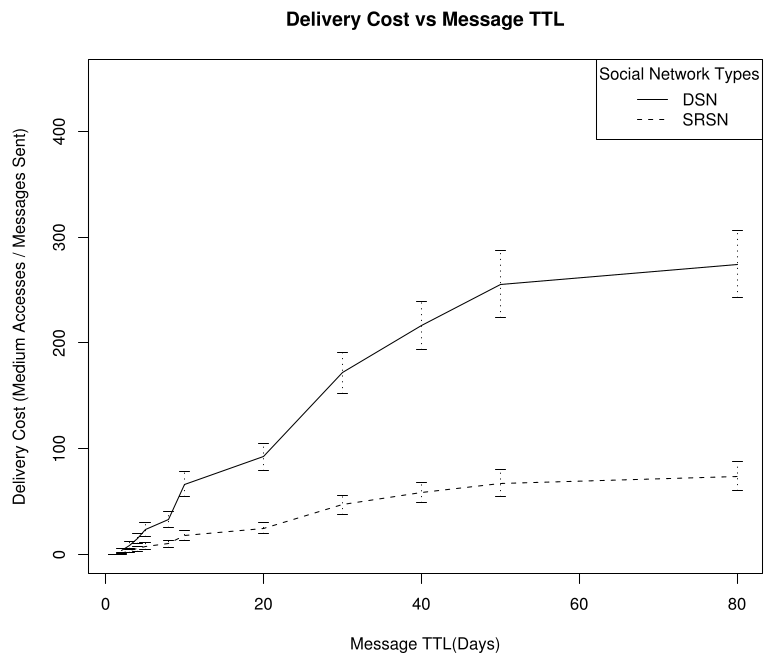 (Above: Comparison showing that SRSN-based routing consistently maintains lower medium access costs across various Time-to-Live settings.)
Critical Analysis: Why Sparse is Better
The fundamental reason the SRSN approach works so well is its high signal-to-noise ratio. In a DTN, every transmission costs battery and bandwidth. Encounter-based routing often floods the network by sending data to "frequent strangers." By relying on self-reported social ties, the algorithm only utilizes the "strong" paths that human users perceive as significant, leading to a much more surgically precise routing strategy.
Limitations & Future Outlook
The study was limited to a small group (25 participants) in a controlled environment. Real-world urban environments involve more chaotic movement. However, the takeaway is clear: the digital social graphs we use daily are a goldmine for optimizing physical wireless communication. Moving forward, the industry may see "Hybrid DTNs" that start with social media graphs and refine them with real-time encounter data.
Conclusion
This work proves that "Social DTN Routing" is not just a theoretical curiosity but a practical solution to the efficiency problems of delay-tolerant systems. By trusting the user's perception of their community, we can build networks that are faster to deploy and significantly cheaper to operate.