
Beyond the Code: Unmasking Botmasters via Underground Social Dynamics
Examining Social Dynamics for Countering Botnet Attacks
The paper introduces a novel framework for countering botnet attacks by analyzing the social dynamics of Online Underground Social Networks (OUSNs). It moves beyond traditional Command and Control (C&C) analysis to model adversarial behaviors and identifies influential actors using a systematic ranking approach.
TL;DR
While the industry focuses on killing botnet "processes" and C&C servers, this paper argues we should be hunting the "people." By modeling Online Underground Social Networks (OUSNs), the researchers from Arizona State University provide a mathematical framework to identify influential bot-herders and malware developers before their code even touches a target network.
Background: The Limits of Technical Analysis
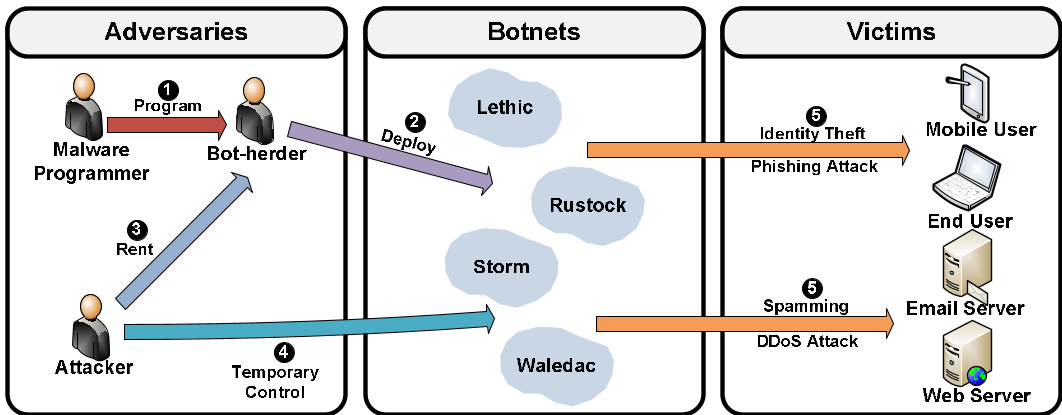
Modern botnets are no longer just scripts; they are products of a complex Cybercrime Workflow. The authors identify five critical steps:
- Tool Development
- Deployment (Infection)
- Rental (The Black Market)
- Attack Coordination
- Execution (Spreading spam, DDoS, etc.)
Current SOTA methods focus heavily on Steps 2, 4, and 5. However, the authors argue that Binary Analysis is becoming too complex due to obfuscation, and evidence found within malware is often obsolete or lacks clear identity links. To win, we must move to Step 1 and 3: the social hubs where these tools are born and traded.
Methodology: Modeling the "Dark" Social Web
The authors define OUSNs differently than Facebook or Twitter. OUSNs are characterized by blog-like long-form technical content, less restrictive privacy (to allow for wider dissemination of tools), and total anonymity.
To analyze these communities, they propose a formal 11-tuple model that links Users, Groups, Articles, Comments, and Strings.
The Four Strategic Indices
The core of their ranking system lies in moving beyond simple link-counts (like PageRank). They introduce:
- User Influence Index (UII): Combines social followers with the "impact" of their articles (measured by comments received).
- User Relevance Index (URI): Uses keyword-based queries to link specific users to known attack events or malware strings.
- User Activeness Index (UAI): Measures the volume of participation (posts, follows, group joins).
- Prevalence Index (PI): Uses a modified TF-IDF approach to track the trending "hot topics" in the underground world (e.g., a sudden spike in "RDP exploit" discussions).
Experimental Results: Influence vs. Noise
The most striking finding comes from the comparison with PageRank. In social networks, PageRank often fails because links (follows) are sparse.
In their evaluation (Fig 2 and 4), the authors demonstrate that a user like "Alice" might speak very little (low Activeness) but command massive influence because her rare posts trigger intense community discussion. Conversely, users like "Edward" might be incredibly loud (high Activeness) but hold zero influence (no followers or meaningful engagement).
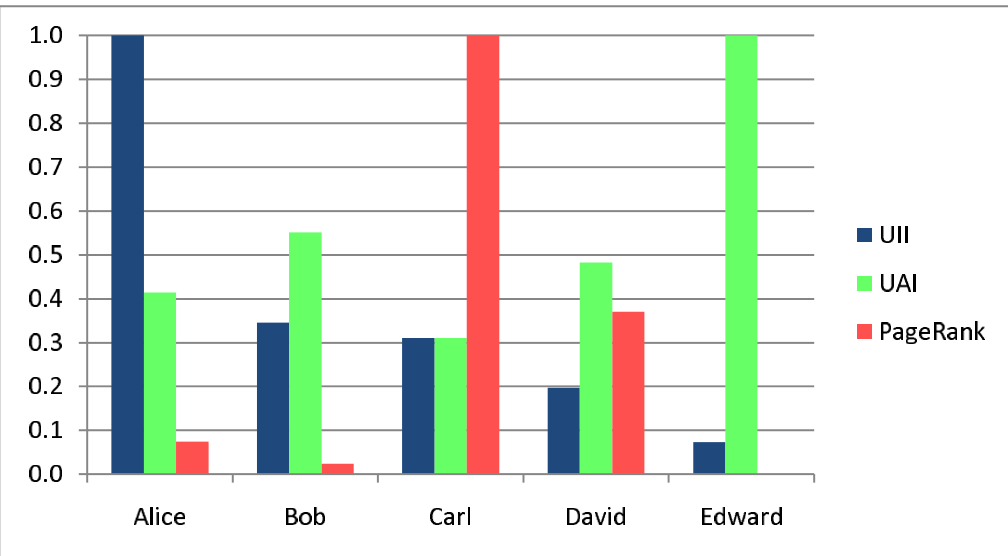
As shown in the charts, the authors' model captures the nuanced difference between being vocal and being authoritative, a distinction PageRank misses entirely by focusing only on the graph structure.
Critical Insight & Conclusion
This work shifts the cybersecurity paradigm from Reactive Defense (waiting for the malware) to Proactive Intelligence (watching the creator).
Key Takeaways:
- Content is King: You cannot understand adversarial communities by structure alone; you must analyze the User-Generated Content.
- The "Silent" Leader: The most dangerous adversaries are often not the most active ones, but those whose content serves as a cornerstone for others.
Limitations:
The current study relies on keyword-based strings. In a world of evolving "leetspeak" and encrypted comms, future work will need to integrate more robust NLP and potentially handle multimedia content (images/videos of exploits) which the authors acknowledge as a current challenge.