
Designing for the "Bottom of the Pyramid": Why Social Dynamics Trump UI in Developing Regions
Social dynamics of early stage co-design in developing regions
This paper explores "early stage co-design" in ICT4D (Information and Communication Technologies for Development) through three field studies in India and Uganda. By introducing technology artifacts—asynchronous voice-messagers, POS devices, and digital cameras—the authors identify how local social networks and artifact interaction elicit deep cultural insights and design requirements from marginalized communities.
TL;DR
This research from UC Berkeley and Google challenges the Western-centric "User-Device" model of HCI. Through three field studies in India and Uganda, the authors demonstrate that when designing for developing regions, the Social Network is the true interface. By using technology artifacts as "props," the researchers uncovered that peer learning, community status, and existing social structures are more critical to technology adoption than the UI itself.
Contextual Positioning
Published in the mid-2000s, this work is a cornerstone of the ICT4D (Information and Communication Technologies for Development) movement. It successfully bridgers the gap between C.K. Prahalad’s economic theories (The Fortune at the Bottom of the Pyramid) and practical Interaction Design, shifting the focus from "what to build" to "how to learn from the community."
The "Artifact" as a Catalyst
The central challenge in designing for developing regions is that potential users often don't know what they don't know. If you ask a villager what they want in a computer, they might have no frame of reference.
The authors solved this by introducing Technology Artifacts:
- The Combadge: A voice-messaging device (Tamil Nadu).
- Lipman Nurit 8000: A POS device for micro-loans (Uganda).
- Digital Cameras: For children to document their lives (Uttar Pradesh).
These weren't just prototypes; they were "probes" used to anchor conversations in reality.
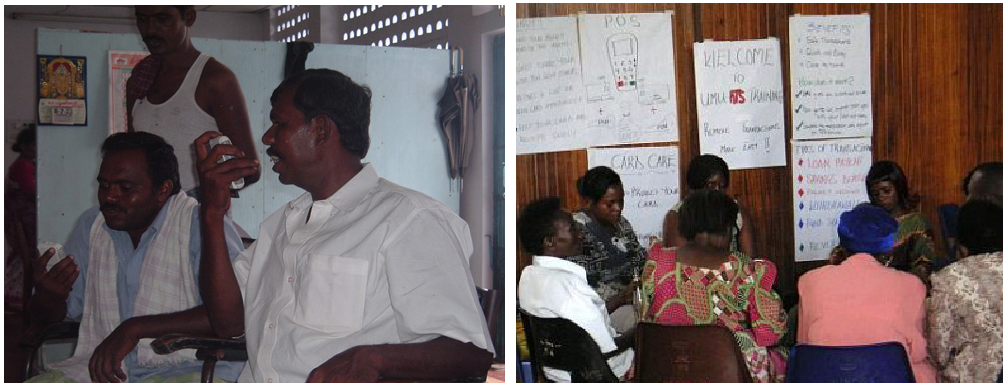 Figure: Participants in Tamil Nadu interacting with the Combadge and microfinance clients in Uganda.
Five Lessons for Global Designers
The paper distills the findings into five core insights that remain highly relevant for today's global product managers and researchers:
1. Assessing the "Technology Baseline"
Designers often underestimate the awareness of rural populations. In Tamil Nadu, villagers were already savvy about mobile phone pricing, suggesting that new tech must fit into a logical market hierarchy (e.g., "This should cost 50% of a cellphone because it does less").
2. Task-Driven Elicitation
Open-ended tasks (like "Take a photo of something you value") proved more fruitful than rigid usability tests. In Uttar Pradesh, children’s photos of buffaloes and TV antennas revealed more about their "socio-economic status" and "private property values" than any survey could.
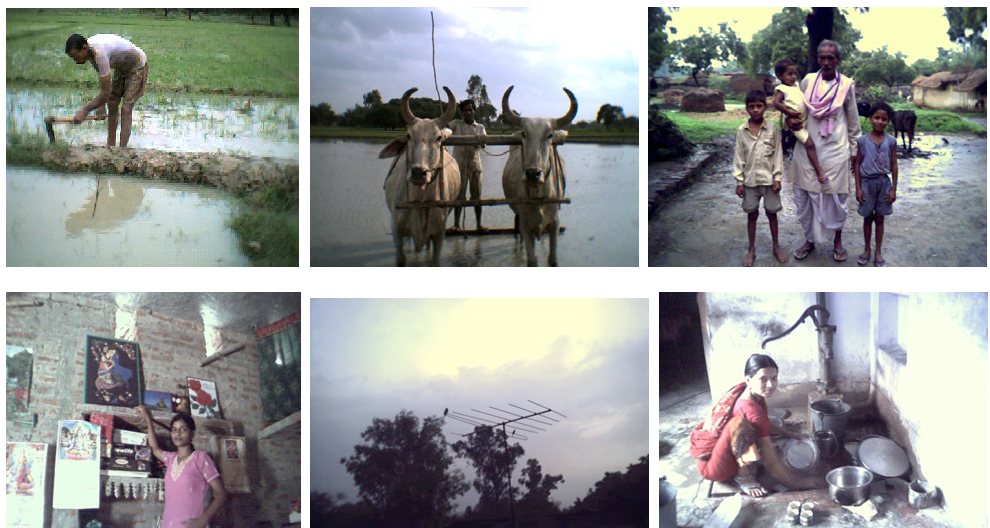 Figure: Photos taken by children in UP, providing a window into family and community values.
3. The "Community Event" Sampling
In tight-knit communities, research shouldn't be private. By conducting sessions in public porches, the researchers triggered "opportunistic sampling." The draw of "new foreign technology" created a buzz that brought in marginalized groups (like the lowest caste field workers) who would otherwise be invisible to researchers.
4. The Power of Peer Learning
A critical observation was that participants were often intimidated by the researchers but empowered by their peers. Illiterate users would whisper instructions to their children or wait for a friend to struggle with the device first to "reduce the cost of failure."
5. Mapping Social Hierarchies
Technology usage revealed deep social strata. In Tamil Nadu, certain users refused to sit on furniture based on caste; in Uganda, women valued secret PINs as a way to maintain financial independence from their husbands.
Critical Insight: Social Networks vs. System Specs
The most profound takeaway is that Network Effects are social before they are technical. In the Uganda study, even though the POS device was meant to be portable, its success depended on the "field officer" (an authority figure). If the officer struggled with the device, the clients' confidence evaporated. This suggests that the Trust Chain is a prerequisite for any ICT deployment.
Conclusion & Future Outlook
This paper serves as a reminder that UI/UX is only the tip of the iceberg. In developing regions, the success of a digital product is determined by its "Social Fit"—how it navigates caste, gender, literacy, and community trust.
Limitations: The study acknowledges selection bias (it attracts tech-curious people) and the "Wizard-of-Oz" faking of voice recognition, which might mask some technical frustrations.
Takeaway for Today: As we deploy AI and fintech solutions globally, the lesson is clear: Stop looking at the user as an isolated individual. Start looking at the community as the user.