
NETT: Building a Social Intelligence Layer for Entrepreneurship Education
Towards a social e-learning platform for demanding users
The paper introduces the NETT platform, a specialized social e-learning environment designed for entrepreneurship education. It utilizes a metadata-driven architecture and a multi-tier peer-review system to enable teachers to collaboratively create, share, and aggregate complex pedagogical structures like modules and courses.
TL;DR
The NETT platform is a specialized social network for educators that moves beyond simple file-sharing to a collaborative ecosystem. By combining a rigorous quality-review workflow with intelligent search and recommendation systems, it allows teachers to build entrepreneurship curricula from community-vetted modules while protecting intellectual property and reputation.
Problem & Motivation: The "Demanding User" Gap
Most e-learning repositories act as static silos. For a rapidly evolving field like entrepreneurship, a top-down approach (where a few experts dictate the curriculum) is insufficient. The authors identify a specific class of "demanding users"—teachers who are not just consumers but active producers of material.
These users face three primary hurdles:
- Reliability: How do you trust content created by a peer you've never met?
- Complexity: Entrepreneurship requires complex, multi-layered aggregates (modules and courses), not just single PDFs (Learning Objects).
- Ambiguity: Traditional search fails when pedagogical goals (like "acquired skills") are not explicitly mapped.
Methodology: The Architecture of Trust and Discovery
The NETT platform solves these issues through a dual-layered approach: Social Quality Control and Metadata-Driven Intelligence.
1. The Peer-Review Lifecycle
Instead of an "all-or-nothing" publishing model, NETT utilizes a state-machine for content quality. Users are categorized into Contributors, Experts, and Masters. This mimics the academic journal review process but within a fast-moving social network context.
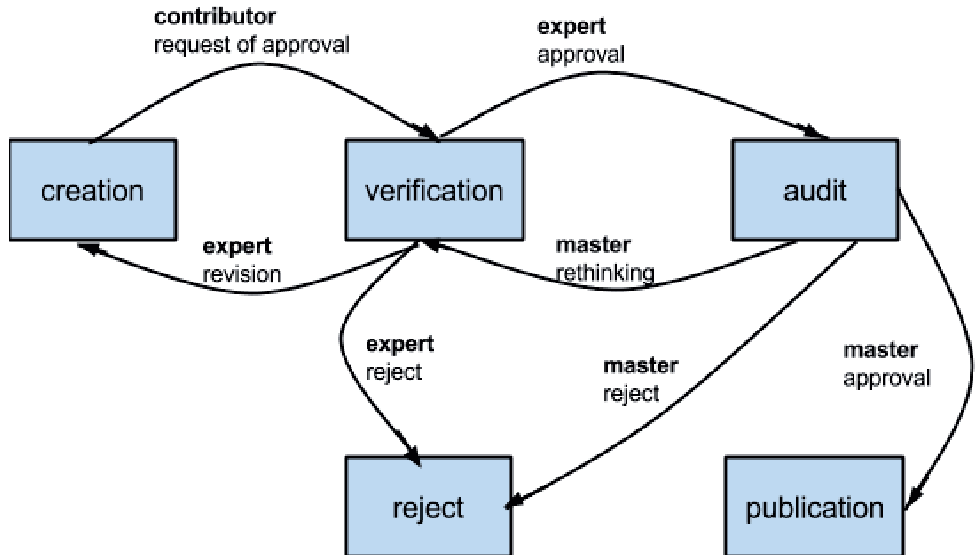 Figure 1: The flow from creation to "Green Flag" status ensures that the community can distinguish between raw ideas and gold-standard curriculum.
2. Intelligent Search and Recommendation
The platform adopts a subset of the IEEE LOM (Learning Object Metadata) standard, focusing on "Required Skills," "Acquired Skills," and "Difficulty."
- Automated Extraction: Metadata for modules is aggregated from their constituent contents, reducing the manual tagging burden on teachers.
- Decision Tree Recommendations: As a teacher selects modules, the system uses learning algorithms to suggest the next logical "branch" to complete a course, creating a personalized course-authoring experience.
Experiments & Technical Implementation
The system is built on a robust open-source foundation, integrating Moodle (for LMS features) with Mahara (for social/e-portfolio features).
Search Modalities
The search engine (visualized below) supports a three-tier discovery process:
- Strict Metadata: Filtering by specific difficulty levels or target ages.
- Full-text: Ranking results by relevance to keywords in titles and summaries.
- Thesaurus: Expanding queries to catch related concepts in the entrepreneurship domain.
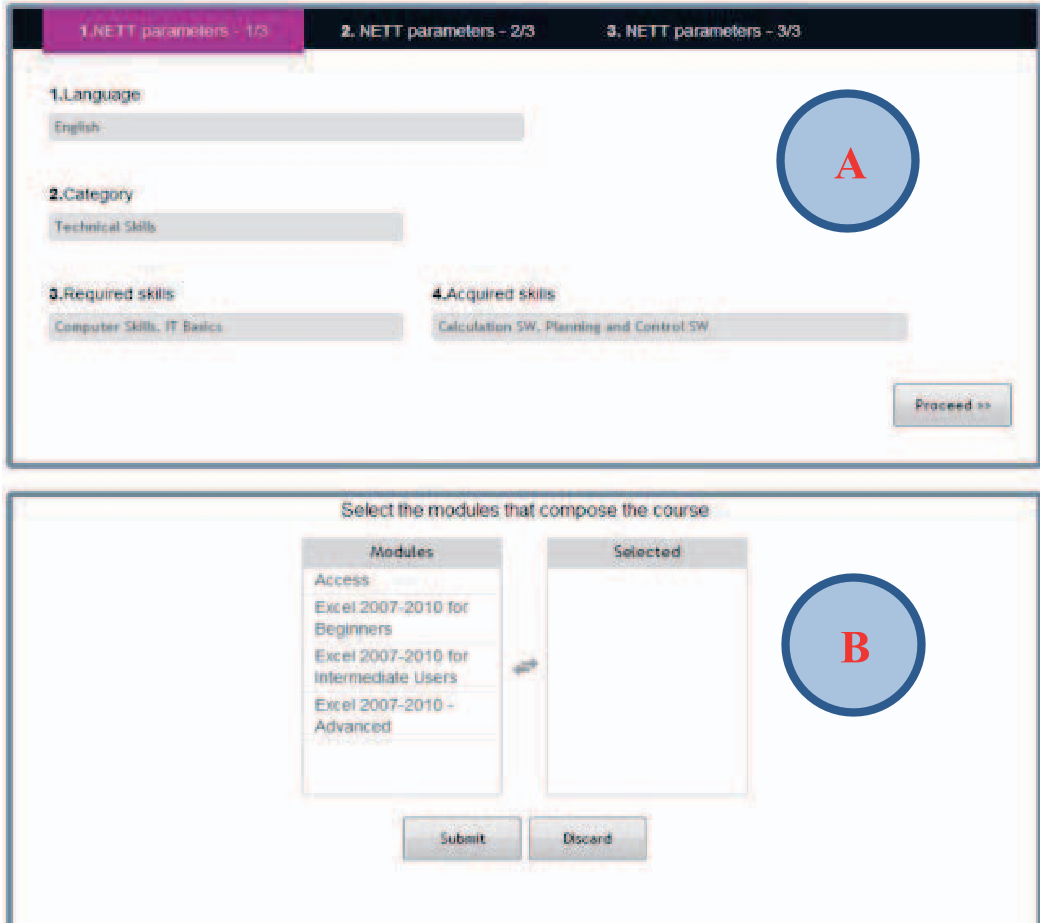 Figure 2: The interface allows simultaneous metadata adjustment (Part A) and real-time curriculum assembly (Part B).
Critical Analysis & Conclusion
Takeaway
The genius of the NETT project lies in its recognition that provenance (knowing where a module came from) and reputation (getting credit for your work) are the primary drivers for professional engagement. By using gamification to award "bonuses" and reliability scores, the platform converts a lonely preparation task into a social game.
Limitations & Future Work
While the metadata structure is sound, the paper notes that the "social network integration is under working." The reliance on manual review by "Masters" could also become a bottleneck as the platform scales. Future iterations aim to automate the combination of modules even further, using the recommendation engine to build "draft courses" based on a teacher’s background automatically.
Final Thought: NETT shifts the e-learning paradigm from "Content is King" to "Community-Validated Context is King," providing a blueprint for how professional associations can digitize their collective wisdom.