
Beyond Six Degrees: A Dynamic Game-Theoretic Approach to Small-World Networks
Social and Economic Network Formation: A Dynamic Model
This paper introduces a dynamic game-theoretic model for network formation that explains the emergence of small-world properties through strategic individual behavior. By incorporating dynamic link-pricing, maintenance costs, and transfer payments, the authors prove that equilibrium networks (Pairwise Stable and Nash) consistently exhibit a small diameter of at most 4.
TL;DR
Why do social networks across the globe consistently exhibit a "small-world" structure? This paper moves beyond random probability models to a strategic one. By allowing players to negotiate link costs through Transfer Payments and updating link prices based on Dynamic Distances, the authors prove that the resulting networks will always have a diameter of 4 or less—perfectly mirroring modern empirical data from platforms like Facebook.
Context & Motivation: The Failure of Static Pricing
In the 1960s, Stanley Milgram suggested "six degrees of separation." Recent studies on digital networks suggest that number has shrunk to below four. While stochastic models (like Watts-Strogatz) can generate these structures, they don't explain why rational individuals would create them.
Previous game-theoretic attempts, specifically the work by Even-Dar and Kearns, used static pricing. If the price to connect is fixed based on a starting grid distance, the model fails when the network evolves. This paper identifies that dynamics are key: as the network becomes denser, the "distance" (and thus the cost) of forming new shortcuts should change.
Methodology: The Economic Micro-foundation
The authors redefine the utility function of a player by considering three distinct cost components:
- Dynamic Link-Price (): Calculated as . Unlike previous models, is the current distance in the network, not the initial grid distance.
- Maintenance Cost (): A recurring fee to keep a link alive, preventing "dead" links from persisting.
- Transfer Payments (): Side payments that allow players to "bribe" or compensate others to form/maintain mutually beneficial links.
The Core Utility Equation
This utility reflects the fundamental trade-off: players want to be close to everyone else (minimizing total distance) but must balance this against the costs of those connections.

Theoretical Breakthroughs
The paper provides two major proofs that elevate it within the field:
- Existence and Convergence: They prove that in a linking game with transfers, "cycles" (endless adding/removing of links) are avoided. The game always converges to a Pairwise Nash Equilibrium.
- The "Diameter 4" Guarantee: Through a rigorous boundary analysis of the set of players (those within distance of player ), the authors prove that for any sufficiently large network, the diameter cannot exceed 4. This is a significant improvement over previous models where the diameter grew with the number of nodes .
Experimental Validation
Using simulations with 1,000 nodes, the authors tested various values of (price sensitivity) and (maintenance).
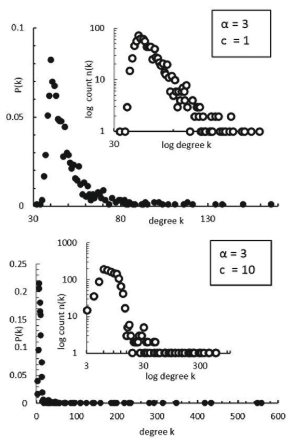
Key Findings:
- Power-Law Distribution: The degree distribution followed a heavy-tail pattern, a hallmark of real-world social structures.
- Clustering: The networks maintained high clustering coefficients relative to their edge density, distinguishing them from random Erdos-Renyi graphs.
- Stability: The diameter consistently landed between 3 and 4, regardless of the starting parameters.
Critical Insight & Conclusion
The true value of this work lies in the Transfer Payment mechanism. In real life, we don't just form connections; we negotiate them. By including side payments, the authors bridge the gap between "Pairwise Stability" (where two people agree to link) and "Nash Equilibrium" (where an individual acts in their own best interest).
Takeaway: The "Small-World" phenomenon isn't just a mathematical curiosity or a result of random chance—it is a stable, strategic equilibrium of human economic behavior.
Limitations: The model assumes "myopic" agents (looking only one step ahead). Future work could explore "far-sighted" agents who anticipate how a new link will change the behavior of the entire network.