
Decoding the Social DNA: Why We Interact the Way We Do Online
Understanding social effects in online networks
This study presents a comparative triadic analysis of four major Online Social Networks (OSNs)—Facebook, Twitter, YouTube, and Slashdot—to decode the sociological drivers of user interaction. By employing the M-A-N triad census scheme and UMAN distribution, the authors identify how social stature, relationship strength, and egocentricity shape digital network evolution.
TL;DR
Why do you follow a celebrity who never follows back? Why do you trust a "friend of a friend" online? This paper uses Triadic Analysis—the study of three-way relationships—to prove that our online lives are driven by three hidden forces: Social Stature, Relationship Strength, and Egocentricity. By analyzing Facebook, Twitter, YouTube, and Slashdot, researchers found that online networks are surprisingly more tolerant of "uncomfortable" social hierarchies than the physical world.
The Problem: The Limit of Two-Person Analysis
In the early days of social network analysis, researchers focused on dyads (A → B). However, human society is built on triads. In a triad, a third person can be a mediator, a gatekeeper, or a "homewrecker." Without looking at these three-way clusters, we miss the "Why" behind the network's structure. Previous works suggested users interact based on individual preference, but this paper argues that the topological position within a triad reveals the true motive.
Methodology: The Science of Triad Census
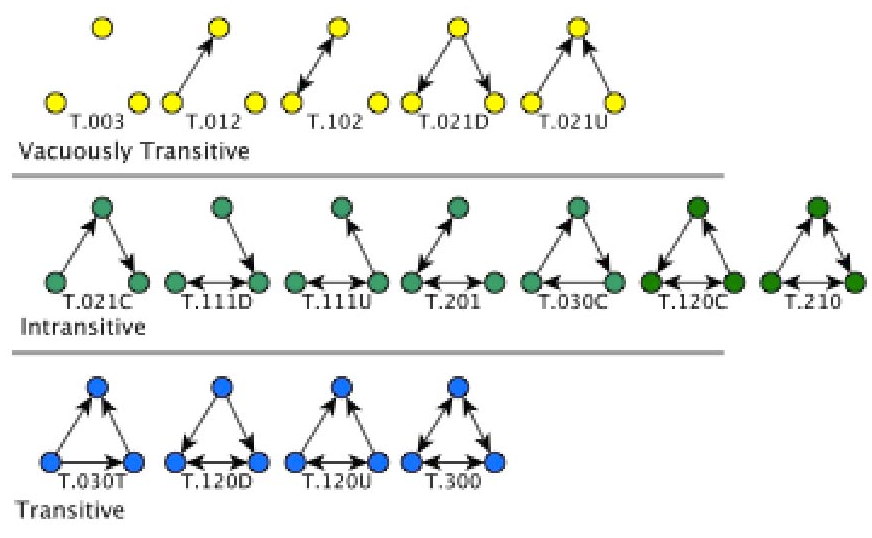
The researchers categorized every possible combination of three people into 16 types using the M-A-N (Mutual, Asymmetric, Null) scheme. They then grouped these into three categories of transitivity:
- Intransitive (The Power Play): Relationships like A → B → C where A does not know C. This gives B "Social Stature" as a gatekeeper.
- Transitive (The Inner Circle): The classic "friend of my friend is my friend" (A → B, B → C, and A → C). This indicates "Relationship Strength."
- Vacuously Transitive (The Ego Trip): Situations where one person receives all the attention but gives none (e.g., T.021U), representing "Egocentricity."
Platform Showdown: How They Differ
The study analyzed four platforms and found distinct "social fingerprints" for each:
1. Facebook: The Digital Mirror of Offline Life
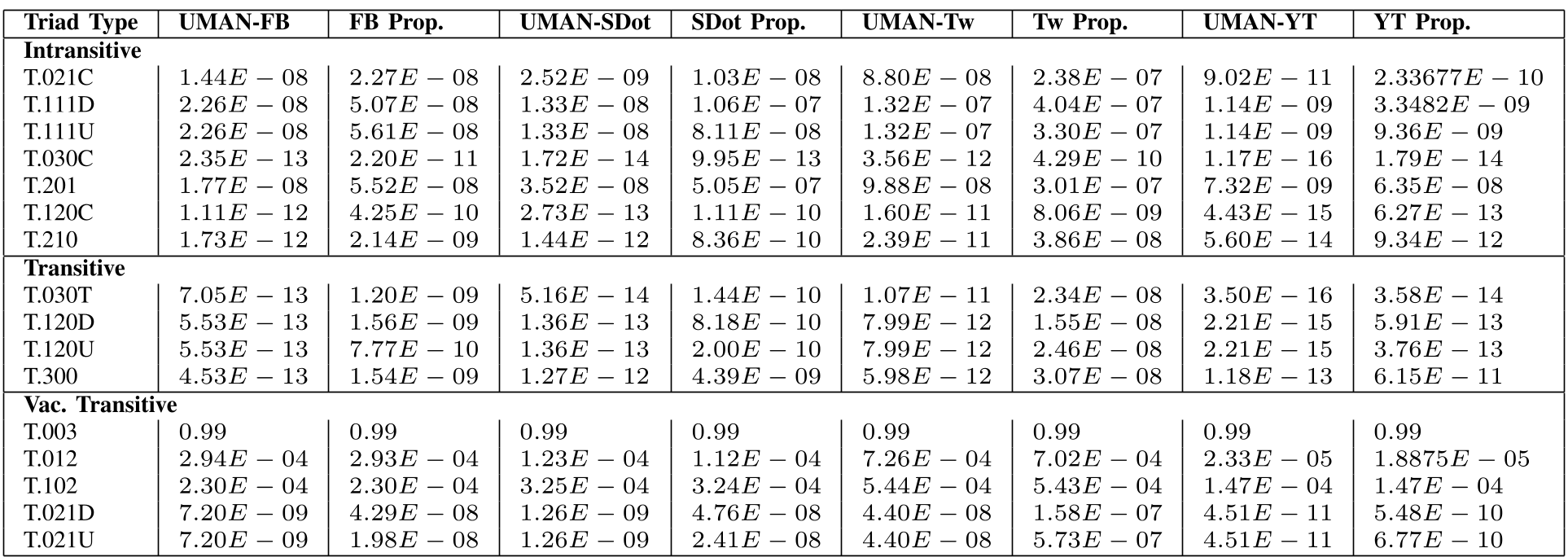
On Facebook, Transitive Triads were higher than expected. This confirms that Facebook is largely a digital extension of our real-world friendships, where mutual trust (Relationship Strength) is the primary driver.
2. Twitter & Slashdot: The Land of the Ego
These platforms showed a massive spike in Vacuously Transitive triads. On Twitter, this represents celebrities and "opinion leaders" who broadcast to thousands but follow no one. On Slashdot, it highlights the presence of "trolls" who tag others as foes to gain negative attention.
3. YouTube: The Rise of the Mediator
YouTube was the most heavily influenced by Social Stature. Intermediaries act as "channels," screening content. Interestingly, online networks are much more stable with these "middle-man" relationships than offline networks, where such gaps usually cause social tension.
Critical Insight: The "Social Stress" Paradox
In traditional sociology (Heider’s Balance Theory), a triad like A → B, B → C (but no A → C) is considered "unstable" and "stressful." We usually feel pressure to either meet the stranger or cut ties.
The authors provide a fascinating takeaway: Online, this stress doesn't exist. Because digital interactions are lower-stakes, we are perfectly happy letting "mediators" (brokers of info) control our feed. This is why "Social Stature" is a much more powerful force in the digital evolution of networks than in physical villages or offices.
Conclusion & Future Look
This paper moves us beyond simple "follower counts" into the structural physics of social life. While Relationship Strength remains a universal constant, the digital medium has supercharged Egocentricity and Social Stature.
Future Directions: The researchers plan to look at temporal changes—how a mediator eventually turns their stature into a permanent closed circle, or how a celebrity’s ego-network collapses over time. For developers, these insights are gold for designing better recommendation engines that respect the "role" a user plays in their local triad.