
The Social Embeddedness of Decision Making: Navigating the Causality Challenge
The social embeddedness of decision making: opportunities and challenges
This multidisciplinary synthesis defines the "social embeddedness" of economic decisions, proposing a research framework to analyze how interpersonal and inter-organizational ties drive choices. It identifies the "Causality Challenge"—distinguishing social contagion from homophily—and highlights the transformative power of Online Social Networking Platforms (OSNP) for large-scale behavioral data.
TL;DR
Economic decisions do not happen in a vacuum—they are "embedded" in social networks. This paper explores why humans and organizations make choices based on their peers and provides a roadmap for researchers to use the "data opportunity" of the digital age to solve the causality dilemma: Do we act like our friends because they influence us, or are we friends because we were already alike?
The "Causality Challenge": Correlation is Not Contagion
The central insight of this paper is a warning to those who see patterns in social media and call it "influence." The authors break down the similarity of behavior into three distinct paths:
- Social Contagion: Direct influence via communication (Cohesion) or competition for prestige (Structural Equivalence).
- Homophily: "Birds of a feather flock together." People with similar tastes form links, making it look like they are influencing each other when they are simply acting on shared traits.
- External Influence: The "Raincoat Effect." If everyone opens an umbrella at once, it’s not because they saw others do it—it’s because it started raining.
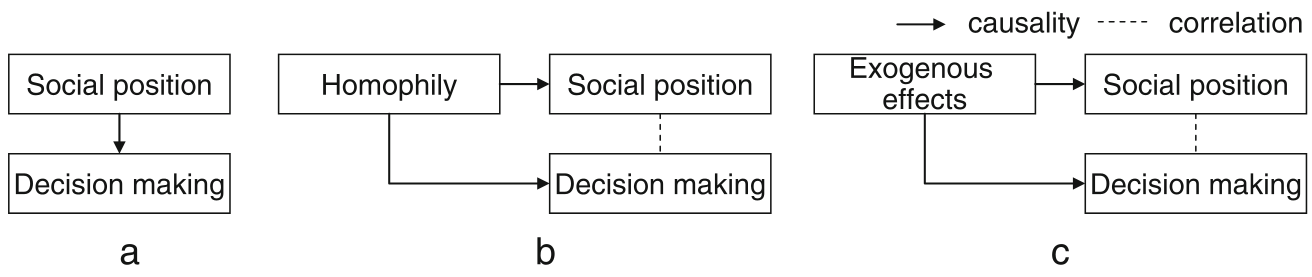 Figure 1: Distinguishing between (a) Social influence, (b) Homophily, and (c) Common external influence.
Methodology: A Multi-Level Framework
The authors propose a structured way to look at this problem across different layers of society and business.
1. The Individual Level
The focus here is on identifying Opinion Leaders. Interestingly, the paper notes that while "Hubs" (people with many connections) are often targeted, they are not always the best influencers. Some researchers suggest that "Influentials" are harder to move because they are bombarded with information from too many sources. Instead, "Bridges"—people who connect two separate social groups—often hold more strategic value (Betweenness Centrality).
2. The Organizational Level
Companies are also socially embedded. Their success is often dictated by their position in supply chains or collaborative networks. Interestingly, the paper points out a reversal of the "Strength of Weak Ties" theory: for individuals, loose connections provide new info; for organizations, horizontal alliances (competitors) often have redundant info, while vertical alliances (suppliers) provide the most value.
3. The Aggregate Level (Diffusion)
When individual decisions scale up, we get Diffusion. The paper highlights that traditional models (like the Bass Model) often treat the market as a flat, homogeneous group. Modern IS research must treat the market as a complex web where the topology of the network dictates how fast a product or idea "goes viral."
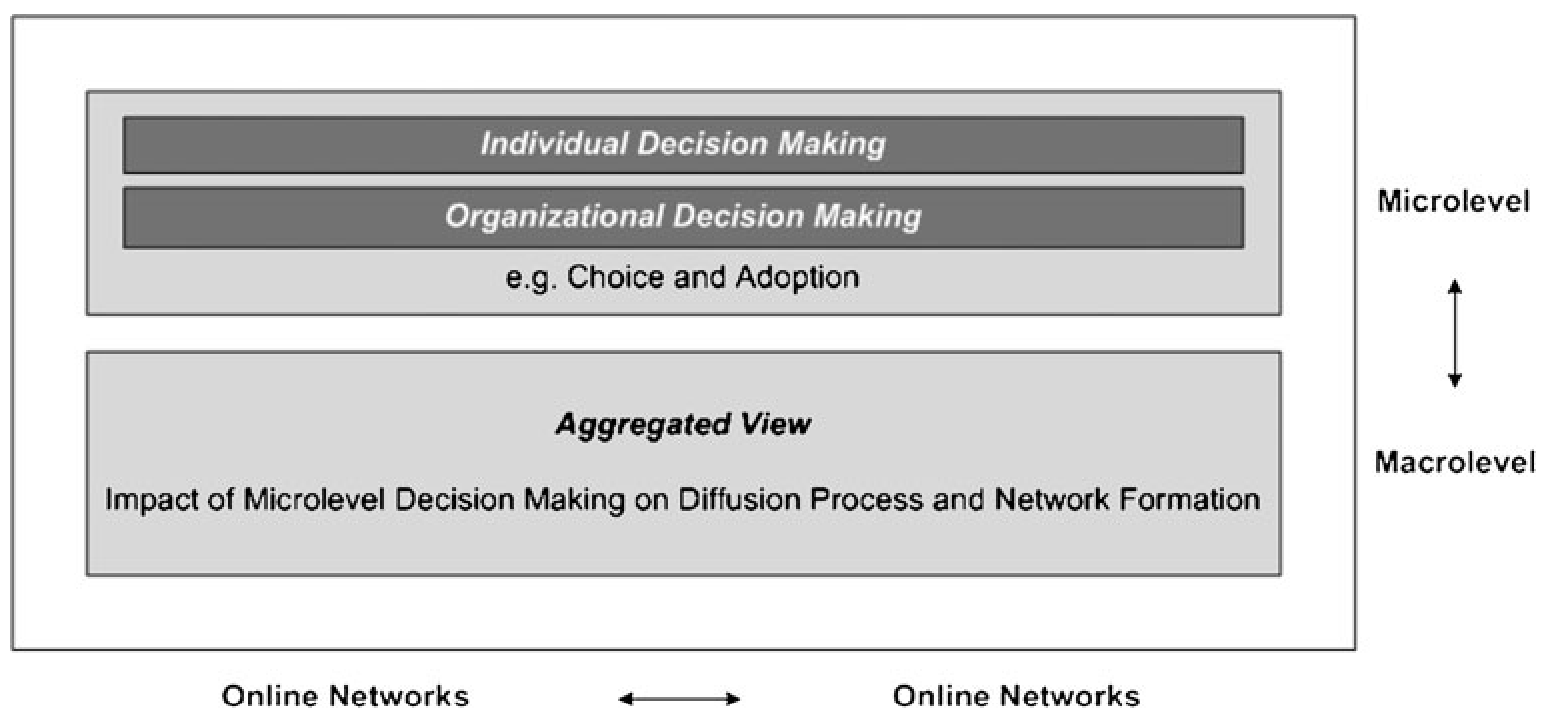 Figure 2: A Research Framework for the Social Embeddedness of Decision Making.
Online vs. Offline: Does the Digital Twist Change Everything?
The paper argues that while online networks (Facebook, LinkedIn) follow "Small World" principles (six degrees of separation), they differ in three key ways:
- Zero Cost: Communicating and adding "friends" is virtually free, leading to "information overload" and a high number of "weak links" that don't actually influence behavior.
- Trust Deficit: Offline, face-to-face contact is the bedrock of trust. Online, trust is fragile and temporary, making social contagion more volatile.
- Transparency: Digital networks offer unprecedented price and return transparency, which can accelerate rational decision-making while potentially inviting "information cascades" where people follow the crowd blindly.
Critical Insight: The Future is Experimental
The authors conclude that we cannot solve the causality challenge by looking at static datasets. To truly understand social embeddedness, researchers must:
- Run Small-Scale Experiments: Use Facebook "widgets" or virtual worlds to manipulate network structures and observe the fallout in real-time.
- Analyze Network Evolution: Don't just look at who is connected; look at how they became connected.
- Refine Targeting: Moving beyond "targeting everyone," marketers should use sociometric measures to find the "crossroads" of the network.
Summary Takeaway
Social embeddedness is the invisible hand of the 21st-century economy. By moving from simple "influence" narratives to rigorous, longitudinal, and experimental analyses, we can better predict how information, products, and behaviors will spread across an increasingly connected world.
Keywords: Social Network Analysis, Decision Making, Social Contagion, Homophily, Diffusion.