
Analyzing the Invisible Thread: Modeling Social Engineering Attacks through Graph Analytics
Modelling of the social engineering attacks based on social graph of employees communications analysis
This paper introduces an automated social engineering attack analyzer that constructs and analyzes "compressed" social graphs of employees using VKontakte data. It specifically develops algorithms to estimate the probability of multi-step attack propagation based on user interaction intensity.
TL;DR
Cybersecurity isn't just about patching software; it's about patching people. This paper presents an automated Social Engineering Analyzer that maps employee communications from social networks (specifically VKontakte) into a social graph. By applying Graph Compression techniques—including a 0.2 probability threshold—the system identifies the most dangerous "trajectories" an attacker can take to compromise an organization through human manipulation.
Contextual Positioning
While most security tools (like SIEM or DLP) monitor technical logs, this research positions itself in the Cyber-Social Systems domain. It treats interpersonal trust as a quantifiable metric, bridging the gap between social psychology and computational graph theory to predict multi-step attack paths.
The Pain Point: The "Complete Graph" Problem
The authors identify a critical bottleneck in social engineering modeling: Computational Complexity.
- The Reality: If you map every possible interaction between 1,000 employees, you get a "dense" graph where almost everyone is connected via some weak signal (a like, a common group).
- The Cost: Analyzing multi-hop attack paths in a complete graph is NP-hard or simply too slow for timely incident response.
- The Insight: An attacker is unlikely to use a high-friction, low-trust connection (e.g., a stranger's comment) when a high-trust path (e.g., a spouse or close colleague) exists. Therefore, "weak" edges are essentially noise.
Methodology: From Raw Data to Compressed Insights
1. Data Aggregation & Profiling
The system pulls data from VKontakte, looking for "Evidence of Interaction":
- Official Status: Relationship status, friends list.
- Approval Symbols: Likes and reposts.
- Shared Context: Common photos, joint group memberships, and comment history.
2. The Analyzer Architecture
The workflow follows a modular pipeline, transforming raw social network data into a "Security Estimate."
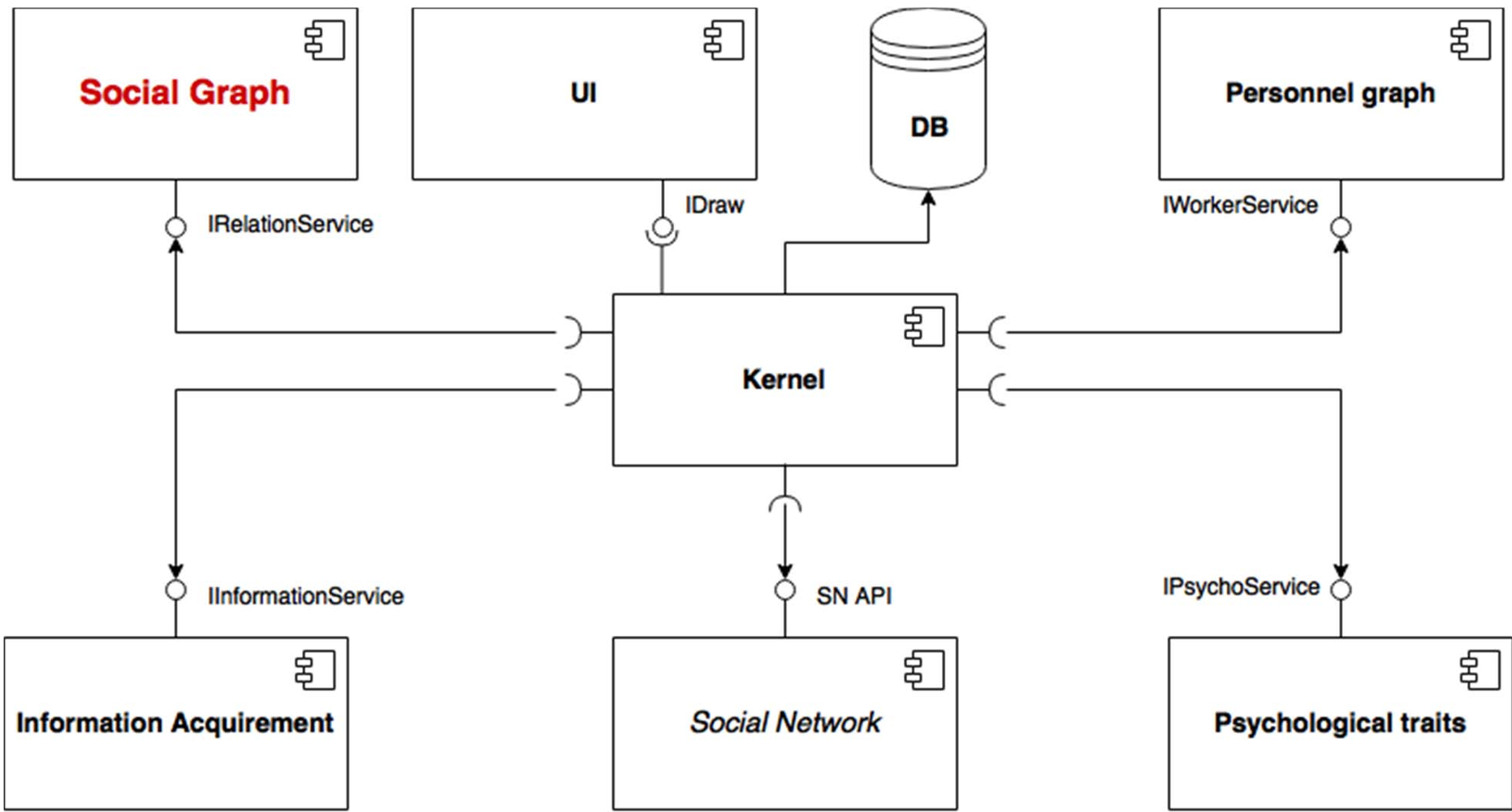
3. Graph Compression Strategies
The core contribution is the evaluation of three compression methods:
- No Compression: Maximum accuracy but consumes excessive resources. Only viable for small teams.
- Expert-based: Relies on a security officer’s knowledge to narrow the scope. Highly tailored but prone to human oversight.
- Threshold-based (The "Golden Mean"): The system automatically discards any connection with an interaction probability below a certain value. The authors propose a default threshold of 0.2, which optimizes the balance between model fidelity and execution speed.
Experiments and Practical Value
By focusing on the "intensity" of communications, the analyzer can visualize the most probable traces of an attack. For example, if an attacker compromises a former employee (an "insignificant entry point"), the system can predict the likelihood of that influence spreading to a senior manager based on the strength of their social ties.
Key Results:
- Optimization: Pruning edges significantly reduces the dimensionality for downstream algorithms.
- Visibility: The system identifies "bottlenecks" and high-risk trajectories that typical technical audits miss.
- Flexibility: Supports hybrid analysis (expert data + automated social mining).
Critical Insight & Future Outlook
This work formalizes the "social" in social engineering. By converting qualitative trust into quantitative probability, it allows security teams to run "What-If" simulations of human-centric attacks.
Limitations: The reliance on a single social network (VKontakte) may create a bias. In a global corporate setting, data would need to be synthesized from LinkedIn, Slack, and Email metadata.
The Takeaway for the Industry: The future of SIEM (Security Information and Event Management) lies in Identity-Centric Graphs. Understanding "Who trusts whom" is now as important as knowing "Who has access to what."