
The Human Firewall: Decoding the Affect-Based Model of Social Engineering in SNSs
Social engineering in social networking sites : affect-based model
This paper presents a comprehensive conceptual model for understanding social engineering in Social Networking Sites (SNSs). It systematically identifies four core entities—the Environment (SNS), the Attacker, the Trick (Plan/Technique), and the Victim—and maps their interdependencies using socio-psychological theories to explain why humans remain the "weakest link" in information security.
TL;DR
In the modern cybersecurity landscape, the most sophisticated "exploit" isn't a zero-day vulnerability in code; it's the human psyche. This paper introduces a comprehensive model for social engineering in Social Networking Sites (SNSs), breaking down the mechanics of how attackers leverage psychological triggers and the inherent trust of social platforms to bypass organizational security. By moving beyond "what" happened to "why" it worked, the authors provide a roadmap for understanding human-centric security risks.
Background & Motivation: Why SNSs are Paradigms of Risk
Technology-based threats are shielded by increasingly complex encryption and firewalls, causing attackers to shift their focus toward the "wetware"—the human brain. SNSs are the perfect laboratory for this for three reasons:
- Massive Disclosure: Users willingly share names, birthdays, and professional roles.
- Inherent Trust: The "friendship" paradigm lowers cognitive defenses.
- Automation: Tools like "Facebook Blaster" allow attackers to automate the delivery of social tricks to thousands of targets simultaneously.
Methodology: The Four-Pillars of the Social Science of Hacking
The core contribution of this work is a conceptual model that identifies the four entities driving social engineering success.
1. The Environment (The SNS)
The architecture of SNSs dictates the success of Information Gathering. Privacy settings (often left at defaults) enable search engines to index over 100 million profiles, providing a goldmine for "Pretexting"—the art of creating a believable scenario.
2. The Attacker (The Social Engineer)
Success depends on the attacker's ability to "wear a suitable hat." This involves using Source Credibility Theory to appear as a trusted figure (a boss, a romantic interest, or a technical support agent).
3. The Trick (Plan and Technique)
The paper categorizes common techniques including:
- Reverse Social Engineering: Tricking the victim into contacting the attacker first, creating an immediate (but false) sense of trust.
- Phishing/Spam: Leveraging hyperlinks embedded in sensationalized content.
- Shoulder Surfing: Digitally "watching" user activities and tags to gain context.
4. The Victim (The SNS User)
This is where the paper dives into deep psychology. The authors argue that humans fail to detect lies due to "Truth Bias"—the natural assumption that others are being honest.
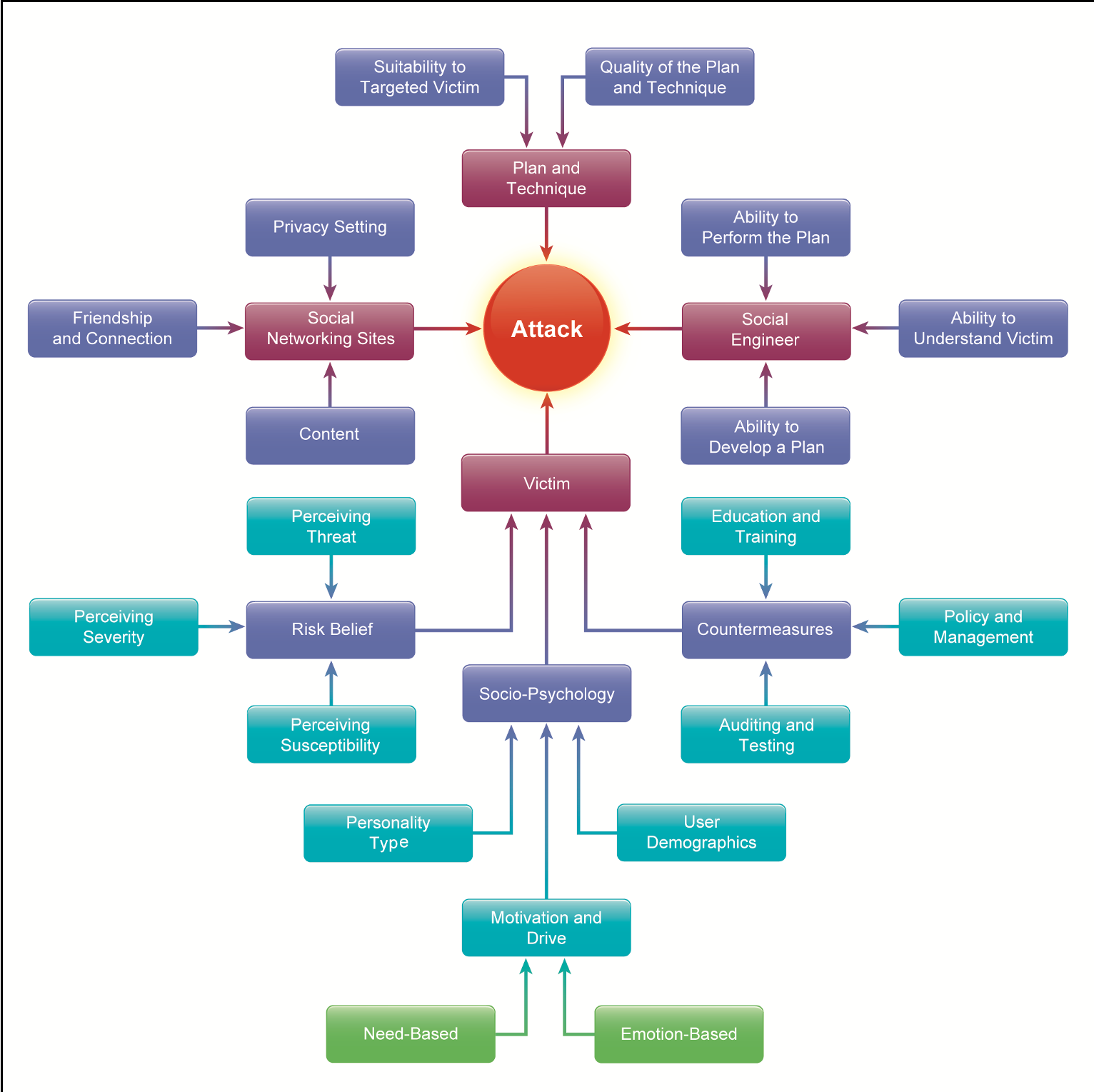 Fig 1: The proposed conceptual framework mapping the interaction between the attacker, the environment, and the human victim.
Deep Dive: Needs-Based vs. Emotion-Based Behaviors
The most insightful part of the methodology is the classification of behaviors that social engineers exploit:
- Need-Based (Incentive Theory): Exploiting greed (free e-books/money) or biological drives.
- Emotion-Based (Affect Theory): Modern attacks often bypass the Central Route of logic and instead use the Peripheral Route of emotion. A sudden sense of urgency, fear of a locked account, or anger can trigger a "bodily response" that suppresses rational judgment.
Experimental Analysis: Who is at Risk?
The paper synthesizes demographic vulnerability data, revealing that technical background and personality traits are the strongest predictors of resistance.
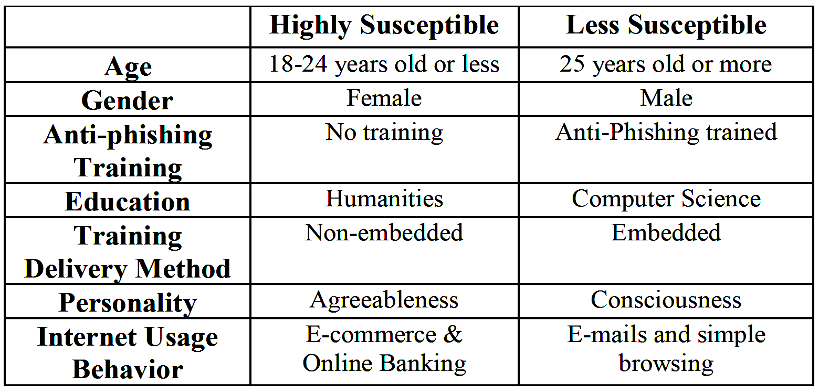 Table 1: User demographics and their susceptibility to social engineering attacks.
Key Findings from Result Analysis:
- Age Matters: Users aged 18-24 are significantly more susceptible, likely due to higher comfort with transparency and lower risk perception.
- Personality Profiling: Users high in "Agreeableness" (desire to please others) are prime targets for persuasion-based tricks.
- Training Efficacy: Embedded, hands-on training (simulated attacks) is vastly superior to passive lectures.
Critical Insights & Future Outlook
This paper serves as a bridge between pure sociology and cybersecurity. It argues that we cannot "patch" human behavior the same way we patch software.
Limitations: The model is descriptive, not predictive. While it explains why a trick works, it does not yet offer a mathematical probability of an attack's success in a specific network topology.
The Takeaway: Future defense systems must be context-aware. If a user is experiencing "high affect" (emotional arousal), social networking platforms could theoretically implement "cooling-off" periods or secondary authentication steps specifically designed to re-engage the brain's logical centers before sensitive information is shared.
Main Reference: Social Engineering in Social Networking Sites: Affect-Based Model (Algarni et al.)