
SoAGREE: Mastering Group Dynamics through Hierarchical Attention
Social-Enhanced Attentive Group Recommendation
This paper proposes AGREE (Attentive Group REcommEndation) and its extension SoAGREE, leveraging neural attention mechanisms and Neural Collaborative Filtering (NCF) to recommend items to groups. It dynamically learns group member weights and incorporates social followee information to achieve state-of-the-art results on Mafengwo and CAMRa2011 datasets.
TL;DR
Recommending a restaurant to a group of friends is significantly harder than recommending one to an individual. SoAGREE (Social-enhanced Attentive Group REcommEndation) solves this by abandoning "one-size-fits-all" aggregation rules (like averaging everyone's tastes). Instead, it uses Hierarchical Attention Networks to dynamically learn who "calls the shots" for specific items and enriches user profiles using their social followee networks, all powered by a robust Neural Collaborative Filtering backbone.
The Problem: Why Group Decisions are Elusive
Most group recommendation systems operate on a flawed assumption: that group members' influence is static. Whether it's the "Average" strategy or the "Least Misery" approach (don't pick anything anyone hates), these methods are data-independent.
In reality, influence is contextual. If a group is choosing a destination in China, a member who has traveled there extensively should have a higher "vote" or attention weight. Existing SOTA methods often missed three critical components:
- Dynamic Weighting: Member influence changes depending on the item.
- Social Context: Your social followees are a goldmine for understanding your personal latent preferences.
- Task Synergy: Group-item and user-item interactions are two sides of the same coin and should be modeled together.
Methodology: Deep Dive into SoAGREE
1. The Hierarchical Attention Architecture
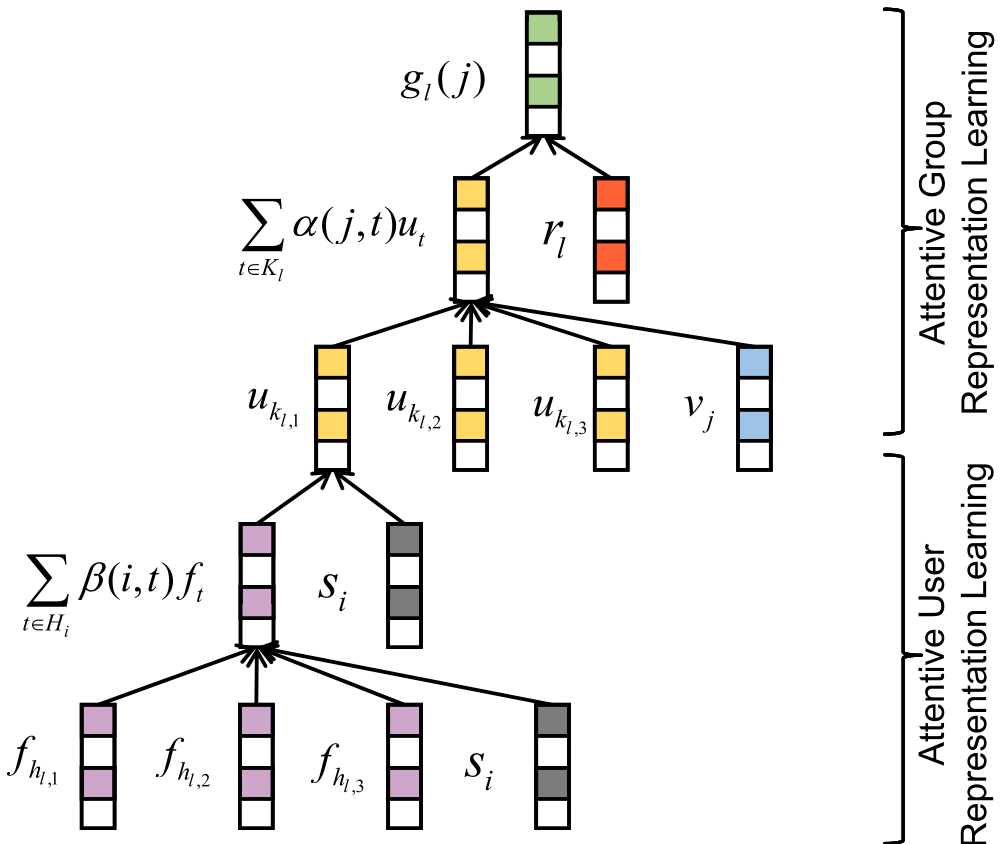
The core innovation lies in the two-stage attention process that builds a "Semantic Bridge" between individuals and groups.
- Group-Level Attention: Instead of a simple sum, the model calculates an attention score for member regarding item . This ensures that "experts" or highly interested members contribute more to the final group embedding.
- User-Level Attention: Each user's representation is enhanced by aggregating their followees' embeddings through another attention layer. This captures the "Social Influence" aspect, where your tastes are often shaped by those you follow.
2. Interaction Learning with NCF
Once the group and user embeddings are refined, they are passed into a Neural Collaborative Filtering (NCF) framework. Unlike Matrix Factorization (MF) which uses a simple inner product, SoAGREE uses a multi-layer neural network to capture non-linear, high-order correlations.
A key design choice here is the Shared Hidden Layers. Since group embeddings are derived from user embeddings, they exist in the same semantic space. Sharing layers allows the model to use abundant user-item data to "warm up" or reinforce the sparser group-item recommendation task.
Experimental Results
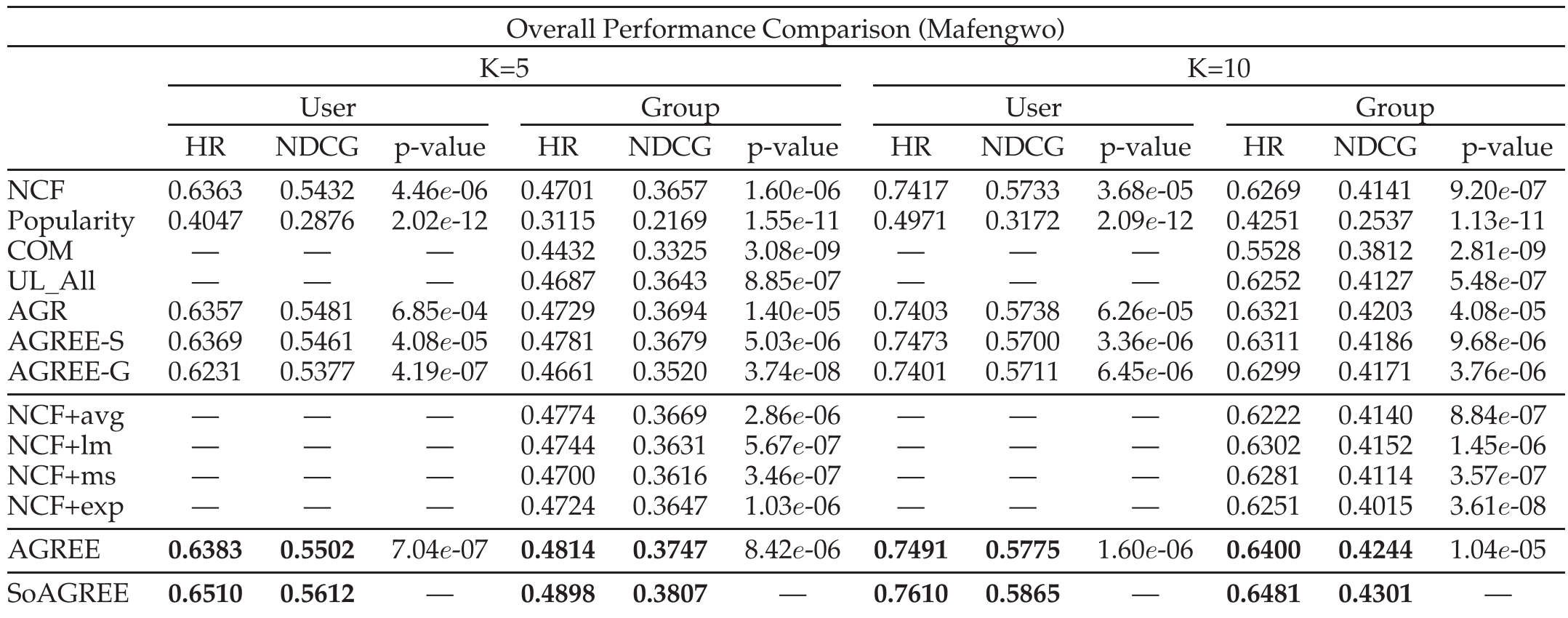
The researchers tested SoAGREE on Mafengwo (tourism) and CAMRa2011 (movies).
Key Findings:
- Superiority over Predefined Strategies: It consistently beat NCF+avg and NCF+lm, proving that learned weights are better than fixed math.
- Social Power: On the Mafengwo dataset, SoAGREE (with social data) significantly outperformed AGREE (without social data), highlighting that who you follow defines what you like.
- Interpretability: Micro-level analysis (see Table below) showed that the attention weights actually shifted logically. For instance, when recommending a Chinese travel destination, the model automatically assigned higher weights to group members who had previously visited China.
Deep Insight: Beyond the Math
The genius of SoAGREE isn't just in the attention mechanism; it's in the representation of "Group Utility." By including a "General Group Preference" embedding () alongside the aggregated member weights, the model accounts for the "Family Cinema Effect"—where a group might choose an educational movie that none of the members would have watched alone, simply because they are acting as a group.
Conclusion & Future Outlook
SoAGREE marks a shift from static social filters to dynamic, attentive neural models. While the current work focuses on implicit feedback, the authors hint at the next frontier: Online Reinforcement Learning. As group dynamics shift in real-time on social platforms, recommenders must learn to adapt "on the fly" rather than relying on batch-trained weights.
Key Takeaway: If you are building a recommendation engine for social platforms, stop averaging users. Start attending to them.