
Social Event Extraction: Moving Beyond Trending Topics to Hyper-Local Intelligence
Social event extraction: Task, challenges and techniques
This paper introduces a novel framework for "Social Event Extraction," specifically targeting localized, organized events (e.g., concerts, tech mixers) on platforms like Facebook. The authors propose a tuple representation (type, phrase, time, location) and utilize an unsupervised content segmentation approach combined with external knowledge bases (Foursquare/Yelp) to achieve high-precision fine-grained location detection.
TL;DR
While most research on social media event detection focuses on "what's trending" (e.g., elections or disasters), this paper tackles the harder problem of "Social Event Extraction"—identifying small-scale, organized local events like gallery openings or neighborhood parties. By combining unsupervised phrase segmentation with external POI (Point of Interest) databases like Yelp, the authors transform messy Facebook posts into structured data: <Event Type, Phrase, Time, Location>.
The "Tail" Entity Problem
Traditional Event Extraction (EE) systems, such as those developed for the ACE program, are built for the "New York Times" style of writing. They expect clear grammar and well-known entities. In the chaotic world of social media, these models break down.
The authors identify two fatal flaws in previous SOTA methods when applied to social events:
- Lack of Redundancy: Local events (like a local band playing at a dive bar) aren't mentioned millions of times, so frequency-based trending algorithms ignore them.
- Granularity Gap: Standard NER (Named Entity Recognition) might identify "San Francisco" as a location, but for a social event, you need the specific venue (e.g., "Monarch Bar") to make the information useful for a recommendation system.
Methodology: The Hybrid Architecture
The proposed system bypasses the limitations of supervised learning for informal text by using a multi-layered approach.
1. Two-Stage SVM Classification
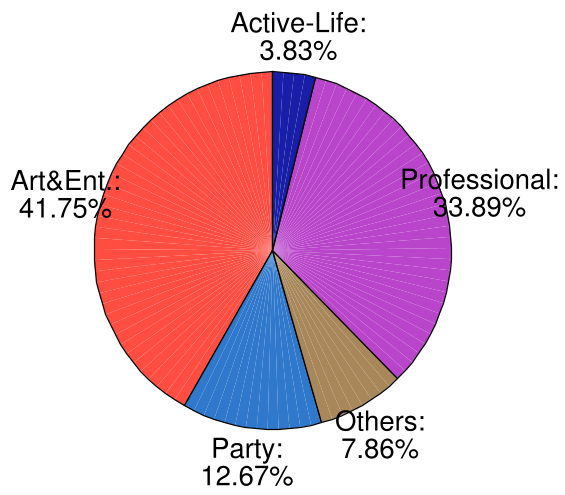
Instead of a single complex model, the authors use a binary classifier to first filter "social" vs "non-social" posts, followed by a multi-class SVM to categorize the event into types like Art & Entertainment, Professional, or Active Life.
2. Unsupervised Content Segmentation
To extract event phrases (like "Tech in Motion"), the authors avoid standard POS taggers, which frequently fail on slang. Instead, they use a PMI (Pointwise Mutual Information) stickiness function powered by the Microsoft Web N-gram corpus.
The intuition: Words that frequently appear together in the massive Bing index are likely to be part of the same "event phrase," even if they aren't in a standard dictionary.
3. Fine-Grained Location Linking
This is the paper's "secret sauce." The system takes suspected location segments and queries Foursquare and Yelp APIs. By matching the informal mention (e.g., "MEZZ") to a confirmed POI in a commercial database ("Mezzanine"), they resolve the ambiguity of social media shorthand.
Experiments and Insights
The researchers curated a new benchmark dataset from Facebook Public Pages, where 63.6% of posts were event-related—a much richer source than the general Twitter stream.
| Task | Accuracy / F-1 |
|---|---|
| Social Event Detection (Binary) | 85.0% |
| Event Type Categorization | 78.6% |
| Event Phrase Extraction (Unsupervised) | 34.0% (F-1) |
| Fine-Grained Location Extraction | 51.9% (F-1) |
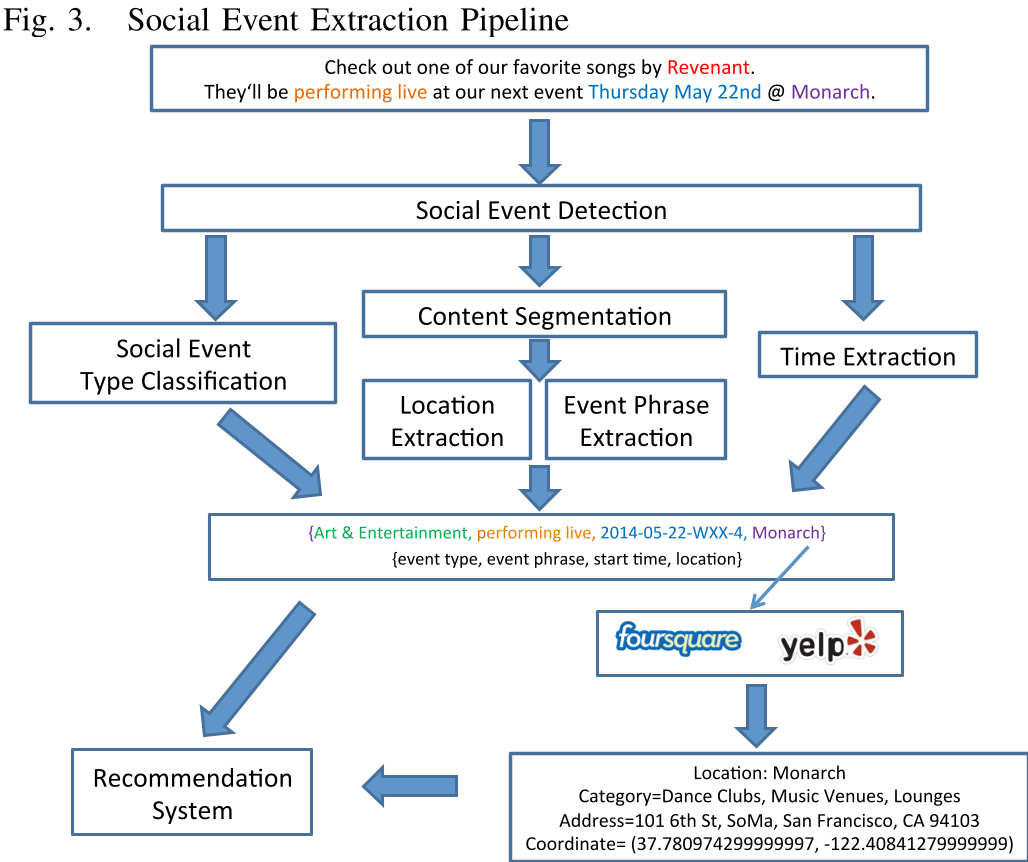
The results show that while classification is relatively accurate, phrase extraction remains the "Final Boss" of NLP in this domain. The 34% F-1 score reveals the extreme difficulty of identifying exactly which words define an event when the language is as varied as "going to Phono Del Sol" vs "join the SF Opera."
Critical Analysis & Future Outlook
The primary contribution of this work is the shift from "Global Trends" to "Local Context." By defining the social event as a specific tuple anchored to a POI, the authors provide a blueprint for next-generation LBS (Location Based Services).
Limitations:
- The system still struggles with "partial names" (e.g., "MEZZ" for "Mezzanine").
- The phrase extraction relies on a graph-based random walk that becomes sparse if data is limited.
The Future: As we move toward 2026, the inclusion of Collective Inference—clustering multiple posts about the same event—will likely be the key to overcoming the noise of individual messages. For developers building recommendation engines, this paper proves that external Knowledge Bases (Yelp/Foursquare) are no longer optional; they are the necessary "ground truth" for social media mining.