
Social Event Networks: Bridging the Gap Between Intent and Reality in Urban Space
Social Event Network Analysis: Structure, Preferences, and Reality
The paper introduces a social event network analysis framework applied to bimodal (user-performance) data from the "Long Night of Music" in Munich. By modeling interactions as bipartite graphs, the authors validate that socio-spatial event data exhibits small-world properties and high clustering characteristic of social networks.
TL;DR
This study investigates the "Long Night of Music" (LNM) event in Munich by modeling user-event interactions as a social network. The research proves that distributed cultural events possess "small-world" properties and introduces a methodology to measure how closely participants follow their planned itineraries.
Background: The Event as a Network
In a distributed urban event, thousands of participants move between hundreds of performances. While these interactions are often viewed as simple logistics, this paper argues they form a bimodal social network. By treating users and performances as nodes in a bipartite graph, the authors reveal hidden structural patterns in human socio-spatial behavior.
Problem & Motivation: The "Plan vs. Execution" Paradox
Existing location-based social network (LBSN) research often focuses on online traces (Check-ins). However, offline distributed events present a unique challenge:
- Implicit Links: Connections are formed by shared presence at a performance, not explicit "friending."
- Deliberation vs. Reality: There is a significant difference between what a user plans to see (Preference) and what they actually attend (GPS-tracked attendance). The authors seek to quantify this mismatch and determine if these temporary interactions mirror the structural robustness of permanent social networks.
Methodology: High-Dimensional Analysis
The researchers employed a multi-stage analytical pipeline:
1. Structure: Bipartite Projections & KNC-Plots
To measure connectivity, they used K-Neighborhood-Connectivity (KNC) plots to see how the network degrades as the requirement for shared performances increases. They then projected the bipartite graph into a user-only graph to calculate Small-World metrics.
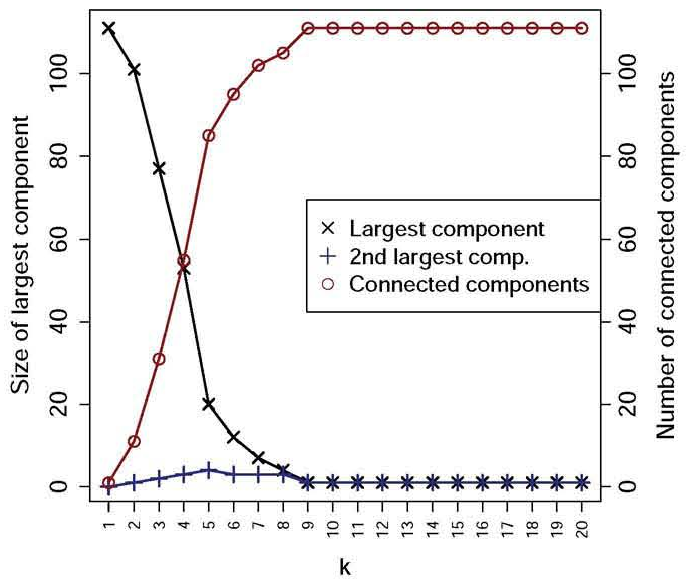 Figure 1: High connectivity is observed; a single giant component persists even when requiring multiple shared performances.
2. Dynamics: Plan Fulfilment Measures
Using Information Retrieval theory, they defined:
- Recall (u): Did the user attend what they intended?
- Precision (u): Did the user only attend what they intended (no ad-hoc visits)?
3. Individuality: Formal Concept Analysis (FCA)
Using FCA, they derived the User Individuality Coefficient (uic) to measure how unique a participant's night was compared to others.
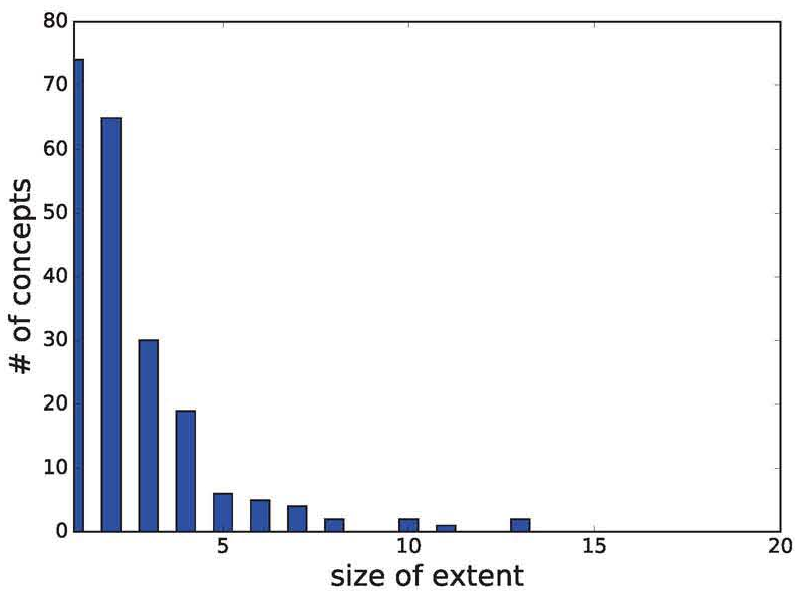 Figure 2: Distribution of concepts shows a high number of individuals with entirely unique performance sets.
Experiments & Results
The findings were striking:
- The Social Connection: The LNM network exhibits an Average Shortest Path Length of ~1.6, significantly lower than random graphs, proving that participants are "closer" than expected through shared experiences.
- High Individuality: The was 0.93, meaning 93% of users had a unique attendance list.
- Low Fulfilment: The average plan fulfilment was only 0.23. Most users attended performances they hadn't planned for (Ad-hoc behavior) or skipped segments of their itinerary.
- Subgroup Insights: Using Subgroup Discovery, the authors found that "Handmade Music" and "Hit/Rock" performances had the highest overlap between intention and attendance.
Critical Insight & Conclusion
This paper shifts the perspective of event management from "scheduling" to "social network engineering." The low plan fulfilment rate suggests that static itinerary planning is insufficient. Users are "socially influenced" or "spatially distracted" during the event.
Future Outlook: For developers of tour-planning apps (like those for Disney World or Music Festivals), this research suggests that algorithms must be dynamic and reactive, accounting for the "high individuality" and "ad-hoc" nature of urban exploration. The next step is integrating real-time social density data to predict where "intent" will likely give way to "reality."