
SES: Maximizing Social Attendance Through Strategic Event Scheduling
Social Event Scheduling
This paper introduces the Social Event Scheduling (SES) problem, an "event-centric" optimization task aimed at maximizing total attendance by strategically assigning candidate events to specific time intervals. The authors propose a Greedy (GRD) approximation algorithm to solve this NP-hard problem, significantly outperforming baseline methods in realistic scenarios.
TL;DR
Successfully organizing a large-scale festival like Summerfest isn't just about booking the best talent—it's a high-stakes game of scheduling. This paper tackles the Social Event Scheduling (SES) problem: how to assign events to time slots to maximize total attendance while navigating user habits, resource limits, and "poaching" from competing events. The authors prove this is a hard (NP-hard) problem and offer a Greedy algorithm that outperforms standard selection strategies.
Background: Moving from Participant to Organizer
In the world of Event-based Social Networks (EBSN), researchers usually ask: "Given these events, which users should attend?" This paper flips the script. It asks: "Given these users and these competitors, when should I host my events?"
The "Satisfactory" metric here isn't just user happiness—it's the revenue and publicity generated for the organizers. To solve this, one must account for:
- Spatiotemporal Conflicts: You can't have two shows on the same stage at the same time.
- User Habits: Alice might love Pop music, but if she works every Tuesday, scheduling a concert then is a waste.
- External Competition: A rival club hosting a DJ nearby will naturally syphon off your potential crowd.
Methodology: The Logic of Choice
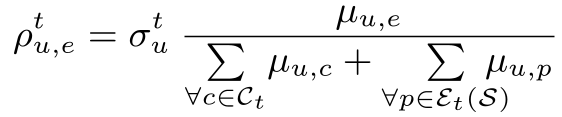
The authors use Luce’s Choice Theory to calculate the probability of a user attending event at time . The intuition is that a user's attention is a finite resource divided among all available "attractions" (both yours and the competitors').
The Formal Core
The attendance probability is determined by the user's affinity for the event divided by the sum of affinities for all other events happening at the same time:
The Greedy (GRD) Algorithm
Because checking every possible schedule combination is computationally impossible (NP-hard), the authors developed a Greedy (GRD) approach.
- Initialization: Calculate the potential score (expected gain) for every possible (Event, Time) pair.
- Selection: Pick the pair that adds the most attendees to the total tally.
- Dynamic Update: Once an event is scheduled at time , the "worth" of other potential events at that same time changes (because they now compete with your own new event). The algorithm updates these scores and repeats until events are scheduled.
 Note: The GRD algorithm ensures that internal competition between your own events is accounted for in every step.
Experiments & Real-World Impact
The researchers tested their model against a massive Meetup dataset from California, containing over 42,000 users.
Performance vs. Baselines
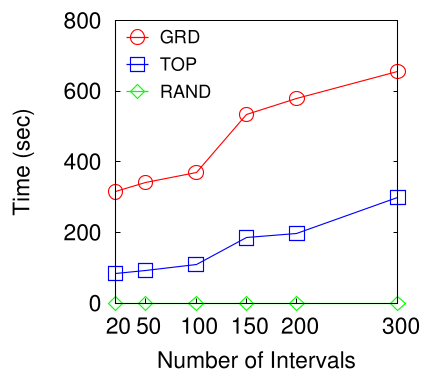
- TOP Strategy: Selecting events that are simply popular in isolation fails because it ignores that two popular events at the same time "steal" each other's audience.
- RAND Strategy: Random assignment, as expected, performs poorly.
- GRD Result: The Greedy algorithm consistently finds the "sweet spot" in the schedule, maximizing the utility (total attendees) across varying numbers of events () and time intervals ().
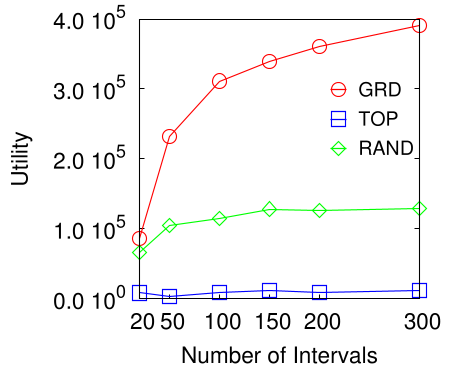 Figure: Utility vs. number of events scheduled (k). GRD maintains a clear lead as complexity increases.
Critical Insight & Conclusion
This work highlights a fundamental truth in event planning: Context is everything. An event's success is not just a factor of its own quality, but of when it happens and who else is trying to grab the audience's attention at that exact moment.
Limitations: The model assumes user interests are static and that we have perfect knowledge of competitors' schedules. In a real-world "arms race" between venues, both parties might adjust schedules dynamically, which would require a Game Theory approach rather than simple greedy optimization.
Future Outlook: This framework is highly extensible. Tomorrow's event planning software could integrate real-time social media "hype" data into the affinity function , allowing organizers to pivot their schedules based on emerging trends in real-time.