
Social Explanations: Do They Actually Work, or Just Trick Us into Clicking?
Do Social Explanations Work? Studying and Modeling the Effects of Social Explanations in Recommender Systems
This paper investigates the impact of "social explanations" (e.g., "Friend X likes this") in music recommender systems through a user study (N=237). It introduces a generative probabilistic mixture model to quantify how systemic explanations interact with inherent user preferences to influence decision-making.
TL;DR
In this classic study, researchers from Cornell University dissect the ubiquitous "Your friend likes this" feature in recommender systems. By separating the decision to try an item (Likelihood) from the decision to enjoy it (Consumption), they reveal a startling truth: social explanations are powerful tools for persuasion (CTR), but they are surprisingly poor predictors of whether you will actually like the product.
Context: The Ubiquity of Social Proof
From Facebook's "Like" counts to Amazon's "Customers also bought," social proof is the engine of modern discovery. We are neurobiologically wired to trust the crowd or our friends. However, this paper argues that we shouldn't treat all "social info" as equal. A recommendation from a close friend with great taste is fundamentally different from a raw "Like" count.
The Core Problem: Persuasion vs. Satisfaction
The authors identify a critical disconnect in RecSys research:
- Persuasiveness: Does the explanation make you click?
- Informativeness: Does the explanation help you accurately predict your future enjoyment?
Most systems optimize for the former, leading to what they call "the gap." If a system tricks you into watching a movie you hate because "3 friends liked it," the system succeeds in the short term but erodes trust in the long term.
Methodology: The "ExploreMusic" Experiment
The researchers built a web app that pulled real Facebook data.
- Phase I (Likelihood): Users saw 30 unknown artists paired with one of 5 social explanation strategies.
- Phase II (Consumption): A week later, users actually listened to the music and rated it.
The Five Strategies:
- OverallPop: Total global likes.
- FriendPop: "N of your friends like this."
- RandFriend: "Friend X likes this" (picked randomly).
- GoodFriend: "Close Friend Y likes this" (based on interaction frequency).
- GoodFrCount: Combines the close friend's name with the total friend count.
The Mathematical Intuition: The Mixture Model
To explain the results, the authors proposed a Generative Model. They hypothesized that a user's likelihood rating () isn't just one factor—it's a mixture:
- (The Skeptic): An exponential decay function. This represents our natural "discerning" nature—we assume most things are bad until proven otherwise.
- (The Social Animal): A Gaussian (Normal) distribution. This represents the "shove" the explanation gives us toward a certain rating.
- (Rigidity): How much the user ignores the explanation.
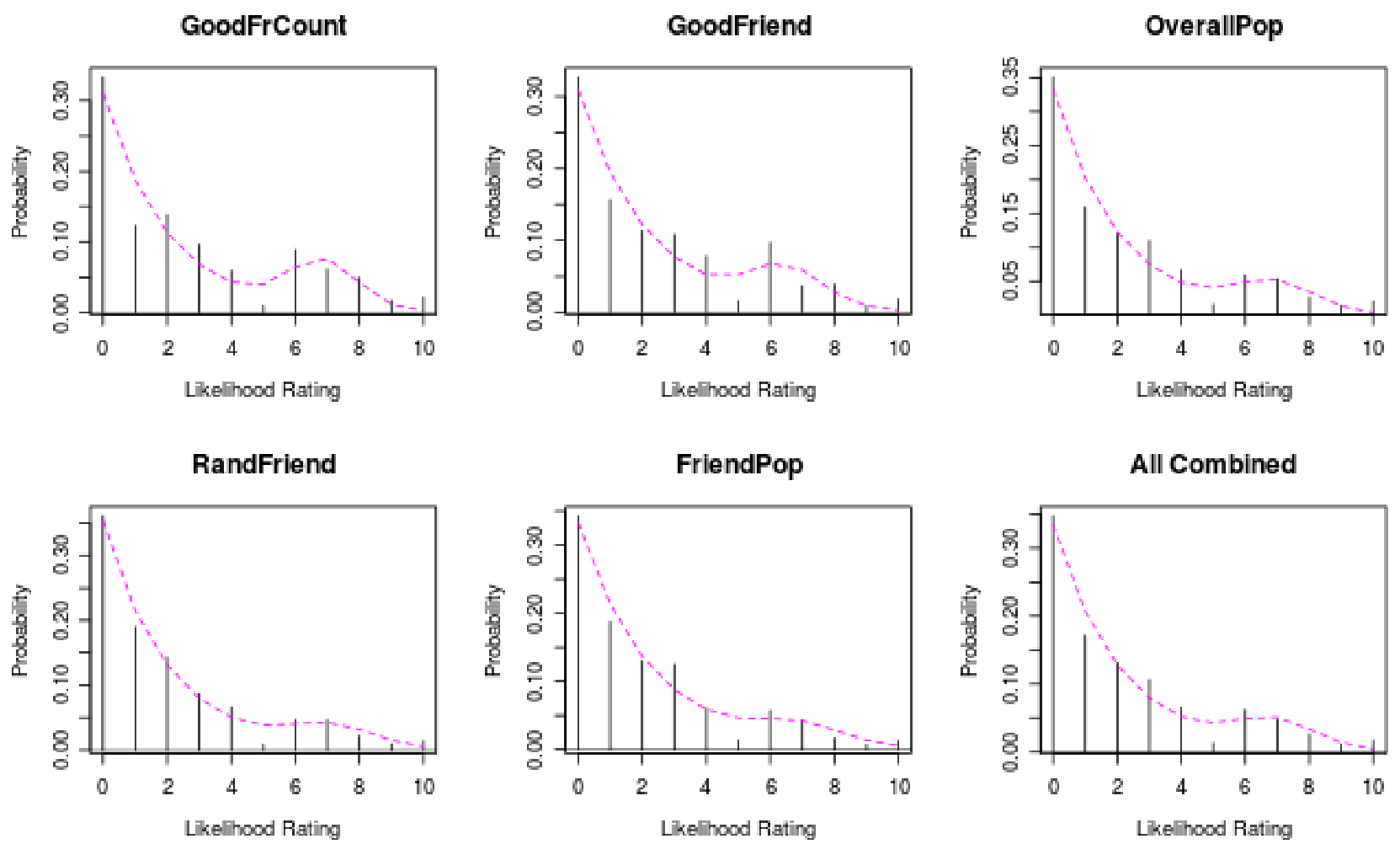 The model (line plot) accurately captures the "bump" created by social explanations against the backdrop of natural skepticism.
Key Insights
- Names > Numbers: Seeing a specific friend's name (especially a "Good Friend") is far more persuasive than seeing a count like "12 people like this."
- The Persistence of Skepticism: Even with great explanations, the "mode" of likelihood ratings was 0. Social info is a "second-order effect"—it helps, but it won't save a bad recommendation.
- The "Informativeness" Failure: The correlation between Likelihood and Consumption was only 0.17. Social explanations are great at getting you to "check it out," but they provide almost zero insight into whether you'll actually appreciate the music.
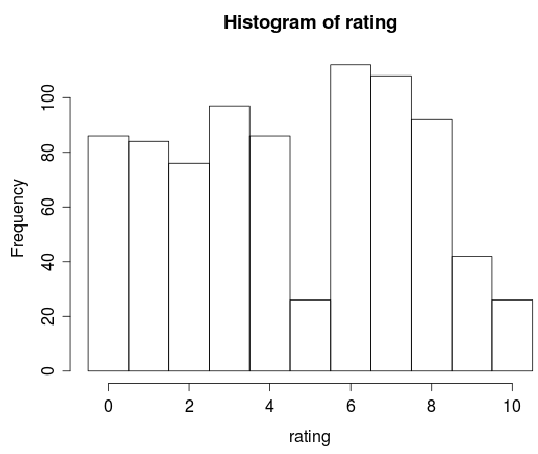 Consumption ratings were nearly uniform, showing that the high "Likelihood" ratings driven by social proof didn't translate into high "Consumption" satisfaction.
Engineering Implications: Two-Phase Optimization
If (Likelihood) and (Consumption Rating) are not correlated, we shouldn't optimize for just one. The authors suggest a constrained optimization: In plain English: "Find the best possible item that also has an explanation persuasive enough to make the user actually click it."
Conclusion: Toward Personalized Explanations
The study discovered three clusters of users:
- Cluster 1: Traditionalists (Unmoved by social proof).
- Cluster 2: The Skeptics (Slightly moved by good data).
- Cluster 3: The Socialites (Heavily reliant on what friends think).
Future recommender systems shouldn't just personalize the "What." They must personalize the "Why." If a user is a "Cluster 1" type, don't waste UI space on social counts—show them technical tags or genres instead.