
Social Fabric and the Rhythm of Fear: Beyond Local Neighbors
Social fabric and fear of crime: Considering spatial location and time of day
This study investigates the complex relationship between social networks and fear of crime using egocentric network data from Southern California. It introduces the "safety ties" concept and employs spatial-temporal modeling to demonstrate that the impact of social networks on fear varies significantly between day and night and across different geographic scales.
TL;DR
Why do some people feel safer in high-crime neighborhoods while others living in "safe" areas are paralyzed by fear? This study reveals that our fear is not just a reaction to local statistics, but a product of our social fabric. By analyzing "safety ties" across Southern California, researchers found that the distance of our friends and the time of day change how we process danger. Crucially, having safety ties reduces fear primarily at night, and knowing people in even more dangerous areas can actually make us feel safer during the day through social comparison.
The Paradox of Social Ties
In criminology, the "Social Disorganization Theory" suggests that ties are good—they foster collective action and trust. Conversely, the "Indirect Victimization" view suggests ties are bad—they act as conduits for scary gossip and "urban legends" about crime.
The authors of this study argue that both can be true, but only if you look at where those ties are and when the fear occurs. Most research treats "fear of crime" as a static trait, but it is actually a dynamic response to the environment that shifts when the sun goes down.
Methodology: Mapping the "Safety Tie"
The researchers moved beyond generic social ties (like "friends" or "kin") to identify Safety Ties: individuals an person would specifically contact if they observed a crime near their home.
Using the American Social Fabric Project (ASFP), they linked 1,359 respondents to:
- Spatial coordinates of both the ego (the person) and their alters (their ties).
- Micro-crime data for both the ego's and the alters' census tracts.
- Temporal surveys measuring fear specifically during the day versus after dark.
Note: The study utilizes a multi-scale spatial decay model to account for how neighbors (micro), regional friends (meso), and distant contacts (macro) influence individual psychology.
Core Insights: The "Comparison" Effect and Nighttime Guardianship
1. Relative Safety (The Daytime Comparative Insight)
One of the most striking findings is that if your friends live in high-property-crime neighborhoods, your own fear decreases during the day. This suggests a "downward comparison" mechanism: hearing about worse conditions elsewhere makes your current environment seem safer. However, this effect disappears at night, when the primal fear of physical vulnerability overrides social comparison.
2. The Power of Local Proximity
The study reinforces the "distance decay" principle. Safety ties within a 1.6km (1 mile) radius are significantly more effective at reducing fear. Interestingly, these local ties are four times more powerful at reducing fear during the day than at night. This points to the "guardianship" mechanism—knowing someone is physically there to watch the street.
3. Why Nighttime is Different
Fear of crime is universally higher at night. The study found that:
- Violent crime in your own neighborhood is the primary driver of nighttime fear.
- Safety Degree (the number of ties) reduces fear at night.
- Social Isolation (having zero safety ties) significantly spikes fear during the day, but its effect is absorbed by other factors at night, as everyone feels more vulnerable in the dark.
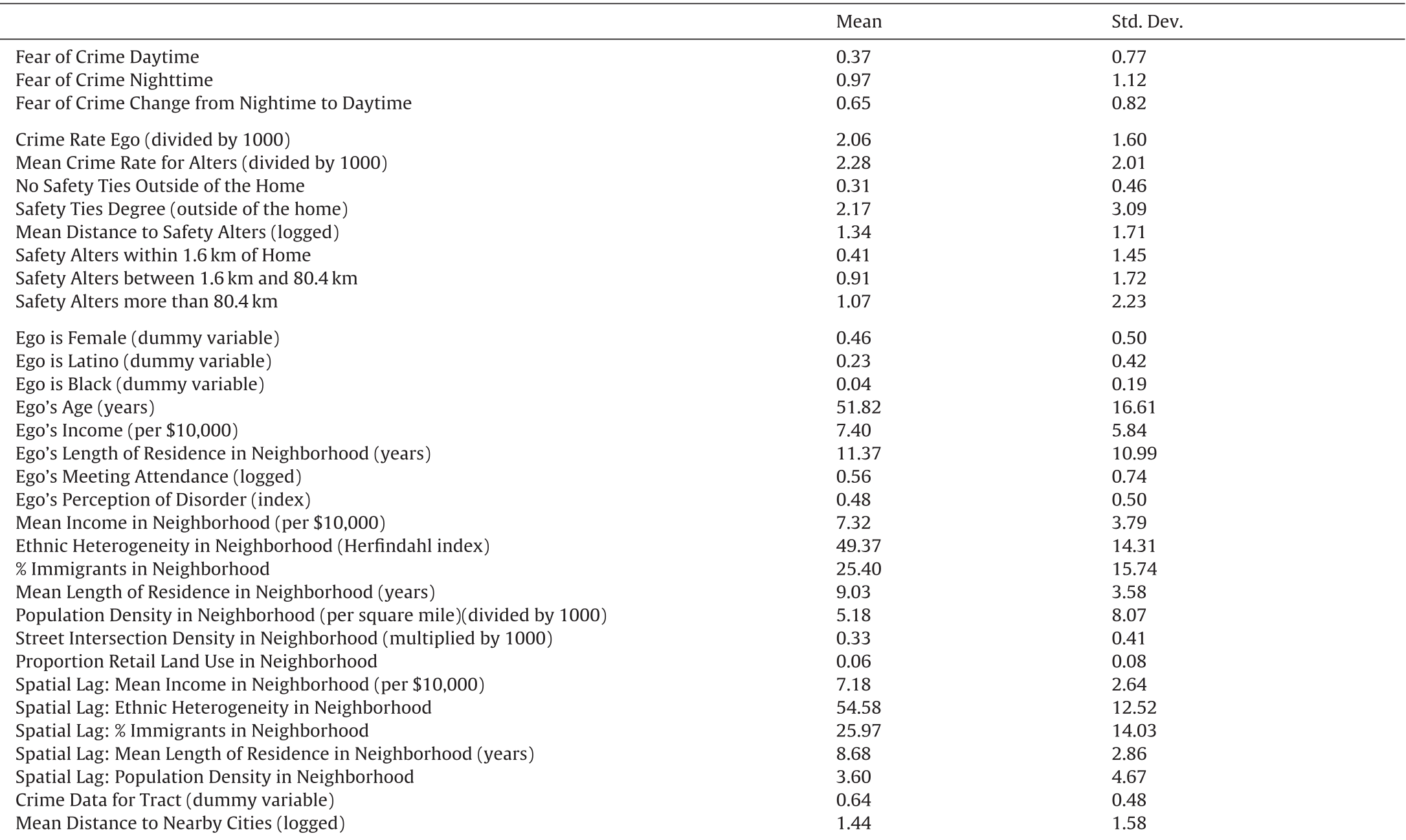 Table 1: Descriptive statistics highlighting the stark baseline difference between Daytime (0.37) and Nighttime (0.97) fear levels.
Critical Analysis
The study's strength lies in its Relational Perspective. It shifts the focus from the individual to the "networked neighborhood." By proving that crime rates in other neighborhoods (measured via alters) affect my fear, the authors demonstrate that mental maps of safety are not bounded by census tract lines.
Limitations:
- Static Locations: The data assumes people stay at home. In reality, people work and commute, meaning their "guardianship" and "risk" move with them.
- Cross-sectional Nature: We cannot definitively say if fear makes people withdraw from making ties, or if a lack of ties causes fear (though the authors provide strong evidence for the latter).
Conclusion: Takeaway for the Future
For urban planners and sociologists, the message is clear: Density of ties is just as important as the density of police. To reduce urban fear, interventions should not just focus on crime reduction, but on strengthening the "safety fabric"—assisting residents in forming ties specifically geared toward neighborhood safety. The future of safe cities lies in understanding that our sense of security is a collective, spatial, and temporal construct.