
From Access to Fluency: Reimagining the Digital Divide
Social Facilitators and Inhibitors to Online Fluency
This paper reformulates the "digital divide" from a binary of access into a spectrum of "online fluency," identifying social facilitators and inhibitors. It categorizes Internet usage patterns across demographics and proposes that social networks, technical infrastructure, and cultural relevance are the primary drivers of digital literacy.
Executive Summary
TL;DR: This seminal paper by Caroline Haythornthwaite argues that the "digital divide" is not a simple binary of haves and have-nots, but a complex spectrum of online fluency. It posits that social infrastructures—like family networks and community support—are the true engines of digital inclusion.
Background Positioning: This work serves as a critical theoretical pivot. It moves the academic discourse away from a "pro-innovation bias" (which measures speed of adoption) toward a "practice-oriented" view that values how technology meaningfully integrates into daily life.
The "Moving Target" Problem
The core insight of this paper is that the digital divide is a moving target. As early adopters (typically young, affluent, and tech-savvy) move to newer innovations like broadband or social media, they set a new benchmark for "inclusion."
The author identifies three alarming patterns:
- Temporary Lags: Gaps that close over time (e.g., gender).
- Evolving Delays: Groups that catch up but remain perpetually behind the latest innovation (e.g., low-income groups and broadband).
- Permanent Exclusion: Groups that may never catch up due to systemic barriers (e.g., specific rural regions or the disabled).
Methodology: The Four Pillars of Fluency
Haythornthwaite dismantles the problem by analyzing the social facilitators that actually drive "fluency"—the ability to use the Internet seamlessly across life's domains.
1. Social Networks and "Proxy Use"
One of the most profound insights is the role of Net Evaders. These are individuals who do not use computers themselves but utilize the Internet through a "proxy"—often a child or a spouse.
- Children as Catalysts: Kids bring skills from school into the home, often gaining social status as they teach their parents.
- The Workplace Effect: Professional use lowers the "frustration curve," allowing skills to trickle down into the household.
2. Infrastructure: Beyond the PC
Inclusion is heavily dictated by where access happens. Schools and libraries are not just terminals; they are "social infrastructures" that provide technical support which a home environment might lack.
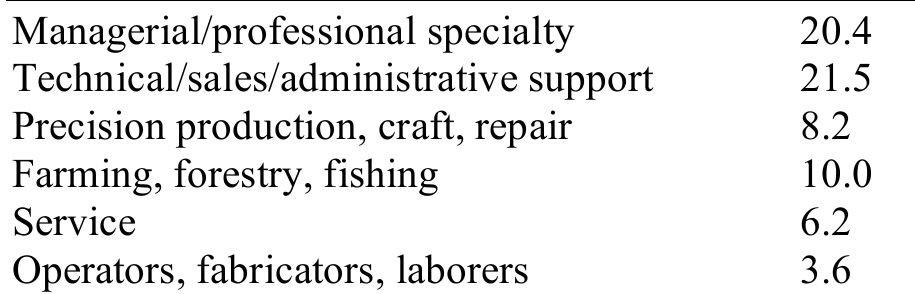 The table above demonstrates how occupation dictates the likelihood of becoming an "experienced" user—technical and managerial roles provide the "support environment" necessary for fluency.
3. Culture and Content
High access does not guarantee use if the content is irrelevant. The paper highlights a "representation gap":
- Language Barrier: While English speakers made up ~35% of users, they occupied ~70% of the content.
- Cultural Relevance: If the content doesn't speak to a user's ethnic, regional, or lifestyle needs, they perceive the Internet as "not for them."
Key Results and Usage Disparities
The paper provides a detailed breakdown of how different groups use the web. It categorizes users into Netizens (fluent), Utilitarians (functional), Experimenters (learning), and Newcomers.
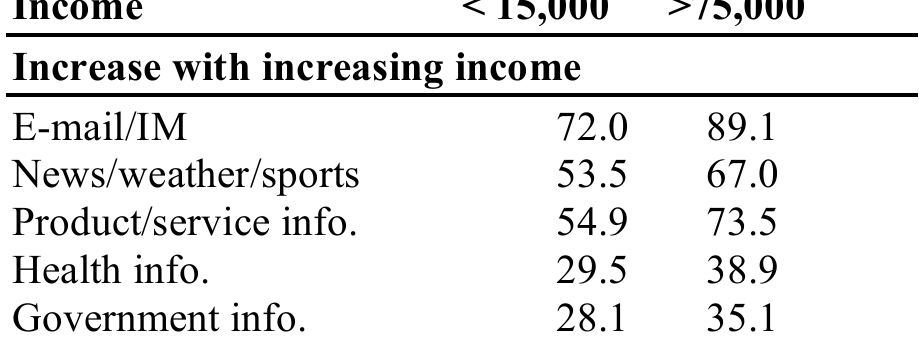 Crucial Data Exhibit: Higher income correlates with "instrumental" use (banking, news), while lower income correlates with "recreational" or "survival" use (gaming, job searches).
Critical Analysis & Conclusion
Takeaway
The paper successfully argues that connectivity goes to the already connected. Those with high social capital (good friends, strong schools, steady jobs) find it easier to bridge the digital gap.
Limitations
Published in 2006, the paper could not anticipate the "mobile-first" revolution. While smartphones have bridged the physical access gap significantly, they have created a new "app-divide" where consumption replaces the creative fluency Haythornthwaite advocates for.
Future Outlook
For today’s researchers, this work serves as a reminder: adding a "feature" or an "app" doesn't solve inequality. We must build technical and social scaffolds—community support and relevant local content—to turn "users" into "fluent citizens."