
Social Factory Architecture: When Industry 4.0 Meets Social Networking
Social Factory Architecture: Social Networking Services and Production Scenarios Through the Social Internet of Things, Services and People for the Social Operator 4.0
The paper introduces the "Social Factory Architecture," a high-level framework that integrates the Social Operator 4.0 within an Adaptive, Collaborative, and Intelligent Multi-Agent System (ACI-MAS). It leverages the Social Internet of Things, Services, and People (SIoTSP) to enable real-time "socialization" and cooperation between humans, machines, and software systems via Enterprise Social Networking Services (E-SNS).
TL;DR
This paper redefines the factory floor as a social ecosystem. By introducing the Social Operator 4.0 and the Social Factory Architecture, the authors move beyond simple automation toward a "Human-Automation Symbiosis." Using an Intelligent Multi-Agent System (MAS) and Enterprise Social Networks, the framework allows humans, machines, and AI to communicate as "social entities" to solve production problems in real-time.
Problem & Motivation: The Human-Centric Gap in Industry 4.0
While Industrie 4.0 has digitized the factory, it has often left the human operator as a secondary component. The technical pain point identified is the "out-of-the-loop" performance problem: when systems are too automated, humans lose situation awareness, leading to catastrophic errors when intervention is finally required.
The authors' insight is that production is inherently social. By treating machines as "Social Assets" and software as "Social Companions," we can shift from rigid automation to a flexible, adaptive environment where control is shared based on context and current "agenthood" status.
Methodology: The ACI-MAS Architecture
The core of the proposal is the Adaptive, Collaborative, and Intelligent Multi-Agent System (ACI-MAS). This architecture bridges the physical and cyber worlds through specialized agents:
- Human/Artificial Agents: The digital representation of the worker and the machine.
- Active Interface Agents: These "look over the shoulder" of the user, learning through observation and feedback to provide personalized assistance only when a difficulty is detected.
- Broker Agents: The "conductors" of the factory. They manage the Levels of Automation (LoA), deciding when to trade control between a human and a robot based on the mission's current needs.
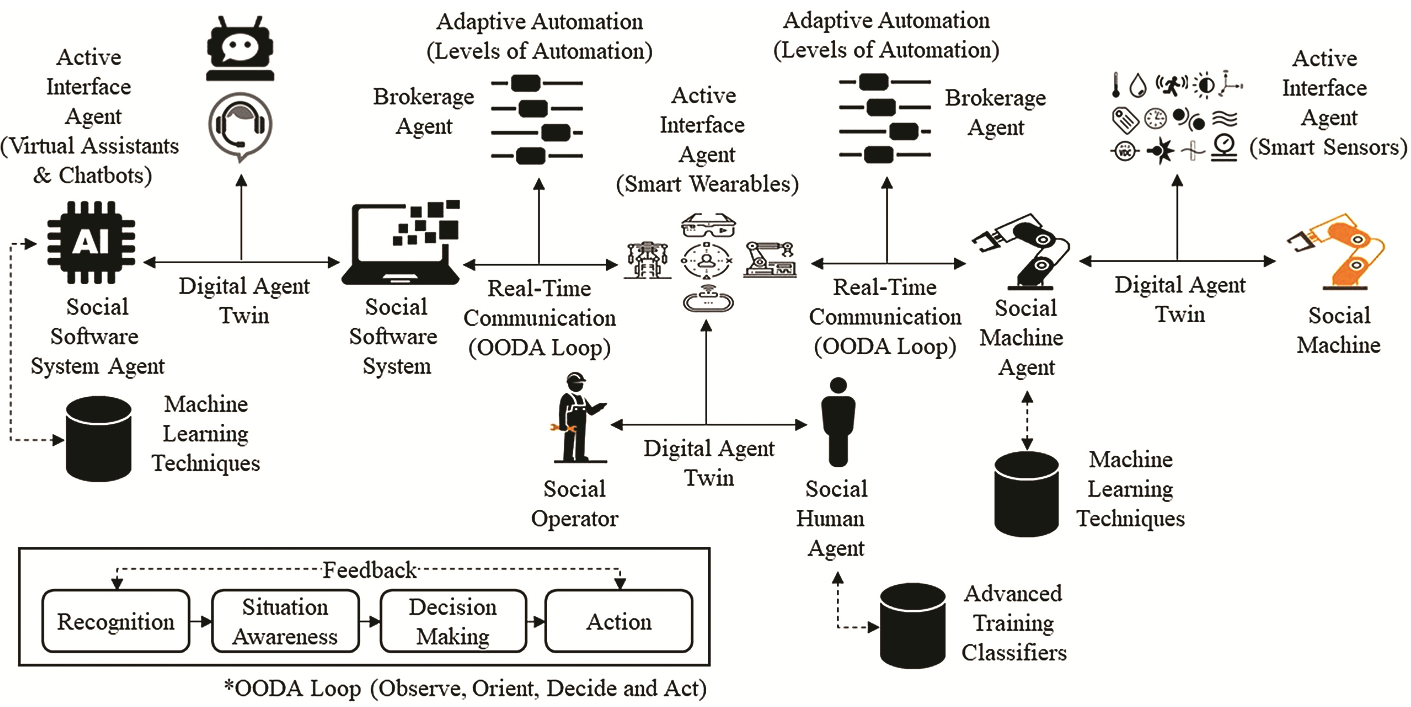 Figure 1: High-level Social Factory Architecture illustrating the interaction between Human Agents, Artificial Agents, and the Broker/Interface layers via Enterprise Social Networking Services.
Production Scenarios: The Factory as a Social Network
The paper envisions three primary networking scenarios powered by an Enterprise Social Networking Service (E-SNS) (think of it as a professional, industrial-grade Twitter or Facebook):
- Operator-to-Operator: Using smart wearables (like MS HoloLens), an operator can broadcast a problem to a network of experts, receiving real-time holographic guidance regardless of geographical location.
- Operator-to-Machine: Machines act as "social things," posting updates about their health, location, and availability. Interaction happens via "Interactive Machine Learning," where the operator acts as a mentor to the machine.
- Operator-to-Software: AI systems like IBM Watson act as "Virtual Assistants," proactively providing decision support by monitoring the factory's "social feed" for anomalies.
Experiments & Results: Toward Symbiosis
The work emphasizes the Humanware factor. By using Advanced Trained Classifiers (ATC) and Digital Poka-Yokes (error-proofing), the system monitors mental workload and prevents judgment errors.
The primary "result" is a framework that maintains Human Inclusiveness. Unlike traditional automation which aims to replace the operator, the Social Factory aims to tech-augment them. The integration of social networking logic allows for "social problem-solving," which the authors argue is far more flexible for complex, unpredictable manufacturing tasks than static algorithms.
Critical Analysis & Conclusion
Takeaway
The paper successfully shifts the paradigm of Industry 4.0 from "Connectivity of Things" to "Socialization of People, Services, and Things." The move toward Human-Automation Symbiosis is a direct precursor to what many now call Industry 5.0.
Limitations
While the architecture is conceptually robust, the paper lacks large-scale empirical data or quantitative benchmarking against traditional ERP/MES systems. The privacy implications of monitoring "humanware" (mental workload and error tracking) through ATCs also remain a significant hurdle for real-world adoption.
Future Outlook
The next step for this research lies in the "Social Machine to Social Machine" interaction, where decentralized fleets of robots could negotiate resources and schedules through social protocols without any centralized server intervention.