
Socially-Aware PSNs: How Social Ties and Selfishness Shape Mobile Networks
Impact of Social Features on the Performance of Pocket Switched Network
This paper investigates the performance of Pocket Switched Networks (PSN) by proposing a "contact-and-cooperative" model that integrates BA scale-free social structures and differentiated node selfishness. Using routing algorithms like PROPHET and BUBBLE RAP, the authors demonstrate that social network awareness significantly improves packet delivery ratio and reduces delay compared to non-socially aware models.
TL;DR
Researchers from the University of Science and Technology of China have developed a new framework to understand how our social lives impact "Pocket Switched Networks" (PSNs). By modeling nodes not as random particles, but as socially connected individuals with varying degrees of selfishness, they discovered that social structures actually help networks survive selfishness. In fact, "hub" nodes (the social butterflies of the network) become the unsung heroes, carrying the brunt of the work when others refuse to cooperate.
Background: The Human Element in Networking
A Pocket Switched Network (PSN) is essentially a network formed by the smartphones in our pockets using Bluetooth or D2D communication. Unlike traditional networks, PSNs are intermittent and rely heavily on "store-carry-forward" mechanics.
The authors identify two fatal flaws in previous research:
- The Ghost of Randomness: Most models assume people move randomly. In reality, we are more likely to meet friends than strangers.
- The Myth of Altruism: Most models assume nodes always help. In reality, nodes (users) are selfish—they save battery or bandwidth for themselves, especially for "outsiders."
Methodology: The Contact-and-Cooperative Model
The core of this research is a mathematical bridge between social topology and networking physics.
1. Scaling Contact Frequency
Instead of a uniform Poisson process, the contact rate () is scaled by social distance and community affiliation . If you are in the same community and have a short social hop-count, your "contact probability" spikes.
2. Modeling Social Selfishness
The paper introduces a differentiated cooperation model. A node's willingness to relay a packet isn't a fixed coin flip; it's a social decision: This means nodes are highly likely to help those in their social circle but will likely ignore requests from social "strangers."
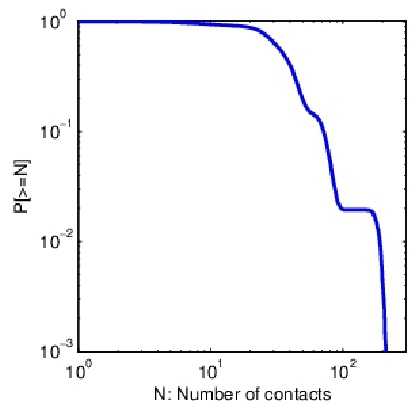 Fig 1: The model's contact distribution (left) closely mimics real-world traces from Infocom06 (right), validating its accuracy.
Key Insights: Why Hubs Matter More in Selfish Networks
The most profound finding of the paper lies in the behavior of "Hub Nodes"—nodes with high social centrality.
- Predictability Wins: Algorithms like PROPHET perform significantly better in socialized scenarios because social structures create "predictable paths" that the algorithm can exploit.
- The Resilience of Hubs: Under heavy selfishness (), regular nodes saw their relay activity drop by over 40%. However, hub nodes only saw a 6.74% drop.
- Why? Because hub nodes are socially "close" to almost everyone. Their cooperative probability remains high across the network, making them the backbone of the system when the "socially isolated" nodes stop helping.
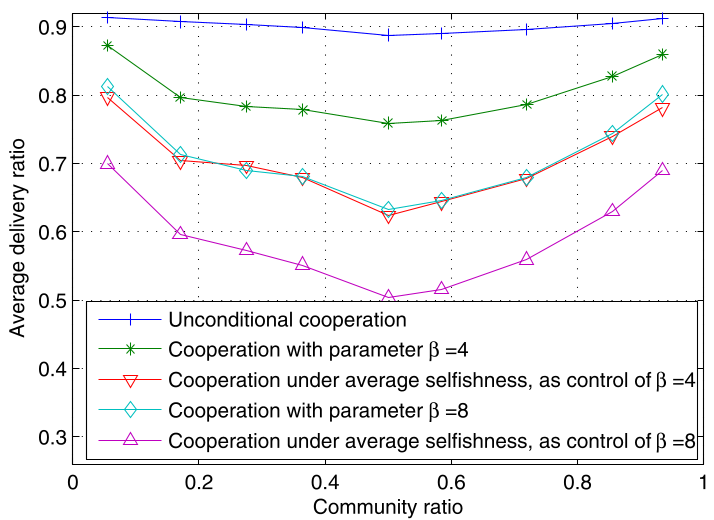 Fig 2: Comparison of delivery ratio. Notice how social structure awareness consistently outperforms non-social models in PROPHET.
Experimental Results
Through semi-analytical derivation and simulation, the authors compared different strategies:
- Spray-Wait: Randomly forwarding packets. This strategy actually suffers in social networks because it wastes copies on socially distant nodes who are likely to be selfish.
- BUBBLE RAP: High-performing by design, it uses social hierarchies. The paper proves its effectiveness is amplified by social selfishness because it naturally gravitates toward the cooperative hub nodes.
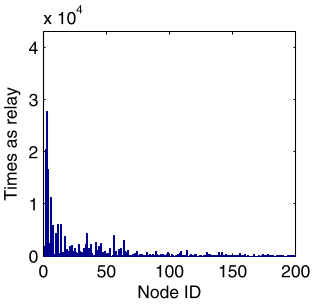 Fig 3: Relay frequency across the network. As selfishness increases (from left to right), the "spikes" (hub nodes) remain prominent while the "floor" (regular nodes) drops to near zero.
Critical Analysis & Conclusion
This paper shifts the perspective from seeing "selfishness" as a net negative to seeing it as a socially distributed variable.
Takeaway: In the real world, "Social Selfishness" is actually more efficient than "Individual Selfishness." Because we prioritize helping those close to us, and hub nodes are close to many, the network maintains a "high-speed backbone" of social hubs despite widespread non-cooperation.
Limitations: The model assumes a static social network. In reality, social ties evolve. Future work should investigate how "dynamic social ties"—new friendships or fading acquaintances—affect the stability of PSN routing.
Final Assessment: A robust theoretical and simulative study that reinforces the importance of using Social Graphs to optimize opportunistic wireless protocols.