
SocialFilter: Leveraging Social Networks to Democratize Spam Mitigation
SocialFilter: Introducing social trust to collaborative spam mitigation
SocialFilter is a trust-aware collaborative spam mitigation system that enables nodes to identify spammers by querying a network of reporters. It combines Sybil-resilient Online Social Network (OSN) trust inference with report auditing to achieve high spam-blocking effectiveness without the false positives typical of rate-limiting approaches.
TL;DR
SocialFilter is a collaborative framework that allows mail servers to share spam intelligence without fear of manipulation. By integrating human social relationships (OSNs) into the trust calculation, it filters reports through a "Sybil-resilient" lens. It outperforms traditional rate-limiting systems like Ostra by eliminating false positives while maintaining nearly 100% spam detection accuracy.
Context & Motivation: The Failure of Blind Collaboration
The battle against spam has moved from individual filters to centralized blacklists (like SpamHaus) and eventually to collaborative P2P systems. However, open collaboration is a double-edged sword:
- The Honesty Assumption: Most P2P systems assume reporters are truthful, but botnets can easily join these networks to whitelist themselves or blacklist rivals.
- The Sybil Threat: Attackers can generate thousands of fake identities (Sybils) to "outvote" honest nodes in a reputation-based system.
- The Cost of Centralization: Professional reputation services are expensive and lack the diverse vantage points needed to catch short-lived "disposable" spamming IPs.
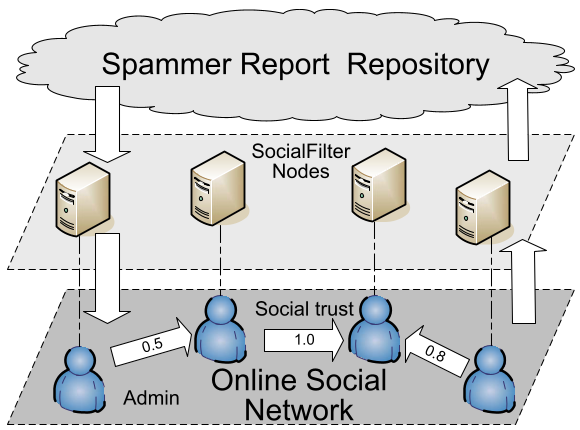
SocialFilter's Core Insight: Nodes don't report spam; people do. By linking a reporter's identity to a real-world social network account, we can distinguish between a network of real administrators and a cluster of botnet-controlled Sybils.
Methodology: The Two Pillars of Trust
The system calculates a Spammer Belief value using two primary metrics to weigh any incoming report.
1. Reporter Trust (Competence & Honesty)
SocialFilter calculates how much we should trust "what" a node says. This is built on a Reporter Trust Graph:
- User-Defined Trust: Admins manually rate the competence of their social acquaintances.
- Report Comparison: If two "friends" report the same IP, the similarity of their reports updates their mutual trust score using an exponential moving average.
- Transitivity: It uses a Max-Trust-Path algorithm (Dijkstra-based) to propagate trust from a small set of "pre-trusted" anchors to the rest of the network.
2. Identity Uniqueness (Sybil Defense)
This calculates how much we trust "who" is speaking. Even if a node reports accurately, it shouldn't have outsized influence if it's part of a Sybil farm. SocialFilter employs a SybilLimit-based technique:
- It performs random walks (routes) on the social graph.
- Since honest social networks are "fast-mixing," random walks from honest nodes tend to stay within the honest region and intersect.
- Sybil clusters are usually connected to the main graph by only a few "bottleneck" edges, causing their random walks to have distinct, non-intersecting tails.
Experimental Validation: SocialFilter vs. Ostra
The authors compared SocialFilter against Ostra, a well-known system that uses social links to "charge" credit for messages.
Effectiveness and False Positives
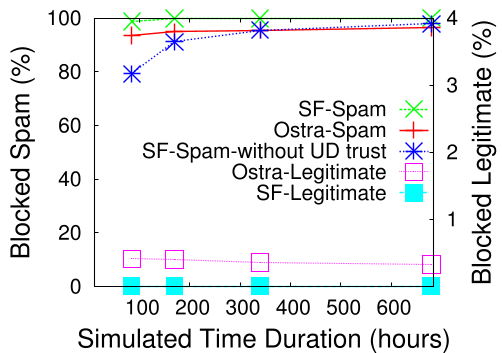
The results highlight a critical trade-off. Ostra works by rate-limiting. If a path carries too much spam, that path is blocked. Unfortunately, this often traps legitimate emails (False Positives) that happen to share those social paths.
- SocialFilter Results: Achieve ~99% spam blocking after a short warm-up period.
- The Zero FP Advantage: SocialFilter only blocks an IP if there is a direct, trusted consensus that the IP is a spammer. In the absence of malicious reporters, SocialFilter’s false positive rate is 0.0%.
The Resilience to Sybils
When spammers created 100+ Sybils to flood the system with false reports, SocialFilter (with Identity Uniqueness enabled) remained stable. Without the Identity Uniqueness module, the system collapsed, proving that social transitivity alone is insufficient—topology-based Sybil defense is the "secret sauce."
Critical Analysis & Takeaways
SocialFilter successfully "democratizes" spam mitigation. It allows smaller mail servers to benefit from the collective intelligence of the network without requiring a centralized, paid authority.
Key Points:
- Auditing Strategy: The use of report similarity to dynamically update trust edges is a brilliant way to "self-heal" the trust graph.
- Limitations: The system relies on the availability of a social graph. If administrators are not active on OSNs (or if OSN providers like Meta don't share graph data), the system loses its signal. Furthermore, while it handles Sybils well, a massive collusion of real (non-Sybil) compromised accounts could still poison the repository.
Future Outlook: This framework could easily be extended beyond email to protect against DDoS attacks, fake news propagation, or malicious actors in decentralized marketplaces.