
Social Filtering: Levering the "Six Degrees of Kevin Bacon" for Better Movie Predictions
Social Filtering Using Social Relationship for Movie Recommendation
The paper introduces a Social Filtering (SCF) method for movie recommendation that enhances traditional Collaborative Filtering by integrating user social relationships. By applying the "Six Degrees of Kevin Bacon" theory to calculate weights for direct and indirect social ties, the system achieves significantly higher recommendation quality (Hit Ratio) compared to traditional user-based baselines.
TL;DR
While most algorithms recommend movies based on what people like you watched, this paper argues that they should look at who you trust. By integrating the "Six Degrees of Separation" theory into Collaborative Filtering, the authors created a "Social Filtering" (SCF) model that outperforms traditional methods in recommendation quality, particularly when user data is sparse.
Problem & Motivation: The Missing Link in Recommendations
Traditional Collaborative Filtering (CF) focuses on finding "nearest neighbors" in a matrix of ratings. However, this mathematical approach lacks a human element: Trust. In the real world, we don't just watch what strangers with similar tastes watch; we listen to our friends.
The authors identified two major pain points:
- Data Sparsity: If a user hasn't rated many movies, the system can't find similar users.
- Reliability: Traditional CF treats all "similar" users equally, whereas social relationships provide a naturally reliable filter for opinions.
Methodology: Mapping Social Proximity
The core innovation lies in Advanced User Modeling. Instead of just looking at rating similarities, the system builds a User-User social network and assigns weights based on path distance.
1. The Six Degrees Theory
Using the "Six Degrees of Kevin Bacon" concept, the authors assign weights:
- Direct Friend: Weight = 1.0
- Each step away: Weight decreases by 0.2
- > 5 steps or no connection: Weight = 0.0
2. Refining the Social Path
In a complex social graph, multiple paths exist between two people. The authors don't just take the shortest path; they calculate the Standard Deviation of the edge weights (user similarities) along the path. They choose the path with the smallest standard deviation, aiming for the most "consistent" social link.
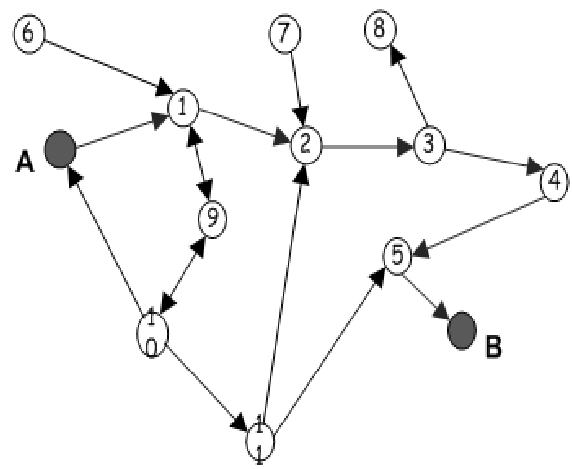 Fig 1: The overall architecture where social links and rating histories are fused.
3. The Similarity Boost Formula
The final similarity between two users () is a hybrid of their rating similarity () and their social relation weight (): This ensures that even if two friends have a low rating similarity due to a lack of shared data, their social bond "boosts" their influence on each other.
Experiments & Results: Quality Matters
The researchers tested their method using data from Epinions, involving nearly 1,000 users and over 100,000 ratings.
Key findings included:
- Precision: SCF showed better performance than traditional CF as the number of recommendations () grew.
- Hit Rate (HR): This was the most significant victory. As shown in the graph below, the Hit Rate for traditional CF drops sharply as increases. In contrast, the Social Filtering method (SCF) maintains a much higher quality of recommendations.
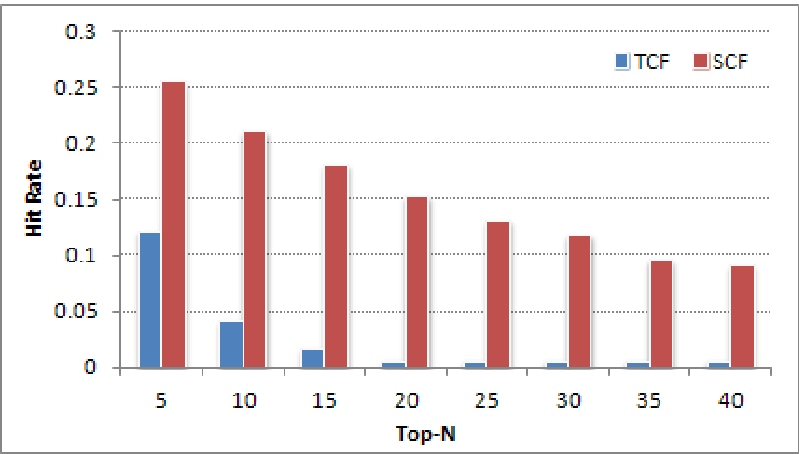 Fig 2: Hit Rate (HR) comparison between TCF and SCF. Note how SCF maintains quality even as the list gets longer.
Critical Analysis & Future Outlook
Takeaway
The study proves that social relationships are a powerful proxy for item preference. By mathematically quantifying "indirect" friends (friends of friends), we can build a much richer user profile than ratings alone allow.
Limitations
- Performance vs. Quality: While the Hit Rate improved drastically, the F1-measure (a balance of precision and recall) remained similar to traditional methods.
- Computational Complexity: Calculating paths in a large social graph using standard deviation and evaluation functions is more expensive than basic matrix multiplication.
Future Work
The authors suggest that future systems should incorporate content attributes (like movie genre or actors) and dynamic behaviors (comments, visits) to further refine the "Advanced User Modeling." As social media continues to dominate our digital lives, these hybrid "Social-Collaborative" models will likely become the industry standard for personalized discovery.