
SF-PHD Filter: Beyond Independent Motion in Pedestrian Tracking
The Social Force PHD Filter for Tracking Pedestrians
The paper proposes the Social Force PHD (SF-PHD) filter, a novel multi-target tracking framework that integrates the Social Force Model into the Probability Hypothesis Density (PHD) filter. It implements both Sequential Monte Carlo (SMC) and Gaussian Mixture (GM) versions to track multiple pedestrians whose motions are interdependent due to social interactions and environmental obstacles.
TL;DR
Researchers from McMaster University have bridged the gap between social physics and multi-target tracking by introducing the Social Force PHD (SF-PHD) filter. By embedding social interaction dynamics directly into the Probability Hypothesis Density framework, they have created a tracker that "understands" why pedestrians move the way they do—resulting in a 40% improvement in tracking accuracy in crowded environments.
The "Independent Actor" Fallacy
In the world of classical radar and surveillance, we often treat targets like billiard balls moving in a vacuum—completely oblivious to one another. But pedestrians are social animals. We veer to avoid a oncoming person, slow down in a crowd, and gravitate toward exits.
The problem is that standard filters (like the basic PHD or MHT) assume Independent Motion. When two pedestrians walk side-by-side or cross paths, these filters often get confused, resulting in "merged" tracks or targets losing their identities because the filter didn't expect the sudden social-distancing maneuver.
Methodology: The Physics of Social Interaction
The authors integrate the Social Force Model into the prediction step of the PHD filter. This model defines the "forces" acting on a pedestrian as a sum of three vectors:
- Personal Motivation (): The desire to reach a destination at a specific velocity.
- Repulsive Forces (): The urge to maintain personal space and avoid bumping into others or walls.
- Physical Constraints (): Environmental factors like sidewalk edges.
Architectural Innovation
Integrating these forces into a PHD filter is non-trivial because the original PHD filter is "identity-blind." The authors solved this with two distinct implementations:
- SMC-SF-PHD (Sequential Monte Carlo): Uses a Particle Labeling approach. Each particle carries a tag that persists through the prediction and update phases, allowing the filter to calculate the distance between specific target clusters to determine social repulsion.
- GM-SF-PHD (Gaussian Mixture): Employs a Stacked State Approach. By stacking target states into a single vector, the filter can propagate correlated covariances, capturing how the uncertainty of one pedestrian's position affects our prediction of their neighbor.
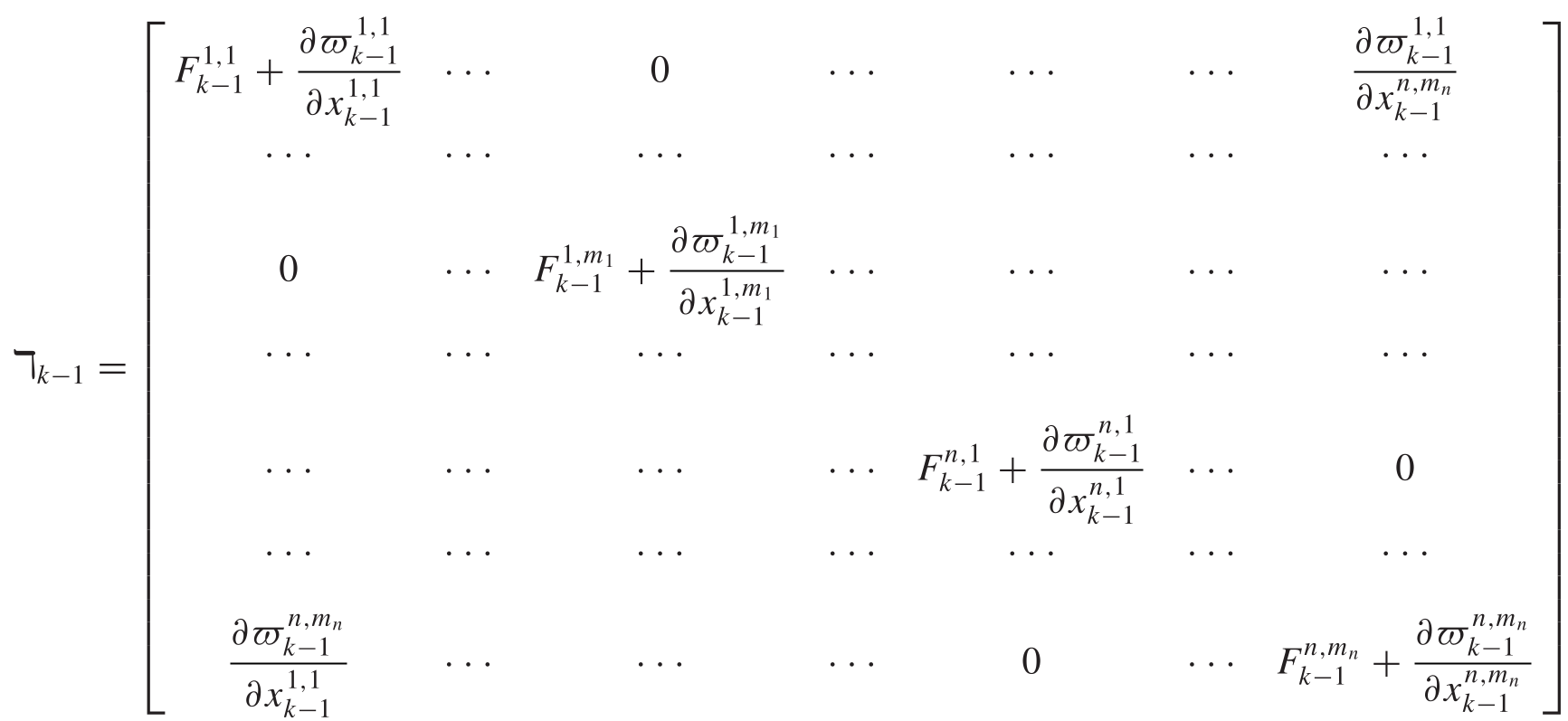 Note: The Jacobian matrix shown above illustrates how the stacked state accounts for the partial derivatives of social forces between targets.
Performance: Proving the Intuition
The researchers didn't just stop at a new model; they derived a new Posterior Cramér–Rao Lower Bound (PCRLB) specifically for dependent targets. This provides a theoretical "gold standard" for the minimum possible error when targets interact.
Key Experimental Results
- Position Accuracy: In a 7-target simulation, the SMC-SF-PHD achieved an RMSE of 1.42m, compared to 2.47m for the standard SMC-PHD.
- Velocity Estimation: The inclusion of "motivational forces" allowed the filter to predict velocity changes much more accurately than constant-velocity models.
- Real-World Validation: Using a standard pedestrian dataset (Andriluka et al.), the SF-PHD successfully maintained tracks during complex crossings where standard MHT trackers failed.
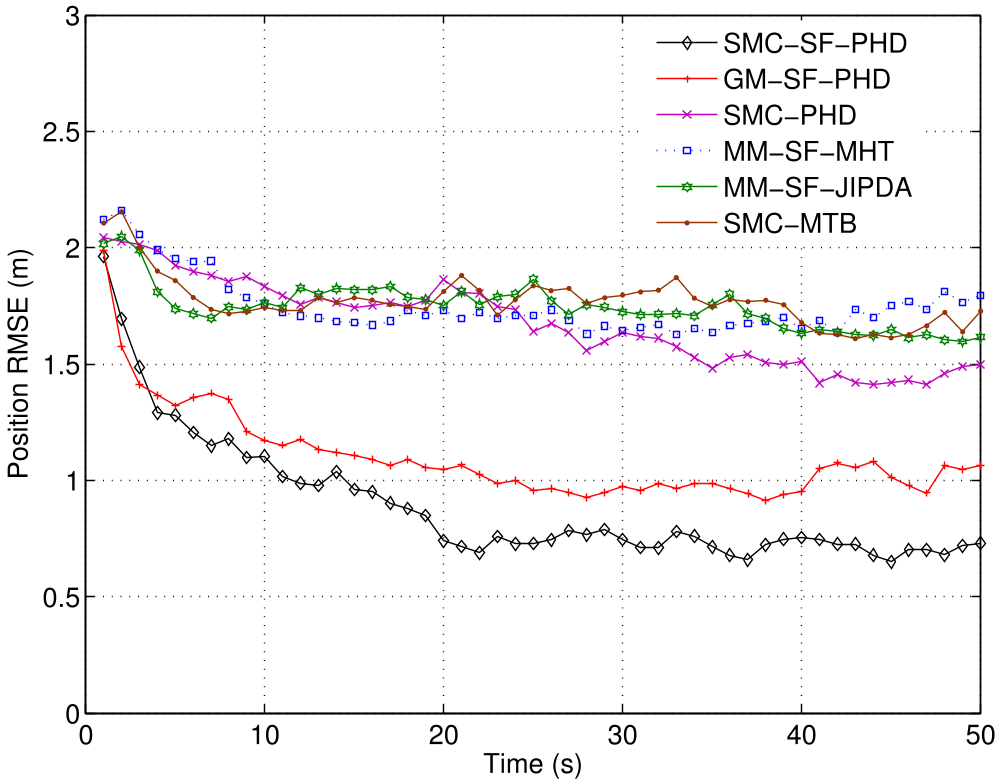 Fig: Comparison of RMSE position errors showing SF-PHD (bottom curve) significantly outperforming traditional filters.
Critical Insight & Future Outlook
The beauty of the SF-PHD filter lies in its Inductive Bias. By telling the math that "people avoid each other," the filter needs less "convincing" from noisy sensor data to realize that two people walking close together are still two distinct individuals.
Limitations: The primary drawback is computational complexity. The SMC implementation's complexity increases exponentially with the number of targets because every particle must check its distance from every other target.
Future Work: Moving toward online parameter estimation (e.g., using an IMM framework to "learn" a pedestrian's desired speed on the fly) will be the next step in making this technology production-ready for autonomous robots and smart city surveillance.
Conclusion
The Social Force PHD filter proves that the best way to track humans is to understand human behavior. By treating social interaction as a physical force, we can create tracking systems that are not just reactive, but predictive.