
NC-based SFR: Aligning Social Roles for Precise Friend Recommendation
4869_Social Friend Recommendation Based on Multiple Network Correlation.
The paper introduces NC-based SFR, a social friend recommendation algorithm that correlates "social role" networks (e.g., Tag and Contact networks) through network alignment and feature selection. By identifying the most influential features that bridge different network topologies, it achieves superior recommendation precision on large-scale datasets like Flickr.
TL;DR
Social networks are not monolithic; we act as photo-sharers in one context and friends in another. This paper proposes NC-based SFR, an algorithm that aligns these different "social role" networks—specifically Tag similarity and Contact lists—to recommend friends. By selecting a sparse set of "important" features while preserving the network's local geometry, the method significantly boosts recommendation precision on real-world Flickr data.
Problem & Motivation: The Gap Between Tags and Friendships
Why is recommending friends on platforms like Flickr or Twitter so hard? Existing systems often use "friend of a friend" heuristics or raw Content Similarity. However, the authors argue that "Interest" (what you tag) and "Affiliation" (who you follow) represent different topologies.
The physical intuition is simple: Not every tag you use is a "social" tag. You might tag a photo with "Nikon" (camera brand) and "Eiffel Tower" (location). "Eiffel Tower" might connect you to travelers (potential friends), while "Nikon" might just be a technical Metadata. Standard algorithms treat these equally, adding noise to the recommendation engine.
Methodology: Aligning Networks via Feature Selection
The core innovation lies in treating friend recommendation as a Network Alignment problem.
1. Network Projection & Correlation
The authors don't just compare tag vectors. They project the Contact Network into its eigen-subspace (capturing structural importance) and then attempt to map the Tag Network into this same space. This is formulated as a minimization problem: Here, is the feature selection matrix. The -norm forces to be row-sparse, effectively picking out only the tags that actually "explain" why two people are friends.
2. Structure Preservation
To avoid over-fitting, the algorithm ensures that if two users were similar in the original tag space (semantically), they remain close after the projection. This is achieved using a Laplacian-based preservation term: This ensures the global and local topology of the interest-based network isn't mangled during the alignment process.
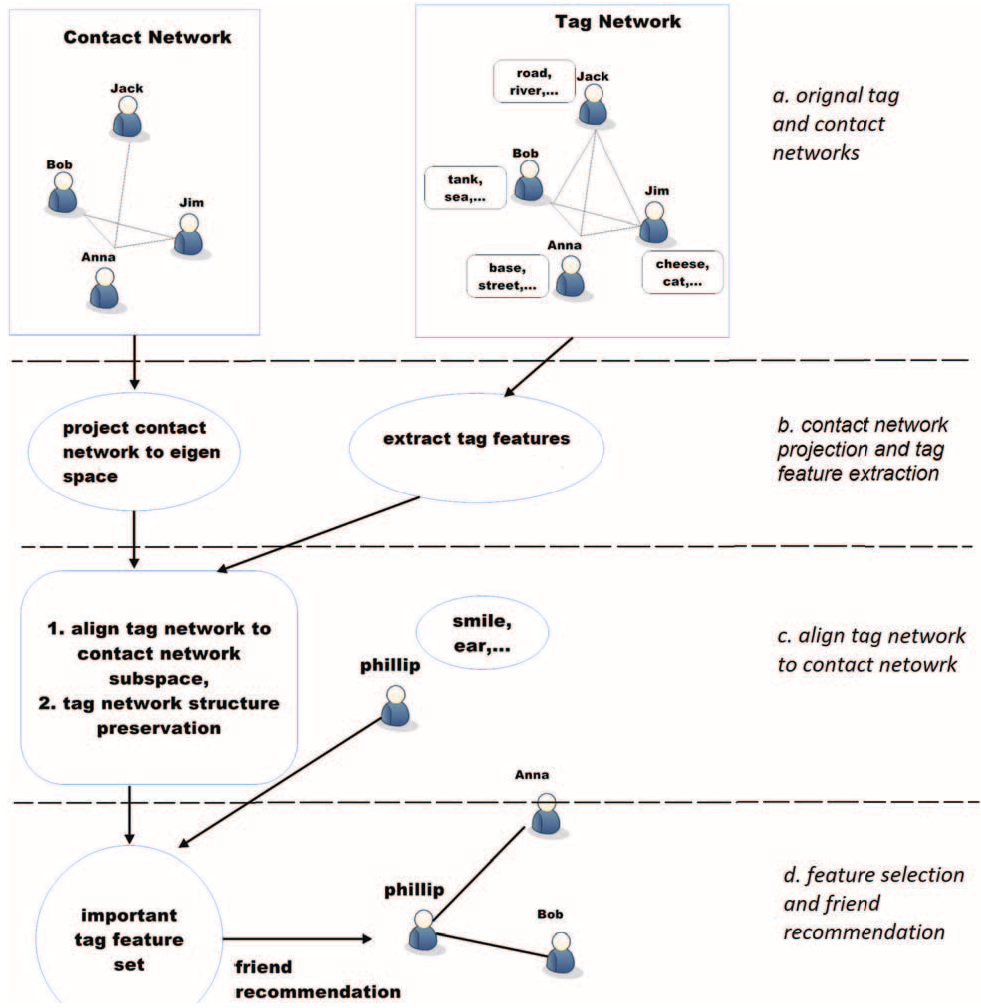 The framework: From raw networks to aligned subspaces and final recommendation.
Experiments & Results: Quality Over Quantity
The researchers crawled 10,000 Flickr users and over half a million photos to test their hypothesis.
Key Insights:
- The Power of Sparsity: As shown in the experiments, increasing the number of features beyond 4,500 leads to diminishing returns. Most social connections are driven by a small subset of shared specific interests (e.g., "Manhattan", "Eiffel") rather than general terms (e.g., "outdoor", "beautiful").
- Performance Leap: The proposed method outperformed SVM-based classification and Online Collaborative Filtering (OLCF). While OLCF suffers from the "cold start" and noise in the user-item matrix, NC-based SFR filters this noise through its alignment mechanism.
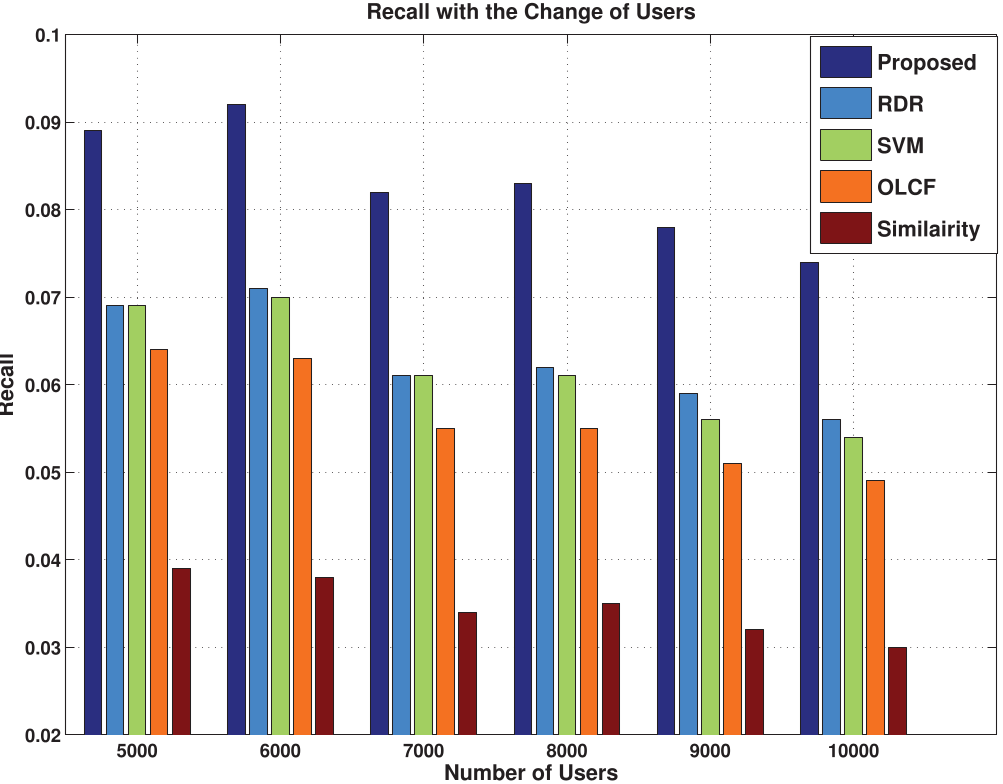 Comparison of Precision across different methods: NC-based SFR (Proposed) consistently maintains higher accuracy.
Critical Analysis & Conclusion
Takeaway
The genius of this paper is the realization that Similarity Connection. By supervising the interest-based similarity with actual structural data from the contact network, the model learns which interests are "socially relevant."
Limitations & Future Work
- Computational Cost: While the authors provide a lower-complexity formulation for the matrix inverse, the initial eigen-decomposition and WordNet similarity calculations are still heavy for real-time applications with millions of nodes.
- Beyond Tags: Future iterations could incorporate Computer Vision (image features) or Geo-spatial data into the multi-network alignment framework, potentially creating a "Universal Social Embedding."
In summary, NC-based SFR moves us away from blind similarity toward a more nuanced, structurally aware understanding of how human connections are formed online.